

The Short Answer
To figure out the right wood stove size for your space, measure the room’s length × width × height in metres. Then divide by 14. If your home is particularly draughty or poorly insulated, divide by 10 instead. For a newer, well-insulated build, divide by 25. Whether you need a compact unit or a large cabin stove, there’s a perfect fit waiting for you.
In This Guide
- ▶ Why Manufacturer Figures Can Mislead
- ▶ Understanding Nominal Heat Output
- ▶ How Many kW Does Your Room Need?
- ▶ Forget About kW — Focus on Firebox Size
- ▶ Do You Need a Room Air Vent?
- ▶ What If the Numbers Say “Go Tiny”?
Why Manufacturer Figures Can Mislead
Stove heat output is measured in kilowatts (kW), and the numbers you see on a spec sheet — “nominal heat output,” “maximum heat output,” or sometimes both — are supplied by the manufacturers themselves. The trouble is that these figures are frequently a wishy-washy average at best, and genuinely misleading at worst.
Stove efficiency is a separate metric entirely. It tells you how much heat actually enters your room versus how much disappears up the flue. A rough rule of thumb: a stove rated at 75% efficiency is losing about 25% of its heat through the chimney.
When it comes down to it, the amount of heat a stove delivers depends on how much wood you burn and for how long. The physical size of the firebox is what truly determines the stove’s maximum output potential — not the number printed on a glossy brochure.
Understanding No minal Heat Output
Here’s the catch: manufacturers in many regions get to choose the nominal heat output they want their stove to carry. The testing labs simply confirm whether the stove can produce that number with a reasonable fuel load. That means the figures can be shaped to suit marketing goals rather than your living room.
Why would a manufacturer want to keep the stated kW low? Simple — in many building codes, stoves rated at 5kW or under don’t require a dedicated air vent in the room. That’s a selling point. So a manufacturer might label a stove as “4.9kW” when its firebox could comfortably push out 7kW or more, just by adding an extra log or two.
Some brands advertise a range like “3–6kW” or “5–7kW,” which effectively shows you the minimum-to-maximum spread. Think of it this way: they’re at least hinting at the top-end performance — but it’s still only part of the picture.
“If you’re browsing stoves in a showroom, compare the actual firebox dimensions between models. Think about how many logs will realistically fit inside. Then treat the manufacturer’s stated kW as a rough guide — nothing more.”

How Many kW Does Your Room Need?
If the outside temperature is hovering around freezing, a good baseline is roughly 1kW of heat for every 14 cubic metres of space in a home with average insulation and double-glazed windows.
To calculate the cubic volume of your room, simply multiply the three dimensions together:
Width × Length × Height = Room Volume (m³)
Example: 4m × 6m × 2.8m = 67.2 m³
Then adjust the divisor based on your insulation quality:
New Build / Super-Insulated
Divide by 25
Average Insulation
Divide by 14
Poor / No Insulation
Divide by 10
Using the example above — a room of 67.2 m³ with average insulation — you’d divide by 14 and arrive at roughly 4.8kW. That’s your target heat requirement.
Now Forget About kW — Focus on the Firebox
Once you’ve got a rough kW figure, it’s time to shift your thinking. Instead of obsessing over the number on the label, look at how big the firebox actually is. That’s what determines real-world performance — how many logs fit, how long a burn cycle lasts, and how much warmth fills your space.
If you have two rooms connected by an archway, treat them as a single space when calculating volume. If the room opens to an upstairs landing or staircase, add around 10–20% to your heat requirement to account for warm air escaping upward.
Here’s another consideration: if there’s already a large radiator in the room that handles most of the heating, you can step down in stove size. A 7kW-capable stove can easily be reduced to a 5kW output simply by loading fewer logs. Many people treat their wood stove as a beautiful supplement to central heating rather than a primary heat source — and that’s a perfectly valid approach.
Pro Tip
Personally, we’d rather size up slightly and burn less wood than risk having a stove that struggles on the coldest nights. You can always load fewer logs — but you can’t make a small firebox bigger. Most stoves will happily burn anywhere from 0–8kW worth of fuel, giving you full control over the heat level.
Forget about kW. Look at the firebox. That’s the real story.
Featured Product
Vogelzang 3,200 Sq. Ft. Large Wood Stove
A spacious firebox built to heat large living areas with ease. Perfect for homeowners who want dependable warmth without compromise.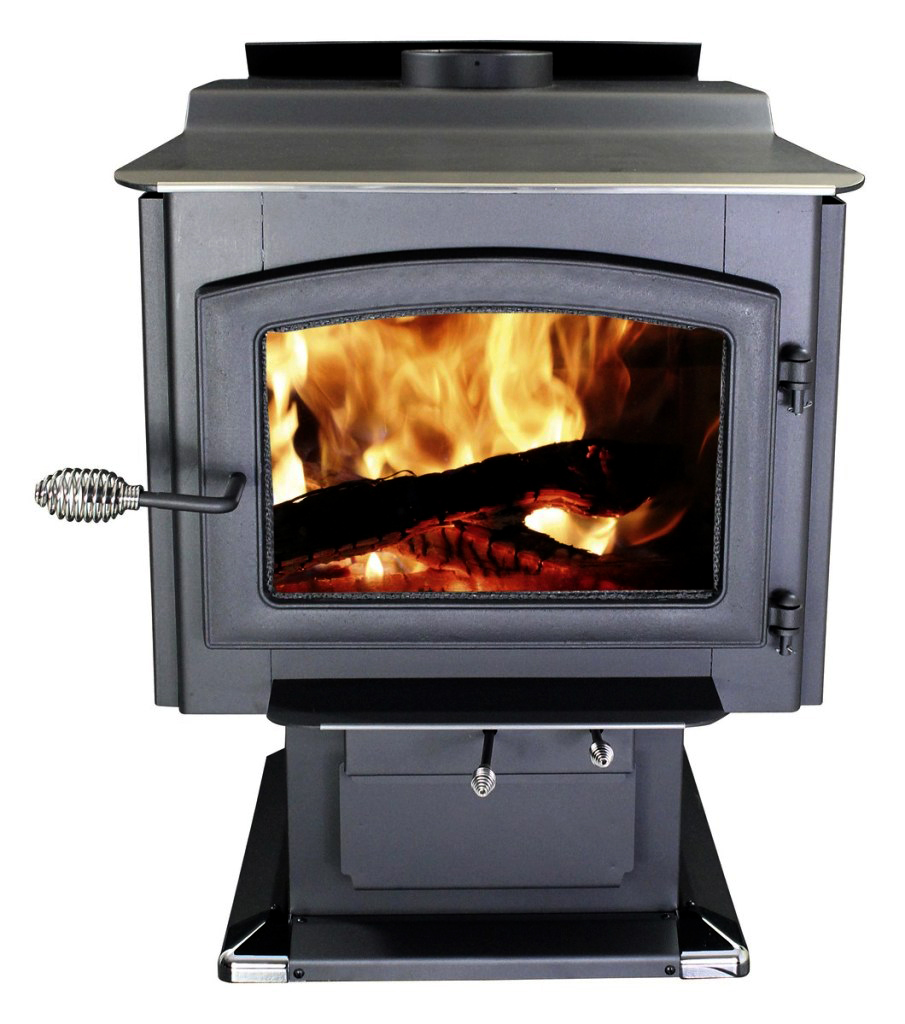
Do You Need a Room Air Vent?
In many jurisdictions, stoves with a nominal output greater than 5kW require a dedicated air vent in the room. If you’re installing in a new-build or an airtight property, you’ll almost certainly need one regardless of the stove’s rating.
However — if your property is older, not particularly airtight, and you don’t want the hassle of fitting a vent, simply choosing a stove rated at 5kW or below can sidestep that requirement altogether. A 5kW stove with a generously sized firebox can still punch well above its weight in real-world performance.
Always check your local building codes and regulations before installation. When in doubt, consult a certified installer to make sure everything is safe and compliant.
What If the Numbers Suggest a Tiny Stove?
Maybe the calculation points you toward a 3kW or 4kW model, and suddenly you’re worried about having a stove that feels too small — one that needs perfectly split kindling-sized logs and gives you no margin for error.
Don’t stress. Going a little larger than the formula suggests is rarely a problem. A slightly oversized stove simply means you burn fewer logs to maintain a comfortable temperature. You stay in control.
What you don’t want is a firebox that’s far too large for your space. Cramming a massive stove into a small room and then starving it of fuel leads to incomplete combustion — meaning more smoke, blackened glass, and wasted energy. The key is balance: choose a stove with a firebox that lets you burn a sensible fuel load comfortably without overheating the room.
If the floor area of your room is on the smaller side, just make sure the logs aren’t too large for the firebox. Oversized logs in a tight space can cause trouble with the door seal and airflow. As long as you’re using appropriately sized fuel, even a compact stove can deliver a wonderfully warm and efficient burn.
Remember
Small can be mighty. A well-designed compact stove can heat a room beautifully — and there’s something deeply satisfying about a perfectly proportioned flame in a cosy space.

The Bottom Line
Measure your space. Run the simple calculation. Then ignore the kW label and focus on the firebox. A stove that fits your room — physically and practically — will keep you warm for years to come. When in doubt, size up slightly and burn smarter.
Shop Vogelzang Wood Stove