

You finally decided to tackle that garage cleanup, and now you're standing at your workbench wondering where everything went. The socket set is missing half its pieces, your favorite tape measure has vanished, and those screwdrivers you swore were right there? Gone without a trace.
If you're a committed DIY enthusiast, chances are your workbench has become a collection point for every tool, fastener, and project remnant imaginable. Tracking down what you need shouldn't feel like a treasure hunt every single time.
We're here to help. This guide walks you through practical methods to organize your workshop and maintain that order, covering everything from pegboard setup techniques to clever storage solutions. Let's dive in.

In This Guide:
Pegboard Essentials • Smart Storage Solutions • Common Questions Answered
Maximize Your Pegboard Potential
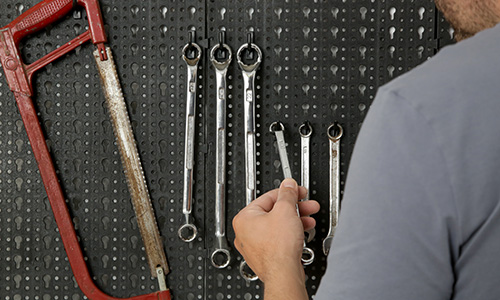
The pegboard remains the gold standard for workbench organization, and for good reason. It transforms unused vertical space into prime storage real estate while keeping your most-used tools within arm's reach. A quick glance tells you exactly where everything belongs and what's missing.
💡 Pro Tip
When shopping for pegboard, opt for the variety with 1/4-inch diameter holes—commonly labeled as "large hole pegboard." This style accommodates heavier-duty hooks capable of supporting bulkier tools without bending or slipping.
Nine Essential Tools for Your Pegboard
Pegboards work beautifully for countless tool types, but certain items belong there more than others. Here are the most common candidates for wall-mounted storage:
Five Pegboard Organization Principles
Understanding which tools go on your board is only half the equation. Arranging them strategically keeps your workspace running smoothly project after project.
Eye-level placement matters. Position your go-to tools where you can spot and grab them instantly without stretching or bending.
Secondary tools go lower. Reserve the bottom sections for items you reach for occasionally, keeping rarely-used pieces near the top.
Group by category and size. Cluster similar tools together and arrange them by dimension—you'll immediately know where to look when wrapping up a task.
Consolidate duplicates. Multiple tools can share a single hook—or better yet, donate or discard extras you no longer need.
Space things out. Allow breathing room between pegs so you can remove one tool without disturbing its neighbors.
Think Beyond the Hooks
Standard hooks handle most situations, but creative accessories unlock your pegboard's full potential:
- Mount small shelving units for jars, containers, or tools that resist hanging.
- Clip binder rings to hooks for holding pouches filled with brushes, cable ties, and miscellaneous supplies.
- Thread tape rolls and wire spools onto dowel rods attached with carabiners—no more fumbling through drawers.
- Slip PVC pipe sections over pegs to corral extension cords, rope, and bungee straps neatly.
💡 Pro Tip
Before committing to a layout, lay masking tape on the floor matching your pegboard's dimensions. Arrange your tools inside this boundary, experiment with different configurations, and only mount them once you've found the setup that works best for your workflow.
Additional Storage Solutions Worth Considering
Pegboards excel at many things, but they can't handle everything. These supplementary storage methods round out a truly efficient workspace.
Drawer Organizers
Small hardware—screws, nails, washers, bolts—disappears into chaos without proper containment. Sectioned drawer inserts keep fasteners sorted by type and size, eliminating frantic searches mid-project.
Magnetic Strips
Mount a magnetic bar along your backsplash or wall for instant access to metal tools. Chisels, files, utility knives, and drill bits stay visible and within reach without occupying drawer space.
Rolling Tool Carts
A mobile storage unit brings your tools wherever the job demands. Roll it next to your workbench during intensive projects, then wheel it aside when you need floor space.
Overhead Shelving
Don't neglect the space above your head. Ceiling-mounted or high-wall shelving stores bulky items you don't access daily—seasonal equipment, backup supplies, or project materials waiting their turn.
Ready to Upgrade Your Workspace?
A quality workbench with integrated pegboard storage forms the foundation of any well-organized workshop.
Trinity PRO Rolling WorkbenchFrequently Asked Questions
What's the ideal workbench height?
Standard workbench height falls between 34 and 36 inches, though personal preference and typical tasks should guide your choice. If you frequently perform detailed work, a slightly higher surface reduces back strain. Heavy-duty tasks often benefit from a lower height for better leverage.
How do I prevent tools from falling off pegboard hooks?
Locking-style hooks grip the pegboard more securely than standard J-hooks. You can also apply a small dab of hot glue behind regular hooks to keep them stationary without permanent attachment.
Should I choose metal or wooden pegboard?
Metal pegboard handles heavier loads and resists moisture damage better than traditional hardboard. However, wooden pegboard costs less and works perfectly well for lighter tool collections. Assess your tool inventory and workshop conditions before deciding.
How often should I reorganize my workbench?
Evaluate your layout every few months or whenever you notice inefficiencies creeping in. Projects change, tool collections evolve, and what worked six months ago might not serve you today. A quick quarterly assessment keeps things running smoothly.
Final Thoughts
An organized workbench isn't just about aesthetics—it directly impacts how efficiently you complete projects and how much you enjoy the process. Start with a solid pegboard foundation, supplement with smart storage solutions, and commit to putting tools back where they belong. Your future self will thank you every time you reach for exactly what you need, exactly where you expected it.