

Shopping for a foosball table? We're here to help you find the ideal match. You'll want a table that fits your room, delivers an outstanding playing experience, and holds up under serious use — whether it's set up in your living room, a break room at the office, or a bustling recreation center.
Below you'll find our expert advice on selecting the right table, understanding dimensions and space requirements, and breaking down every key feature. Jump to any section that interests you, or read through the entire guide to become a true foosball authority.
Quick Navigation
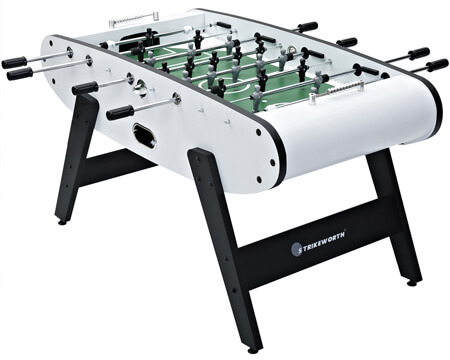
Selecting Your Table Type
The very first step is figuring out where your foosball table will live, who will be using it, and how frequently it'll see action. A table destined for a community center, sports bar, or youth club demands far more durability than one built for casual weekend fun at home with the family.
If you're placing a table in a public or commercial setting, you should also think about whether you want a coin-operated or free-play model. Coin-op tables allow you to generate revenue from gameplay — and they often feature glass or tempered tops to keep the balls stored safely between sessions, preventing them from being lost or taken.
For shared spaces where you don't plan on charging per game — such as an office lounge or company break room — a free-play table is the better route. You won't need the coin mechanism or glass surface, but the build quality should still match commercial-grade standards. Many professional-level foosball tables can be ordered either with or without coin mechanisms, giving you flexibility.
Standard Foosball Table Dimensions
Most full-size foosball tables are built around the officially recognized tournament specifications set by the ITSF (International Table Soccer Federation). These dimensions are approximately 56 inches (142 cm) in length and 30 inches (76 cm) in width for the table body alone — not counting the rods — with about 6 inches (15 cm) between each rod.
ITSF-sanctioned tables typically feature a playing field that measures around 47 inches by 28 inches (120 cm × 70.5 cm). Most regulation-size tables follow these measurements closely. Home-use tables designed for casual entertainment are often slightly smaller than tournament-spec models, so always verify the exact dimensions in the product listing.
You'll also find a range of miniature and tabletop foosball options on the market, some as compact as 3 feet in length. These are primarily designed for children or make excellent desktop games for the office.
How Much Room Do You Need?
Once you've settled on a table size, the next crucial step is confirming you have adequate room for it. Measure the complete width of the table with all rods fully extended to either side — this typically adds 12 to 18 inches (30–45 cm) beyond the body, depending on the model. Then allow at least 3 feet (about 1 meter) of clearance on each side so two players can comfortably operate the handles.
At the goal ends, you need slightly less clearance, but you still want room to walk around the table and retrieve stray balls.
Quick Space Estimate (Based on a 56″ × 30″ Table)
Width needed: 30″ (table) + 36″ (extended rods) = 66″ total. Add 40″ clearance per side → approximately 146 inches (~12 feet) of room width.
Length needed: 56″ (table) + 20″ clearance each end → approximately 96 inches (~8 feet) of room length.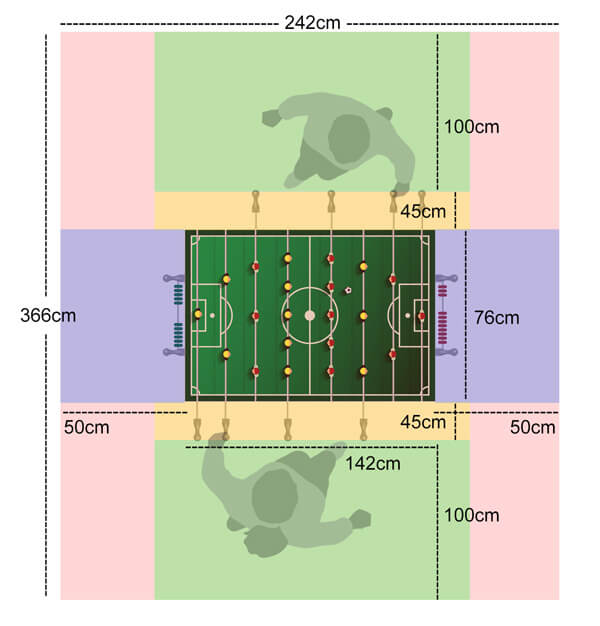
Room clearance diagram showing required space around a foosball table
Leg Design & Stability
Foosball tables endure a lot of punishment. Energetic players can cause the entire table to shake, shift, or wobble — which is why you should prioritize a model with sturdy legs, a wide stance, and a low center of gravity.
Hollow legs tend to be less stable over time. Solid wood legs work perfectly for home use and casual play. However, if you're purchasing a tournament-grade or commercial-setting table, metal legs are the superior choice for long-term strength and rigidity.
Some models feature folding legs — a fantastic option if you need to reclaim floor space when the table isn't in use. Folding tables can be just as robust as fixed-leg versions, but make sure the folding mechanism includes a reliable locking system to keep the legs firmly in place during play.
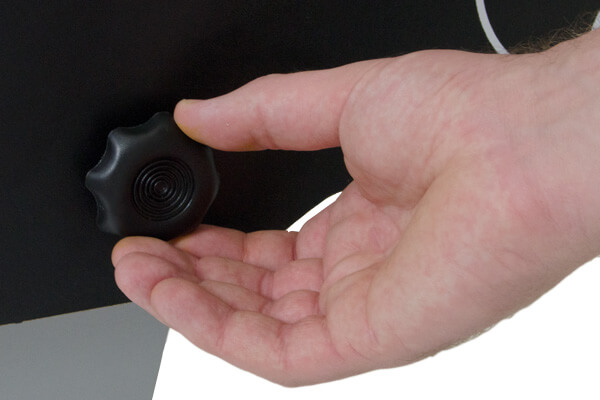
Close-up of a leg lock mechanism on a folding foosball table
Rods & Player Figures
Foosball table rods generally come in two varieties: solid and telescopic. Solid rods are a single continuous metal tube that passes completely through the cabinet and extends out the opposite side. They offer a more responsive, direct playing feel. The trade-off is that rod ends can protrude at a height that may pose a safety concern around small children.
Telescopic rods use a two-piece design — a thin inner rod nested inside a larger outer tube. Instead of poking out through the far side, these rods retract into themselves so that only the handle grip remains visible. This is a safer and more streamlined solution, particularly in homes with young kids.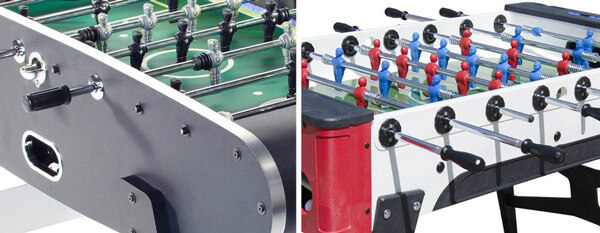
Side-by-side comparison of telescopic (left) and solid (right) player rods
Rod diameter matters, too. Compact tables aimed at casual or children's play often use thinner rods, while high-end tournament and commercial models feature thicker rods that deliver greater durability and more consistent ball control.
Player figures are typically crafted from heavy-duty plastic, though some premium tables opt for metal figures. Look for solid (not hollow) figures for maximum longevity. Pay attention to foot shape as well — wedge or block-style feet are the most common and tend to offer the best ball-striking performance.
Cabinet & Body Construction
The cabinet — the main body of the table — needs to be built tough enough for its intended environment. A table made from quality hardwood or MDF is perfectly suitable for casual family enjoyment at home. However, it simply won't withstand the same level of daily abuse that a metal, reinforced wood, or composite cabinet can handle in a commercial or public setting.
Take a close look at the built-in features, too. Most foosball tables include a ball-entry port on one or both sides for serving new balls into play. Some have return systems that deliver the ball back to the scored-on player, while others funnel all balls to a central collection point for quick restarts.
Playfield Surface
On professional-tier tables, the playing surface is almost always glass — either polished smooth or sandblasted for enhanced ball grip and control. Sandblasted glass in particular provides a slightly textured feel that many competitive players prefer.
On consumer-grade tables, you'll typically find play surfaces made from vinyl-wrapped MDF, hardwood, or durable plastic. These are perfectly adequate for recreational play.
One detail worth checking for is raised corners and angled pitch edges. These prevent the ball from getting trapped in the corners and keep the game flowing smoothly — a really valuable design feature that separates good tables from great ones.
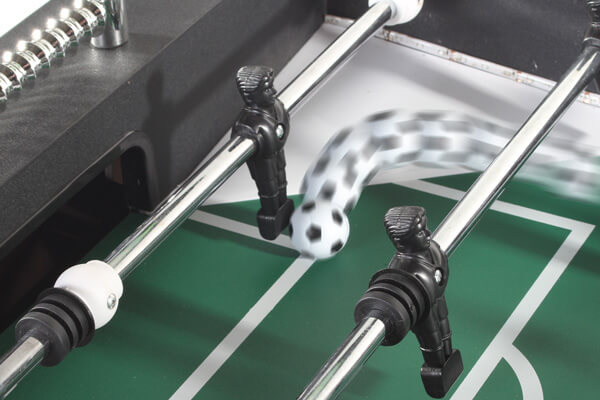
Raised corner detail on a foosball table, designed to keep the ball in play
Player Formation & Feet
On the majority of tournament tables and standard home models worldwide, the default player formation is 1-2-5-3 — meaning one goalkeeper, two defenders, five midfielders, and three attackers per side. You'll encounter this layout on nearly all regulation tables, though a handful of specialty models feature additional players or slightly altered arrangements.
Player figures also vary in foot design. Most use a single block or wedge-shaped foot, which provides the best control and accuracy. Some decorative tables feature two-footed players, but this is primarily an aesthetic choice and doesn't improve actual gameplay.
Delivery & Assembly
Your foosball table will typically ship shortly after your order is placed. In most cases, the carrier will reach out to schedule a convenient delivery window.
Most home-grade tables arrive in flat-pack form and require some assembly — usually attaching the legs, rods, and player figures. More professional models often ship with the cabinet pre-built, so you'll only need to mount the legs and rods. A few folding models even arrive with legs already attached and folded into the body — simply unfold, install the rods and players, and you're ready to play.
Complete instructions are always included, and on select models a professional assembly service may be available. Check the product listing for details on your specific table.
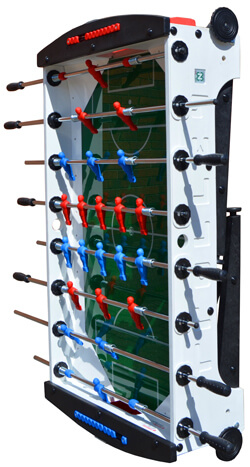
A folding foosball table with legs pre-attached for easy setup
Summary (TL;DR)
Start by defining the purpose of your table. Do you need a heavy-duty, commercial-grade model — potentially with a coin-op mechanism — for a public venue? Or is a more affordable home-use table the right fit for your family game room?
Once you've settled on the category, measure your room carefully to confirm the table will fit comfortably. Then dial in your preferences for leg design, rod type, cabinet material, and playfield surface to match your playing style, budget, and space.
Ready to Buy?
Now that you're equipped with all the knowledge you need, it's time to find your perfect foosball table. Whether you're after a top-tier competition model or a fun table for family gatherings, we've got you covered. Check out our featured pick below — built for serious play and designed to last.
© Backyard Provider — Your Destination for Outdoor Living & Recreation