

Everything you need to know about power tower training — from beginner basics to advanced progressions — plus a complete workout plan to get you started today.
Table of Contents
What Is a Power Tower & Why Should You Consider One?
Home workouts have come a long way. If you're serious about building real strength, increasing muscular endurance, and sculpting your physique without ever stepping foot in a crowded gym, a power tower is one of the most versatile pieces of equipment you can invest in. It combines multiple exercise stations into a single compact frame — giving you a full upper-body and core workout from the comfort of your own space.
Whether you're a complete beginner looking for a starting point or an experienced athlete wanting to add variety to your routine, a power tower can match your pace and grow with your fitness level.
Who Can Benefit from Power Tower Workouts?
Almost anyone can benefit from training on a power tower. Athletes use it to build functional pulling and pushing strength. Beginners appreciate how exercises can be scaled to their current ability. Those who prefer body weight training over machines find it the ideal tool for progressive overload without heavy weights. Even those rehabilitating from minor injuries can use it for gentle, controlled movements that rebuild strength safely.
Benefits of Power Tower Workouts
Full Upper Body Engagement
Pull-ups, chin-ups, dips, and push-ups target the back, chest, shoulders, biceps, and triceps — all in one station.
Core Strength & Stability
Leg raises and knee tucks performed on the vertical knee raise station directly challenge your abdominals and hip flexors.
Compact & Space-Efficient
A power tower consolidates multiple gym machines into one footprint — perfect for home gyms, garages, or apartments.
Scalable for All Levels
From assisted movements for beginners to weighted progressions for advanced athletes, power towers accommodate every fitness level.
No Gym Membership Required
One-time investment, lifetime of use. Train on your schedule without commute times, peak hours, or monthly fees.
Builds Functional Strength
Body weight movements mimic real-world patterns, improving posture, balance, and everyday physical performance.
Power Tower: A Detailed Look
A quality power tower is built with a heavy-gauge steel frame engineered to handle repeated daily use. Multiple grip positions on the pull-up bar allow you to vary hand width and angle, targeting different muscle groups with each variation. Padded armrests on the dip station reduce joint stress and keep your form consistent throughout a set.
First Impressions
From the moment you set it up, a well-made power tower communicates solidity. Wide-base stabilizer feet prevent wobble even during explosive movements. Foam-padded back support on the knee raise station adds comfort during longer ab sessions, and the overall height accommodates most ceiling clearances found in standard home spaces.
Sturdy Frame
The structural integrity of a power tower is what separates a safe, effective training session from a dangerous one. Look for welded steel joints, anti-slip rubber feet, and a weight capacity that exceeds your own body weight by a significant margin — especially if you plan to add weighted vests or resistance bands to your training.
Safety Features to Look For
Never overlook safety when selecting a power tower. The best models are designed with stability and user protection at the forefront. Here are the key safety elements worth prioritizing:
Non-Slip Rubber Feet
Prevent the tower from sliding on tile, hardwood, or concrete during dynamic movements.
Padded Grip Handles
Foam-wrapped grips reduce hand fatigue and improve control throughout each rep.
Rated Weight Capacity
Always verify the manufacturer's stated load limit and leave an adequate safety margin above your body weight.
Wide Stance Base
A broader footprint dramatically increases lateral stability, especially important during kipping pull-ups or explosive dips.
Pro Tip: Always inspect bolts and connections before every workout session. Tighten any loose hardware immediately and never use the tower if it feels unstable or makes unusual noises during use.
Sample Power Tower Workout Routine for Beginners
If you're just getting started, the goal is not to impress — it's to move consistently, build the habit, and establish a foundation of strength. This beginner routine uses controlled tempos and moderate rep ranges to develop your pulling, pushing, and core muscles without overloading your joints or connective tissue.}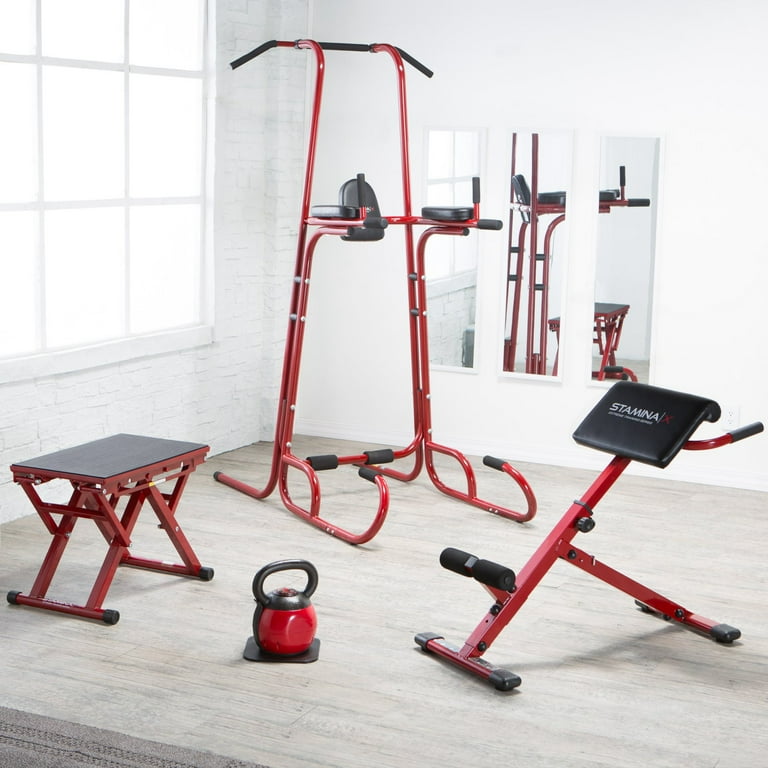 Beginner
Assisted Pull-Ups
Use a resistance band looped over the bar and under your feet to reduce the load. Focus on a full range of motion — starting from a dead hang and pulling until your chin clears the bar. Aim for 3 sets of 5 to 8 reps, resting 90 seconds between sets.
Tricep Dips
Grip the parallel bars with your arms straight and lower your body until your elbows reach 90 degrees. Keep your torso upright to emphasize the triceps. Begin with 3 sets of 8 reps. If this is too challenging, bend your knees and cross your feet to reduce the effective load.
Knee Raises
Using the vertical knee raise station, brace your core and raise your knees toward your chest in a slow, controlled arc. Avoid swinging your legs — the movement should originate from your abs, not momentum. Perform 3 sets of 10 to 12 reps.
Hanging Knee Tucks
Hang from the pull-up bar with a shoulder-width grip. Draw both knees toward your chest simultaneously, hold briefly at the top, then lower with control. This is harder than it looks and directly challenges your lower abdominals. Start with 3 sets of 8 clean reps.
Beginner Tip: Consistency matters more than intensity at this stage. Three sessions per week with one rest day between each is an ideal starting frequency. Quality of movement always takes priority over quantity of reps.
Sample Power Tower Routine for Intermediate Users
Once you can comfortably complete the beginner routine without significant fatigue, it's time to progress. Intermediate training introduces more challenging movement variations, shorter rest periods, and higher total volume. Your joints and tendons need time to adapt, so increase difficulty gradually rather than all at once.
Pull-Ups
Drop the resistance band and perform unassisted pull-ups with a pronated (overhand) grip. Focus on retracting your shoulder blades at the top and avoiding elbow flare. Aim for 4 sets of 6 to 10 reps. Add a pause at the top for an extra challenge and to eliminate momentum.
L-Sit Holds
From the dip bars, press your body up and extend both legs straight in front of you, parallel to the floor. Hold this position for as long as possible while maintaining a neutral spine and engaged core. Begin with 3 holds of 10 to 15 seconds and build up over time.
Wide-Grip Pull-Ups — 4 sets × 8 reps
A wider grip shifts the emphasis more onto your lats and reduces bicep involvement. Pull your elbows down and back rather than simply pulling your hands toward you.
Weighted Dips — 3 sets × 10 reps
Add a dip belt or weight vest to increase resistance. Keep your chest slightly forward to target pectorals, or stay upright to focus on triceps.
Straight-Leg Raises — 4 sets × 12 reps
The straight-leg version significantly increases difficulty over knee raises. Keep your lower back pressed into the pad and raise your feet to hip level or above without swinging.
Chin-Ups — 3 sets × 10 reps
A supinated (underhand) grip recruits more bicep and lower lat. Pair these with wide-grip pull-ups in the same session for comprehensive back development.
Customizing Your Power Tower Workout Plan
One of the greatest strengths of power tower training is flexibility. You are not locked into a single protocol — you can adjust variables like rep range, rest period, training frequency, grip position, and movement tempo to continuously challenge your body and avoid plateaus.
 warm Up and Cool Down
Before every session, spend five to ten minutes warming up with shoulder circles, arm swings, bodyweight squats, and light jumping jacks. A proper warm-up increases blood flow to working muscles, lubricates joints, and reduces injury risk. After training, stretch your lats, chest, biceps, and hip flexors for at least five minutes.
Focus Matters
Distraction is the enemy of progress. Put your phone away, turn on focused music, and commit your full attention to each rep. The mind-muscle connection — the intentional focus on the muscle being worked — has been shown to enhance motor unit recruitment and improve training outcomes, particularly for isolation-style movements.
Power Tower Workout Tips for Maximizing Results
Progressive Overhead
The principle of progressive overload is the engine of all fitness progress. It means consistently increasing the demand placed on your body over time — whether by adding reps, reducing rest intervals, increasing range of motion, or adding external resistance. Without progression, your body adapts and improvements stall. Track your workouts in a simple notebook or app so you always know where you left off.
Track Every Session
Write down your sets, reps, and how each set felt. This creates accountability and allows you to identify patterns — both in your progress and your recovery.
Rest Adequately
Muscles grow during recovery, not during the workout itself. Ensure you're getting 7 to 9 hours of sleep and at least one full rest day between power tower sessions targeting the same muscle groups.
Fuel Your Workouts
Eat a balanced meal with adequate protein and complex carbohydrates two to three hours before training. Hydrate consistently throughout the day — not just during exercise.
Prioritize Form
A sloppy rep completed is worth far less than a clean rep nearly completed. Partial reps with good form beat full reps with momentum and compensation patterns every single time.
Progressive Overload Tip: Once you can complete 3 sets of 12 reps of any exercise with good form and without reaching failure, it's time to increase the challenge. Add a rep, slow down your tempo, add a pause at the peak contraction, or incorporate a weighted vest.
Ready to Build Strength at Home?
A power tower is one of the smartest investments you can make in your long-term fitness. With the right equipment, a structured plan, and progressive effort, building an impressive, functional physique from your own home is completely within reach. Stop waiting — start training.
Stamina X Fortress Power Tower