

Keeping your home comfortable during scorching summers and frigid winters requires a reliable climate-control system. Two of the most popular options available today are mini-split systems and central air conditioning. Each approach brings its own strengths, trade-offs, and ideal use cases. Understanding the key differences will help you invest in the solution that aligns with your home's layout, your energy goals, and your long-term budget.
Below, we walk through how each system operates, the advantages they offer, the potential drawbacks to keep in mind, and the factors that should drive your final decision.
Understanding Mini-Split Systems
A modern, flexible approach to heating and cooling — without the ductwork.
Whether you are constructing a brand-new home, renovating an older property, or simply upgrading a single room, mini-split systems provide targeted climate control without the need for extensive duct networks. They have grown immensely popular in recent years thanks to their energy efficiency, whisper-quiet operation, and ease of installation.
Because of their compact size and modular design, mini splits are especially well suited for additions, garages, workshops, sunrooms, and smaller residences where traditional ducted systems would be impractical or overly expensive.

How Does a Mini Split Work?
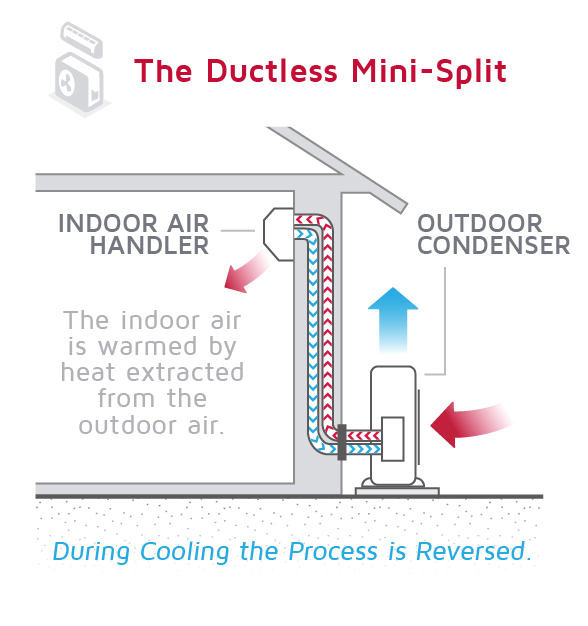
A mini-split system consists of two primary components: an outdoor compressor/condenser unit and one or more indoor air-handling units. These two pieces are connected by a conduit that houses the power cable, refrigerant tubing, suction line, and a condensate drain — all routed through a small opening in the wall.
The settings for each indoor unit are typically controlled by a handheld remote or a wall-mounted thermostat, giving you the ability to set individual temperatures for every room. This zone-based control is one of the defining advantages of mini-split technology.
Depending on the model, you can switch between cooling, heating, dehumidifying, and fan-only modes, giving you year-round versatility from a single system.
Operation Modes & Settings
Most contemporary mini-split units ship with multiple operation modes. In cooling mode, the system works much like a standard refrigeration cycle — absorbing heat from the indoor air and expelling it outside. Switch to heating mode and the cycle reverses, pulling warmth from the outdoor air and delivering it indoors even in surprisingly cold temperatures.
Fan-only and dehumidification modes round out the package, letting you circulate air or reduce moisture without actively heating or cooling. Many models also include a sleep or eco setting that gradually adjusts temperature throughout the night for optimal comfort and energy savings.
Mini-Split Types at a Glance
🔹 Single-Zone
One outdoor unit paired with one indoor unit. Ideal for heating or cooling a single room, garage, or addition.
🔹 Multi-Zone
One outdoor unit supporting multiple indoor units across different rooms. Each zone maintains its own temperature setting.
🔹 Wall-Mounted
The most common indoor style. Mounts high on the wall for efficient airflow and minimal visual footprint.
🔹 Ceiling Cassette / Floor Unit
Recessed cassettes blend into ceilings; floor-standing units sit near baseboards — great when wall space is limited.
Benefits of a Mini-Split System
✔ Superior Energy Efficiency — With SEER ratings that often exceed 20, mini splits consume significantly less electricity than many traditional systems. Inverter-driven compressors adjust output in real time, avoiding the energy-wasting on/off cycling of older units.
✔ Easy, Non-Invasive Installation — No ductwork means no tearing open walls or ceilings. A small three-inch hole connects the indoor and outdoor units, keeping installation fast and affordable.
✔ Room-by-Room Temperature Control — Each zone operates independently, so you only condition the spaces you actually use. No more heating empty guest rooms or cooling an unoccupied basement.
✔ Whisper-Quiet Performance — Indoor units typically operate below 30 dB — quieter than a library. Outdoor compressors are designed to stay unobtrusive as well.
✔ Year-Round Flexibility — Most mini splits double as heat pumps, delivering both cooling and heating from a single system. That dual functionality can eliminate the need for a separate furnace in many climates.
Potential Downsides of Mini Splits
Despite their many benefits, mini splits are not without limitations. The upfront cost per unit can be higher than window air conditioners, and covering an entire large home with multiple zones adds up quickly. The indoor wall-mounted units are visible, which some homeowners find less aesthetically pleasing compared to hidden ductwork vents. Additionally, if you already have a fully ducted home, switching to mini splits may not deliver enough savings to justify the investment.
Maintenance is generally straightforward — cleaning filters regularly and scheduling annual professional check-ups — but each indoor unit requires its own attention, so multi-zone setups demand a bit more effort.
Understanding Central Air Conditioning
The whole-home standard that has kept families cool for decades.
A central air conditioning system — sometimes referred to as a forced-air system — is the most common cooling method in North American homes. It relies on a network of ducts to distribute conditioned air from a single, centralized unit to every room in the house.
If your home already has ductwork in place (from an existing furnace, for instance), adding or replacing a central AC unit is often the most cost-effective path to whole-home comfort.
How Does Central Air Work?
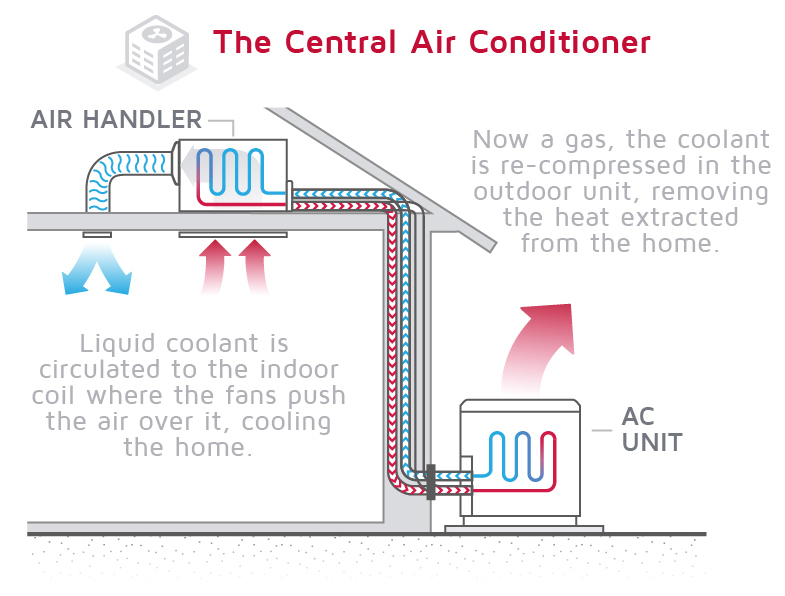
Central AC systems pair an outdoor condensing unit with an indoor evaporator coil, usually mounted on top of a furnace or air handler. Refrigerant circulates between these two components, absorbing indoor heat at the evaporator and releasing it outdoors at the condenser.
A blower fan pushes the newly cooled air through supply ducts and into each room via registers. Warm air returns through separate return vents and cycles back to the evaporator to be cooled again. A thermostat — often a programmable or smart model — governs the entire process.
The cooled air exits through supply vents while a separate set of return vents pulls warm air back into the system, creating a continuous loop that maintains a consistent temperature throughout the home.
Common System Configurations
Central air setups generally fall into three categories: split systems (the most widespread, with indoor and outdoor components), packaged units (everything housed in a single outdoor cabinet, common in homes without basements), and heat pump systems (which reverse the refrigeration cycle to provide both cooling and heating). Your home's existing infrastructure, climate, and budget will determine which configuration makes the most sense.
Benefits of Central Air Conditioning
✔ Whole-Home Comfort in One System — A single thermostat setting keeps every room at a uniform temperature. No need to manage multiple units or zones.
✔ Out-of-Sight Operation — Ducts and vents are largely hidden behind walls and ceilings, giving your interiors a clean, uncluttered look with no wall-mounted equipment.
✔ Improved Air Quality — Central systems pull air through filters before redistributing it, reducing dust, allergens, and airborne particles throughout the home.
✔ Strong Resale Value — Homes equipped with central AC typically appraise higher and attract more buyers, making it a sound long-term investment.
✔ Smart-Thermostat Compatibility — Pair your system with a Wi-Fi thermostat for scheduling, remote control, and energy-use insights delivered straight to your phone.
Potential Downsides of Central Air
The most significant barrier is installation complexity and cost — especially if your home lacks existing ductwork. Retrofitting ducts into walls, floors, and ceilings can be expensive and disruptive. Even with ducts already in place, leaky or poorly insulated ductwork can waste up to 30 percent of conditioned air before it ever reaches your rooms.
Central systems also cool the entire home at once, meaning you pay to condition rooms nobody is using. Energy bills can climb quickly during peak summer months, particularly in larger homes. Maintenance requirements include regular filter changes, periodic duct cleaning, and professional tune-ups to keep the system running at peak efficiency.
Noise can also be a factor — while modern units have gotten much quieter, the blower fan and air rushing through ducts still produce a noticeable hum, especially near return vents.
Head-to-Head: Which One Wins?
A side-by-side look at the factors that matter most.
| Factor | Mini Split | Central Air |
|---|---|---|
| Installation | Simple, no ducts needed | Requires ductwork |
| Energy Efficiency | Higher SEER, zone control | Moderate; duct losses possible |
| Upfront Cost | Higher per zone | Lower if ducts exist |
| Coverage | Room-by-room | Whole-home |
| Aesthetics | Visible indoor units | Hidden behind walls |
| Noise Level | Very quiet (<30 dB) | Moderate (duct hum) |
| Best For | Additions, small homes, no-duct setups | Large homes with existing ducts |
Key Factors to Consider When Choosing
The Size and Layout of Your Space
Start by evaluating the square footage and physical layout of your home. A sprawling two-story house with an existing duct network is naturally suited to central air. On the other hand, if you live in a compact home, a converted loft, or you are conditioning individual rooms like a detached office or a finished garage, a mini split provides precision without the overhead of a whole-home system. Homes with multiple stories, complex floor plans, or rooms that are difficult to reach with ducts will also benefit from the zone-based flexibility of mini splits.
Your Local Climate
Climate plays a critical role. If you live in an area with mild winters and hot summers, a mini-split heat pump can handle both seasons capably — potentially replacing the need for a furnace entirely. In regions with extreme cold, central heating paired with central AC may still be the most dependable combination. That said, cold-climate mini splits (hyper-heat models) have made tremendous strides and can now operate efficiently at temperatures well below freezing.
Budget — Upfront and Long-Term
Consider both the initial investment and ongoing operating costs. Central air may cost less to install if you already have ducts, but it typically carries higher monthly energy bills due to duct losses and whole-home conditioning. Mini splits cost more per unit upfront, yet their superior efficiency and zone control often translate into meaningful savings on electricity over time. Factor in any available tax credits or rebates for energy-efficient heat pump systems, which can offset a significant portion of the purchase price.
Aesthetic Preferences & Noise Tolerance
If a clean, equipment-free interior is a priority, central air wins — the vents are subtle and the hardware is tucked away. Mini-split indoor units, while sleek and modern, are still visible on the wall or ceiling. Regarding noise, mini splits are generally quieter indoors, while central systems produce some ambient sound from airflow through ducts. Consider which trade-off matters more for your day-to-day living comfort.
So, Which System Should You Choose?
There is no universally "better" option — only the system that best fits your home, climate, and lifestyle. If you want zone control, energy efficiency, and flexibility without ducts, a mini split is hard to beat. If you need seamless whole-home cooling with hidden hardware, central air remains the gold standard. Many homeowners even combine both — using central air for the main living areas and adding a mini split for a new addition or hard-to-reach room.
Shop Senville Dual Zone Mini SplitBackyard Provider — Your Trusted Source for Outdoor Living & Home Comfort Solutions