

One of our readers, Gary Buck, has put together his thoughts on training with a robot. We'll also be releasing a video series on how to develop your training — covering the same areas Gary discusses below.
By Gary Buck
The Basic Idea
There are plenty of outstanding books, online resources, and coaching tutorials dedicated to table tennis skills. The reality is that the game almost always assumes you have a training partner, and that both of you are working together to sharpen each other. Not everyone has that luxury. When you don't have a practice partner, a table tennis robot is an excellent substitute.
That's my situation. And while there are plenty of exceptional robots on the market today, very few resources explain how to use them to develop a well-rounded set of table tennis skills. This article is my attempt to fill that gap — to lay out a practical plan for building solid table tennis fundamentals using a robot as your primary training tool.
It's also worth having your strokes reviewed by a qualified coach. If you can't access one in person, online coaching is widely available — you simply record your strokes and submit them for feedback. I've found this personally useful because it reassures me that my technique is developing correctly. Others may prefer different tools or different sources of guidance, and that's completely fine. The most important thing is to make a commitment to learning and keep at it.
I've structured this plan as a steady progression through several stages. The framework draws inspiration from Larry Hodges' writing on the fundamentals of practice development. His model moves from simple to complex, and I've built on that structure here with my own experience using a robot as the sole training device. I want to be clear: I'm not a coach. This is a learning journal as much as it is a training plan.
Regarding the Robot
There are many robots available, and they differ significantly in what they can and cannot do. The robot I personally use is the Butterfly Amicus — a capable machine with solid delivery control, but with limited support for programming multi-drill sequences. That limitation was actually the main motivation for me to develop my own training system. I believe this robot is capable of executing all the drills in this plan.
Other robots cover the full range of functions described here right out of the box. Some will limit you to only the most basic functions, while others may require creative workarounds to replicate certain drills. Consider your robot's capabilities as you work through the stages, and adapt accordingly.
One critical thing to keep in mind: table tennis robots are not precision machines. Shots will vary from delivery to delivery, even when set to repeat the same parameters. This is actually a feature, not a flaw — it more closely mirrors real match play. However, it also means your footwork and reading ability must always stay engaged. Never assume the ball will land in exactly the same spot twice.
Placement accuracy will also vary by a couple of inches or more. This is normal. The better the quality of your robot, the more consistent the shots will be — but some variation will always be present. The goal isn't perfect repetition; it's building the habits and reflexes to handle real variation.
The Practice Sessions
It's assumed you'll be allocating regular time to practice. The more time you invest, the faster the results. Each session should follow a consistent structure:
- Begin every session with simple stretches of the areas that will be used.
- Do some simple warm-ups — a few minutes of forehand drives, then a few minutes of backhand drives, then some simple footwork to raise your heart rate.
- Every session should include service practice. Make serving a habit, not an afterthought. Coaches consistently identify serves as one of the most under-practiced aspects of the game, and working on them delivers some of the greatest competitive returns. Regular service work is essential.
- The bulk of your training time should then be spent on the drills listed in each stage.
There are six stages of practice. They get progressively harder, but you should not move strictly from one stage to the next — rather, you'll cycle through them. In Stage Four, for example, you may be working on Stage Two skills with one stroke while working on a Stage One skill with a different stroke. The goal is to find a balance between working at the edge of your ability and staying within a range where you can perform with reasonable consistency. When things break down, ease back until you can make the shots reliably again.
In all drills, it's important to stay relaxed. This applies to everything — your body position, your stance, your footwork, your arm movement. Tension is the enemy of clean technique. Work on every element until it becomes easy and natural, then begin pushing the difficulty.
The Quality of Practice
The whole purpose of practice is to improve. Practice is fundamentally a brain-training exercise, and it works through two key mechanisms:
Servomechanisms: This is any process that automatically uses feedback to self-correct. In table tennis, this means the brain unconsciously processes feedback — footwork, stroke mechanics, timing, racket angle, ball contact — and makes continuous adjustments without you being consciously aware of each refinement.
Automatization: The brain can learn to perform skills either consciously or automatically. Once a skill is truly automatized, it operates outside conscious control — the body carries out the action efficiently without deliberate decision-making. The goal of practice is to automate your technique, freeing your mind to focus on tactics and reading the game.
It's a popular idea that you need 10,000 hours of practice to master a skill. That's a misreading of the original research. The actual finding was that the average expert had accumulated approximately 10,000 hours — but what mattered most was the quality of that practice, not just the quantity. Good practice has four key qualities:
You must be motivated and focused on improving your performance.
The task must be within your ability level, and should challenge you with genuine effort and concentration.
You must get immediate feedback on your performance so the brain can self-correct in real time.
You should keep repeating the same task or similar variations to build deeply ingrained habits.
Table tennis robots are ideal for meeting all four of these requirements. You can set up every shot correctly, aim for consistency, and continuously work to improve. Set yourself small targets just above your current ability level — and keep doing this again and again. No sloppy shots, no lazy rallies, but everything done to the best of your ability, every single time.
There's an old saying that "practice makes perfect." This is only partly true. Practice makes permanent. If you practice things flawlessly, practice does make perfect. But if you practice poor habits, those habits become permanent too. Quality always comes first.
The Six-Stage Training Program
Stroke Basics
The foundation of everything that follows is learning the basic strokes correctly and being able to perform them consistently. Start with the most fundamental strokes:
- Forehand drive — against a little topspin
- Forehand push — against a little backspin
- Backhand push — against a little backspin
- Backhand drive — against a little topspin
- Forehand block — against a little topspin, slightly faster than the drive
- Backhand block — against a little topspin, slightly faster than the drive
Set the robot to deliver a single ball to the same location. Focus entirely on stroke mechanics — not on where the ball is going. Start slowly. Work at 20–25 balls per minute, or whatever speed is comfortable. As your stroke improves, gradually increase the frequency. Beginning players tend to overestimate what "real pace" feels like, so keep it slow and precise early on. A good initial target is around 50 balls per minute.
Choose the right delivery for each stroke. For forehand and backhand drives, use a long, fairly flat placement — about a foot from the end of the table — with a little topspin. Start slowly and focus on stroke mechanics above all else.
Once you can hit up to fifty balls consecutively with solid mechanics, begin slowly increasing the speed or frequency. If you increase too quickly, ease back. Don't worry too much about placement at this stage — as confidence builds, you'll begin to aim naturally for the forehand and backhand corners.
Move to Strokes
Once you can execute the strokes correctly, it's time to add footwork. This means moving to the ball using the same footwork patterns you practiced in Stage One, with the initial focus on simple, one-step footwork using correct shuffle steps. As the footwork patterns become ingrained, you'll then begin to focus more on the stroke itself. Getting into position first — then playing the stroke — is the essential sequence here.
Once you can reach the ball and strike it cleanly, start thinking about placement. Aim for the two far corners — the baseline and cross court. The elbow (cross-over point between forehand and backhand) is another valuable target.
You'll likely find that footwork requires you to dial the frequency back to around 20 balls per minute to start. Increase from there as you improve.
Combining Strokes & Complex Movement
Now we add more stroke variation and more complex footwork as we practice moving around the table. Key robot drills for this stage include:
Three-Ball Drills — delivery with some topspin: return with drive, block or loop
- FH from wide right, FH from mid-table, then FH left
- BH from wide left, BH from mid-table, then BH from right
- Falkenburg: BH from wide right, FH from mid-table, FH from wide left
- At some point, practice the crossover step when moving wide left to wide right, and integrate it into your training
Four-Ball Drills — delivery with some topspin: return with drive, block or loop
- BH from left, BH or FH from mid, FH from right, BH from left
- FH from right, FH from mid, BH from left, FH from right
- BH, BH, or FH from mid, then BH or FH from right to mid
Step-in Drills — short ball under the table
- BH from short left, BH from long left
- BH from short right, FH from long right
- FH from short left, FH from long left
- FH from short right, BH from long right
Also begin to incorporate different amounts and types of spin into your drills — topspin, backspin, sidespin, and no spin. Use blocks and loops, vary the speed and placement, and practice flicking with the short-ball drills. As you complete each drill more consistently, change the parameters: different spin, different placement, different speed. Push yourself to the corners, across the table, and up and down the line.
Mixing It All Up
In Stage One, we were repeating the same stroke over and over to lock in the basic motor pattern. In Stages Two and Three, we were repeating sequences — the same drills, working towards automatic execution. Stage Four still relies on repetition, but now we're introducing movement variation between shots, which means the same physical actions must be adapted to slightly different situations every time.
In a match, every shot is unique. Our goal is to learn how to play each shot correctly in real time. In Stage Four we work toward this by mixing different drills — we use the same multi-ball drills from Stage Three, but now we vary the return. We might use a forehand loop sometimes, a block other times, a drive or a flick. We mix strokes so we don't fall into repeating the same response sequence. We improve by varying our returns while keeping the incoming ball predictable.
Varying the Return
Using the same Stage Three drills, vary the return by mixing responses. For example, on a FH topspin delivery you might respond first with a long push, then a fast loop, then a spinny loop, then a block. Alternate with unpredictable timing. Switch strokes every time you receive the ball.
Varying the Receives
Modify Stage Three drills by making small changes to the shots received from the robot — change the speed or spin slightly using the robot's settings. For example, if the robot is sending two topspin balls as part of a sequence, replace one with a backspin delivery. Practice a FH loop, then respond to backspin with a drive, and so on. Switch from looping backspin to looping topspin alternately. Be creative and keep finding new ways to challenge yourself.
Simulating Match Play — Loop Drills & Top Spin Serve Practice
Perhaps the best way to mix things up is to develop drills based on real match situations. Some examples:
- Receive short to left, return with BH long push; receive long backspin to left, return with BH loop; receive long topspin to left, return with FH loop
- Receive short right, return with FH drive; receive long backspin right, return with FH loop; receive long topspin right, return with BH loop
- Short top spin serve to left, return with BH flick; receive long topspin drive to left, return with BH drive; receive very fast topspin drive to right, return with BH block
- Short top spin serve to right, return with FH flick; receive long topspin drive to right, return with FH drive; receive fast topspin drive to right, return with FH block
Add Randomization
In Stage Five, the key is decision making. All the previous drills have been predictable — you knew exactly which shots were coming and where they would land. Real matches are not like that. You need to start adding randomization to your practice to more closely replicate what a human opponent gives you.
In a real match, you can watch your opponent's bat, read the incoming spin from the ball's trajectory, and observe where they're aiming from their body position. With a robot, you get none of those cues. A robot gives you more time to watch the ball and react, but you get far less time to read a situation and decide in advance. This is an important difference to be aware of as you use randomization in training.
One approach is to move the robot further back from the table, giving yourself more time to watch the ball, read the shot, and decide where to move for the return. Another approach is to slow the balls down below what you'd expect in a real game — this makes the exercise easier to execute while still training your decision-making. (Different robots have varying randomization features. The Amicus is particularly strong in this area.)
Work on a progression of randomization. Start by choosing one shot and restricting the decision to where the ball lands. Progress toward making two decisions, then three. Eventually, try to serve out a ball and have no idea at all where it will go, requiring quick decisions on placement, spin, and shot selection. Try not to anticipate — wait until you are sure of the right decision — make sure you do not keep changing your mind.
Randomization Progressions:
- Work on random placement of the same shot — same spin and speed, varied placement. Start with FH shots to the right side, moving left or right. Then add BH shots moving left or right. Advance with appropriate placement as you improve.
- Work on the cross-over point — an important decision for shake-hand players. Decide FH or BH based on where the ball falls, near mid-table. Respond with FH or BH and return to neutral position between shots.
- Randomize the serves you receive — receive serves at the table, vary delivery slowly between drive and top-spin. Try to read the spin. Set up a series of balls and stand near the table, block each ball, returning to the neutral ready position each time. As you improve, move back from the table.
- Totally random shots at all speeds, spins, placements, and sequences. Start easy, and slowly increase difficulty. Decision-making under true uncertainty is the highest form of robot training.
Practice Games & Match Strategy
In Stage Six, the goal is to integrate everything into game-like situations. This is where you need a partner. Play practice games, work on your favorite tactics, and honestly evaluate your performance. Identify your weaknesses. If possible, devise robot drills specifically to address those weaknesses.
There is clearly a limit to what you can learn from a robot alone. You can't learn tactics from a robot, nor can you learn to deal with the wide variety of an opponent's playing styles. But you can identify gaps in your game — and in many cases, you'll be able to use the robot to work on those gaps. If not, then you need a coach or a training partner.
Ready to Train?
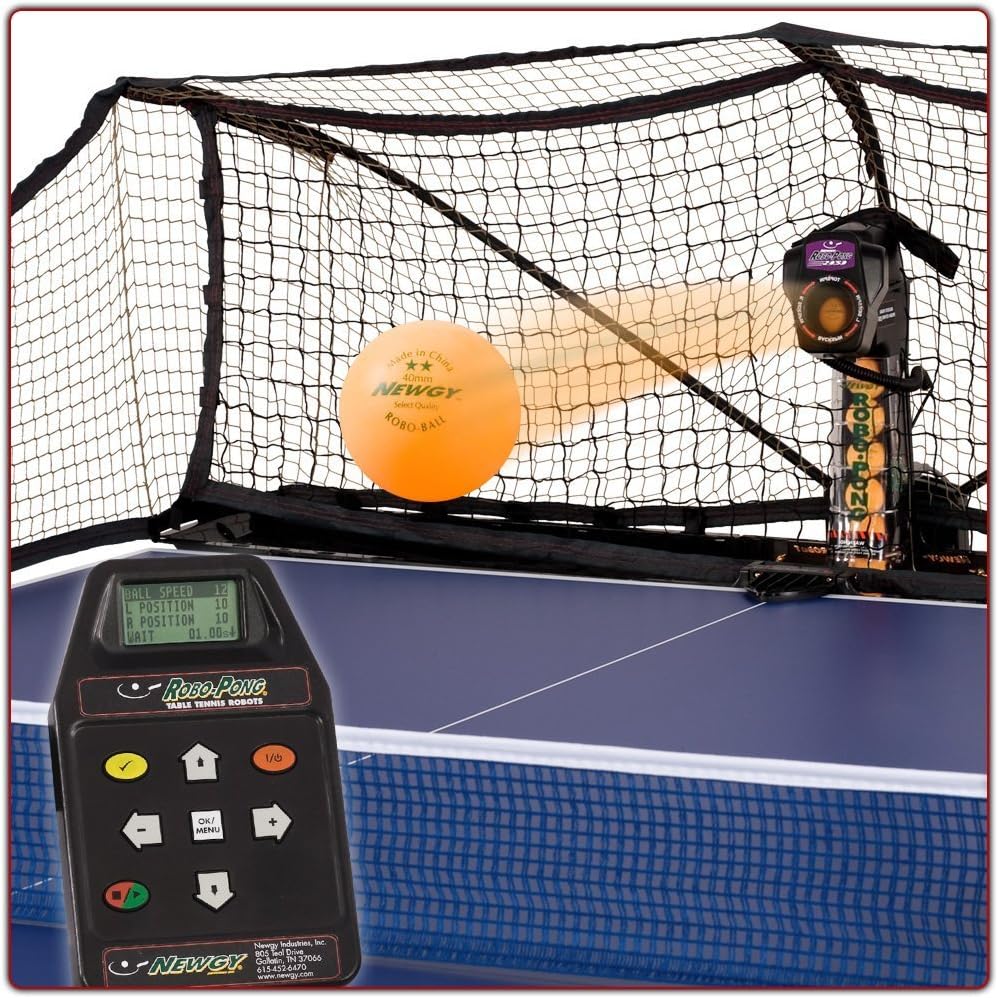
Get the Robo-Pong 2055
The training system described in this article is fully compatible with the Robo-Pong 2055 — one of the most capable and programmable table tennis robots available for home and club use.
Robo-Pong 2055