

Everything you need to understand about industrial and commercial water chillers — from working principles to real-world applications.
Air-cooled and water-cooled chillers are standard in commercial and industrial environments where consistent temperature control is non-negotiable. When operational temperatures stray outside acceptable limits, chillers step in — removing excess heat, protecting machinery, and preventing costly thermal damage to sensitive processes and products. Understanding how they work helps you choose the right unit, maintain it properly, and get the most out of your investment.
Working Principles
Industrial chillers rely on three core principles of physics to transfer heat away from a process and reject it into the surrounding environment.
Phase Change
Refrigerant transitions between liquid and gas states, absorbing or releasing large quantities of heat in the process.
Heat Exchange
Heat energy moves from warmer process fluid to cooler refrigerant across a purpose-built heat exchanger surface.
Pressure Variation
Raising and lowering refrigerant pressure controls the temperature at which it boils and condenses throughout the cycle.
How Does a Chiller Work?
At its core, a chiller operates by using a refrigerant-based vapor compression or vapor absorption cycle. A compressor or heat source drives the refrigerant through the system, transitioning it between liquid and gas phases to continuously pull heat from the process fluid and reject it externally.
Vapor Compression Chillers
Vapor compression is the most widely used chiller design. A mechanical compressor pressurizes the refrigerant vapor, raising its temperature and energy level. This high-pressure gas flows to the condenser, where heat is rejected to either air or water. The refrigerant then passes through an expansion valve — dropping sharply in pressure and temperature — before reaching the evaporator, where it absorbs heat from the process fluid and returns to vapor form, restarting the cycle.
 Vapor Absorption Chillers
Vapor absorption chillers replace the mechanical compressor with a heat source — typically steam, hot water, or a gas burner. A refrigerant/absorbent solution pair (most commonly water and lithium bromide) drives the cycle. The refrigerant evaporates under low pressure to absorb heat, is then absorbed into solution, driven off again by applied heat, and condensed to restart. These systems excel in environments with waste heat sources and operate far more quietly than their compressor-driven counterparts.
The entire process is known as the refrigeration cycle. In a well-sized and properly maintained chiller, this loop runs continuously and efficiently — keeping your process temperature locked within a precise target range regardless of ambient conditions or load fluctuations.
Basic Chiller Components
Every chiller system — regardless of type — relies on the same fundamental set of components working in sequence.
- Condenser
- Compressor
- Evaporator
- Expansion Valve
- Power Unit
- Control Unit
- Water Hoses
Condenser
The condenser is where heat collected from the process is expelled. Hot refrigerant vapor enters the condenser and releases its thermal energy to either an airstream (air-cooled) or a flow of condenser water (water-cooled). As it loses heat, the refrigerant condenses back into liquid form — ready to begin the cycle again.
Compressor
The compressor is the heart of any vapor compression chiller. It draws in low-pressure refrigerant vapor from the evaporator and pressurizes it, raising its temperature before sending it on to the condenser. Compressor type — scroll, screw, centrifugal, or reciprocating — largely determines the chiller's efficiency profile and capacity range.
Evaporator
An expansion valve sits between the condenser and evaporator. It meters the flow of refrigerant and causes a rapid pressure drop, which significantly lowers the refrigerant temperature. This cold, low-pressure refrigerant then enters the evaporator — a heat exchanger where process fluid passes on one side and refrigerant on the other. The refrigerant absorbs heat from the process fluid and evaporates, effectively cooling the fluid before it returns to the system.
Control Panels
Modern chillers integrate electronic control panels that monitor and manage the entire refrigeration process. These panels regulate temperatures, track alarms, log performance data, and allow operators to configure setpoints and schedules — all from a single interface. Advanced systems include remote monitoring and diagnostics.
Types of Industrial Chillers
The first broad distinction in chiller selection is the medium used to reject heat from the condenser. From there, the choice of compressor technology further defines performance, size, and cost.
Water-Cooled Chillers
Use a separate water loop and cooling tower to reject condenser heat. Typically more efficient than air-cooled designs, especially at large capacities. Best suited for indoor installations with access to a cooling tower.
Air-Cooled Chillers
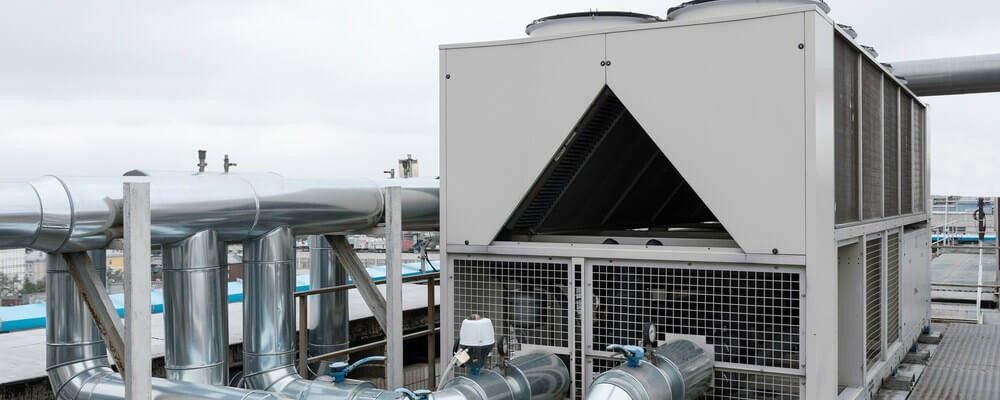
Reject heat directly to the surrounding air via finned coil condensers and fans. Simpler to install, lower infrastructure cost, and ideal for outdoor placement or facilities without access to cooling water.
Vapor Absorption Chillers
Driven by heat rather than electricity. No compressor. Ideal where waste heat or low-cost thermal energy is available. Quieter and longer-lasting mechanical life than compressor-based units.
Glycol Chillers
Use a water-glycol mixture as the process fluid, enabling sub-zero cooling. Widely used in food and beverage production, breweries, pharmaceutical processes, and other applications requiring temperatures below freezing.
Centrifugal Chillers
High-capacity designs that use centrifugal compressors. Excellent efficiency at full load. Typically deployed in large commercial buildings, district cooling, and high-output industrial operatio
Uses of Industrial Chillers
Water chillers and air-cooled chillers serve as the cooling backbone across a wide range of industries. Below are some of the most common real-world applications.
Food Processing
Used to control temperatures during processing and storage, maintaining strict food safety compliance and product quality.
Injection Molding
Rapidly cools molds and machinery components after each production cycle, reducing cycle time and increasing throughput.
Medical & Lab
Maintains precise temperature environments for diagnostic equipment, imaging systems, and sensitive laboratory instruments.
Breweries
Controls fermentation and storage temperatures with precision — a critical factor in product consistency and quality.
HVAC Systems
Central to commercial building climate control, providing chilled water to air handling units across large structures.
Data Centers
Removes heat generated by dense server infrastructure to prevent overheating and maintain uptime reliability.
Determining the Right Chiller for Your Needs
Selecting the right chiller comes down to accurately matching your system's cooling capacity requirements to the unit's rated output. An undersized chiller will run continuously without reaching setpoint, shortening its service life significantly. An oversized unit will short-cycle, wasting energy and causing unnecessary wear. Key factors to evaluate include: required cooling capacity (in tons or kW), process fluid temperature setpoint, ambient temperature conditions, available utilities (electricity, water, natural gas), physical space, and total cost of ownership.
As a general starting point: calculate your process heat load in BTU/hr, then divide by 12,000 to determine the required tonnage. Always add a 20–25% safety margin to account for ambient variation, system inefficiencies, and future load growth. When in doubt, consult a qualified HVAC or process cooling engineer before committing.
Getting the Most Out of Your Chiller
Even the best chiller underperforms without proper setup and ongoing care. Routine maintenance — including condenser coil cleaning, refrigerant charge checks, water treatment, and controls calibration — keeps your system running at peak efficiency. A well-maintained chiller can deliver reliable service for 15 to 25 years. Neglected systems lose efficiency rapidly and face premature component failure. Always follow the manufacturer's scheduled maintenance intervals and log performance data over time to catch degradation early.
Trust BACKYARD PROVIDER for Your Chiller Needs
Whether you're cooling a backyard aquaponics system, a small commercial space, or a production process, we carry water chillers engineered for reliable, efficient performance. Browse our selection and find the unit built for your application.