

A practical guide to understanding head support assessment, mounting hardware types, bracket options, and how to match the right solution to each individual's positioning needs.
Who Requires a Head Support?
Head supports are appropriate for several different groups: individuals who lack sufficient head control when seated upright; those who have adequate head control while seated but require support when using a tilt or recline feature; and individuals who remain seated in their wheelchair during transit and are required by the transport provider to have a head support attached while traveling.
Always Begin With the Pelvis
When assessing for seating and secondary postural supports, the process must always begin with the position of the pelvis — because pelvic position directly influences where the head sits. To understand this relationship, consider what happens when you shift into a posterior pelvic tilt while sitting: the kyphosis in your spine increases and your neck either drops into a forward-flexed position or extends to maintain your line of sight. The same principle applies in reverse with an anterior pelvic tilt.
This is why it is essential to address pelvic and trunk positioning before any attempt is made to assess or fit a head support. The head position you see is often a downstream consequence of what is happening lower in the seating system.
Assessing Head Support Placement
Once the optimal pelvic and trunk position has been established, the clinician can proceed with head support assessment. Placing your hands on the individual's head — much like placing hands on the trunk to assess back support needs — helps determine the direction of support required, the amount of active movement present, and the optimal head position for that person.
When assessing for head support placement, it is important to be aware of the areas on the head that can safely take load versus those that should be avoided.
Safe Load-Bearing Areas
- Occipital and sub-occipital areas
- Lateral cervical spine
- Lateral aspect of the skull above the temporal region
- Forehead
Areas to Avoid
- Temporal area
- Eyes
- Mastoid process
- Mandible
The information gathered during this hands-on assessment informs the size and type of pad required, the relative placement of the pad, the type of hardware needed, and where the hardware should be mounted on the back support. For example, if cervical rotation is present, the direction of force must be aligned between the mounting hardware, the pad, and the individual's head — which may require an off-set mount to reposition the hardware to one side of the back support.
Understanding Mounting Hardware
A generic head support system consists of two components: the mounting hardware and the pad choices. This section focuses on mounting hardware. There are two broad types of head support mounts in common use:
Horizontal & Vertical Bar Mounts
This style uses a horizontal and vertical bar arrangement to position the head support. It allows for anterior-posterior adjustment, though the protruding horizontal rod can present a hazard to caregiving staff — which is why a tennis ball or cap is often placed on the exposed end for protection.
Gooseneck Mounts
The gooseneck style achieves anterior-posterior adjustment without a protruding horizontal rod, reducing caregiver hazard. This style also offers an aesthetic advantage and is increasingly the preferred choice in clinical settings where caregiver safety is a priority.
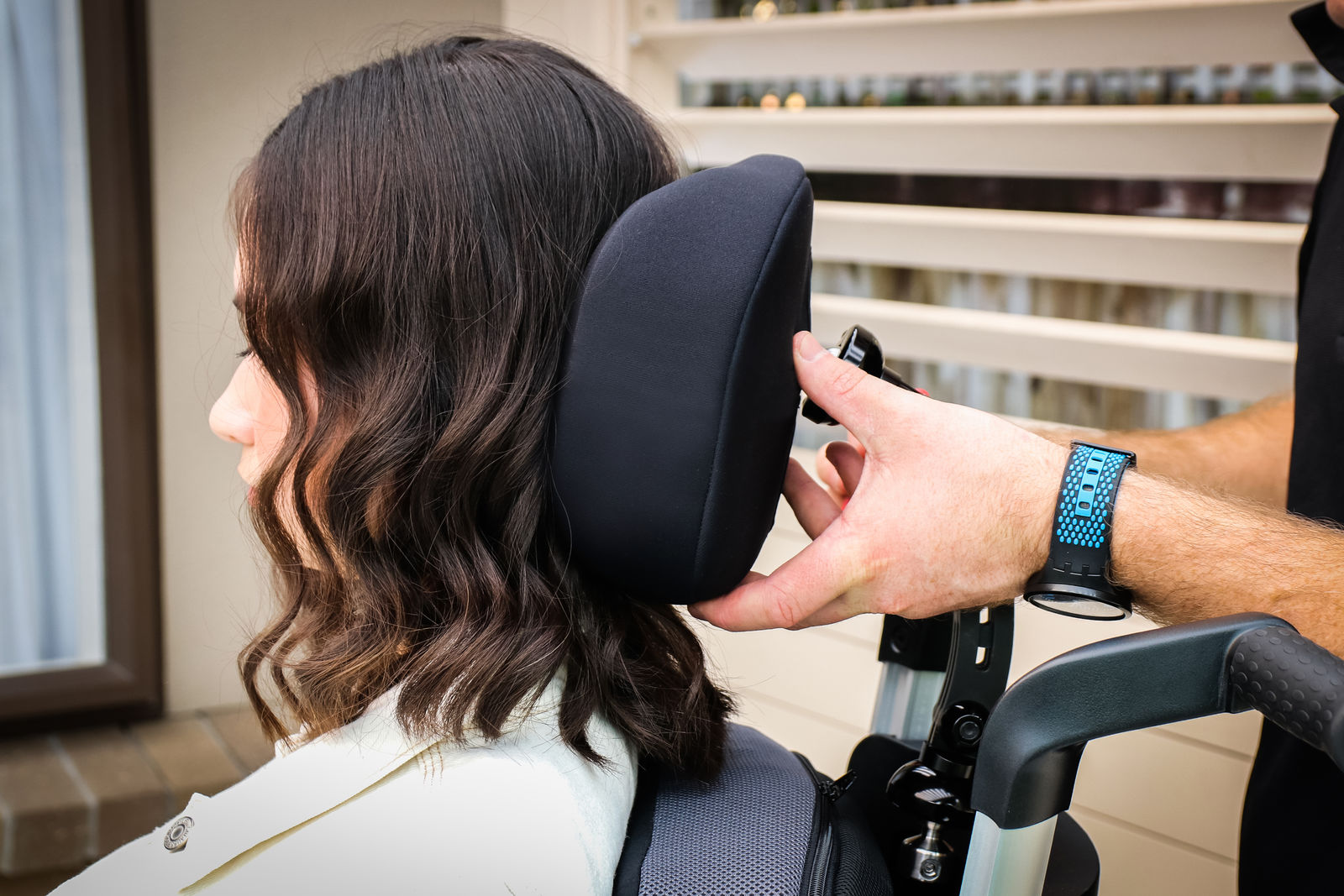
Both mounting types permit anterior-posterior adjustment. The key practical difference is the absence of the protruding rod in the gooseneck design, which eliminates a common point of injury risk for staff working behind the wheelchair.
When individuals consistently break mounting hardware — often due to high tone or forceful movement — the strength and durability of the materials must be carefully considered. A dual mount, in which two mounts are affixed to the headrest pad and to the back support simultaneously, can provide significantly greater structural strength in high-demand situations.
Standard Brackets vs. Flip-Back Brackets
A bracket connects the head support hardware to the back support. Clinicians must choose between standard brackets and flip-back brackets — and this decision has practical consequences for daily use and positioning accuracy.
Comparing Bracket Options
Standard Bracket
Fixed in position. Simple and stable. Best for individuals who do not require frequent transfers or do not need to move the head support out of the way regularly.
Flip-Back Bracket
Allows the head support to fold back and out of the way during transfers while remaining attached to the wheelchair. Because it stays connected, repositioning error is reduced — the support returns to the same intended position each time.
Gooseneck with Built-In Flip-Back
Some gooseneck hardware includes a flip-back mechanism integrated into the neck itself. The pivot point sits higher — at the base of the gooseneck — resulting in a shorter lever arm and less weight to manage during the flip-back motion.
Flip-Back Bracket on Standard Mount
Here, the pivot point is lower, creating a longer lever arm. This means more weight is carried during the flip-back action, which may be a consideration for caregivers with limited strength or working in confined spaces.
When a head support is repeatedly removed for transfers rather than folded back, there is a meaningful risk that it will not be repositioned vertically in exactly the intended location. Over time, this can compromise the postural support the individual receives. A flip-back option reduces this risk by keeping the hardware tethered to the chair throughout.
Pad Selection & Modifications
Pad choices for wheelchair head supports range from simple single-pad systems to complex multi-pad configurations. The type of pad required depends directly on the assessment findings gathered during the hands-on evaluation — including the direction of support needed, the load areas identified as safe, and the degree of active movement present.
In Part 2 of this series, we will cover pad selection in detail, including available modifications and how to match pad design to individual clinical requirements.
Key Takeaway: Head support assessment is not a standalone process. It begins with pelvic positioning, proceeds through hands-on clinical evaluation, and requires careful hardware selection based on the individual's tone, movement patterns, transfer routine, and caregiver context. Getting the mounting hardware right is the foundation — pad selection builds on top of it.
Shop Wheelchair Head Supports
Explore our range of clinically appropriate head support solutions for wheelchair users of all needs.
Patterson Head Support