


Reaching the level of elite human competitors in table tennis requires more than practice — it requires consistent, varied, and high-fidelity ball delivery. Most robotic launchers on the market fall short: they either lack intelligent control interfaces or can't match the speed and spin ranges of real advanced players. This open-source three-wheel launcher changes that. Capable of ball speeds up to 15.4 m/s and spin rates reaching 192 revolutions per second, it brings professional-grade training within reach of players and researchers alike.
The launcher's hardware is fully open-source and distributed through a public repository, making it accessible for duplication, modification, and community-driven improvement. Every core assembly has been documented with precision to ensure builders and researchers can replicate or adapt the system without barriers.
The hardware repository includes all CAD files in both STEP and SolidWorks 2022 formats, along with technical sketches covering the launch unit, base frame, cable duct, electronics box, and control unit. Datasheets for all third-party components are also provided.
CAD Files Included
Full STEP and SolidWorks 2022 files for every mechanical component in the system.
Assembly Sketches
Detailed technical drawings for the launch unit, frame, cable duct, and electronics enclosure.
Wireless Control
Fully operable over open Ethernet or Wi-Fi, enabling remote configuration and real-time adjustments.
Adjustable Parameters
Wheel speed, launch orientation, and timing are all configurable through the software interface.

An extensive dataset was compiled as part of the system's accuracy evaluation and target-shooting algorithm training. The data is structured to support both immediate evaluation and long-term machine learning use cases.
Accuracy Evaluation Dataset
- Accuracy testing with TTmatic 303A across four target distances
- Evaluation with MN4004 KV300 at four different distances
- Evaluation with MN5008 KV170 at four different distances
System Parameter Evaluation Dataset
- Testing across varying stroke gain values
- Evaluation under different ball-pinching settings
- Testing with and without prior orientation jump
- Analysis across different ramp-up times
- Final evaluation using optimized system parameters
Grid Search Dataset
- Training data from grid search including successful table trajectories
- Training data from grid search with trajectories that miss the table
All trajectory data is stored in HDF5 format, enabling efficient handling of large volumes of measurements. Data is organized into named groups for easier access, and all trajectories undergo a visual filtering and inspection process before publication or use in training algorithms.
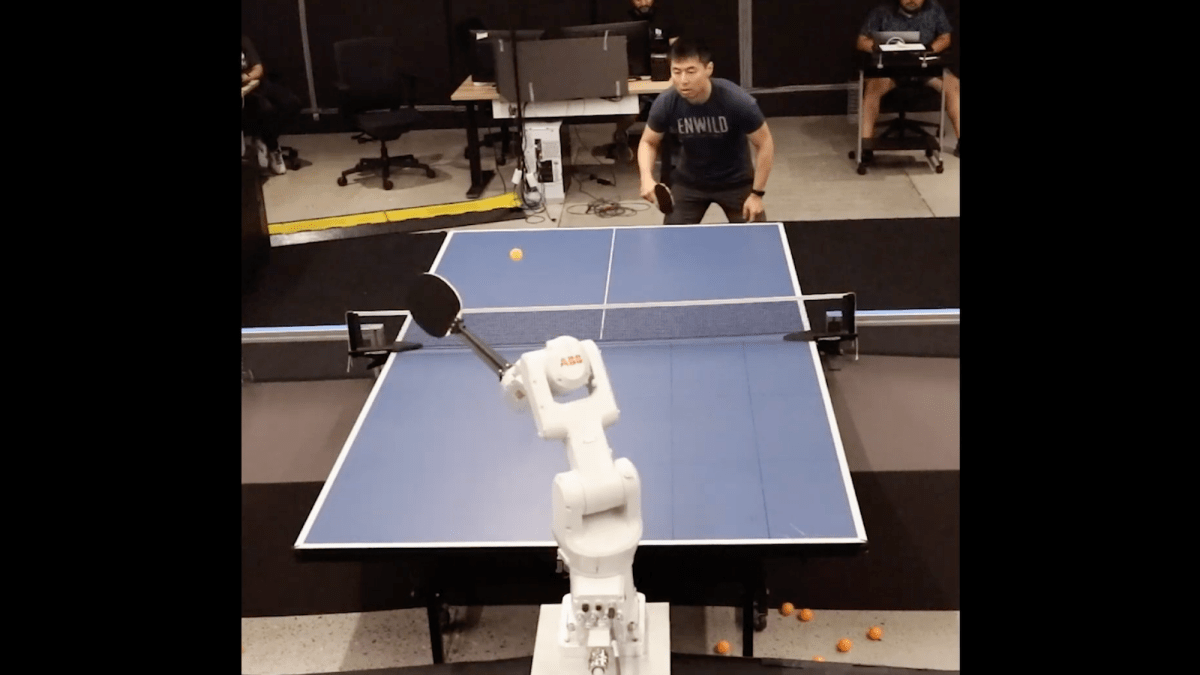
Ready to train like a pro? Explore our precision table tennis robot and take your game to a new level.
A32W Pro Robot