


When you go to buy any leather product, you'll notice right away that quality varies — and so does the price. The difference between leather varieties goes well beyond aesthetics. There are several leather types that don't differ based on quality alone, but on composition. That matters more than most people realize: not all types of leather are 100% genuine.
It can be genuinely difficult to assess leather quality at a glance. Since the quantity of leather used in an office chair is lower than in a full bag or jacket, you can't always hold it to judge. If you're buying a leather chair without seeing it in person, you're at a higher risk of paying a premium for a product that isn't even made with real leather.
There are three main leather types you'll encounter: genuine leather, bonded leather, and faux leather. To help you understand each one, we've put together a clear and detailed guide comparing all three — so you can shop with confidence.
Why Choose a Leather Office Chair?
You might wonder why anyone would choose a leather office chair when a regular mesh or fabric chair is simpler and more affordable. The answer is straightforward: comfort, durability, and appearance. Leather chairs deliver a distinct level of quality that's hard to match.
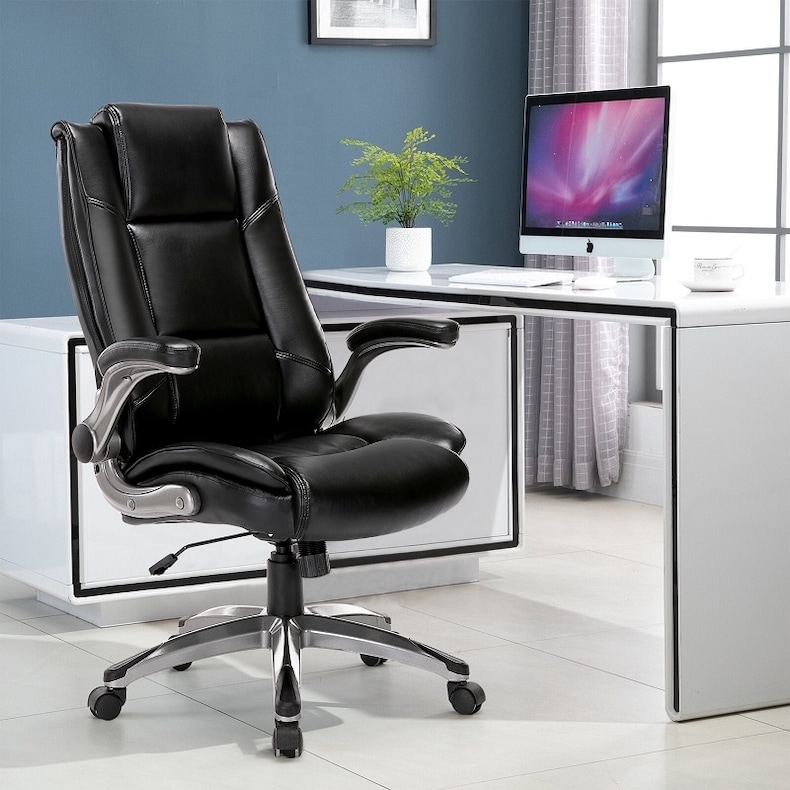
Higher Level of Comfort
Most office chairs are, frankly, uncomfortable. The seat is too stiff, the back too straight, or the armrests badly positioned. A leather chair, however, places your body in the most ergonomically supportive position available. Leather is naturally soft and flexible — it adapts to your shape over time. It also absorbs body heat and helps keep you warm in cooler seasons, while remaining breathable enough for warmer ones. That's a level of superior comfort that few materials can offer.
Enhanced Productivity
Comfort and focus go hand-in-hand. When you're not shifting around in an uncomfortable seat, you're better equipped to concentrate on your work. Leather chairs reduce the physical distractions that come with poor seating — back pain, restlessness, fatigue — which means you can work longer and more productively. A good leather chair isn't just a luxury; it's an investment in your performance.
Bonded vs Faux vs Genuine Leather — All You Need to Know
Now that you understand why leather chairs are worth considering, let's get into the key differences between bonded, faux, and genuine leather. This is where most buyers get confused — and where your decision really matters.
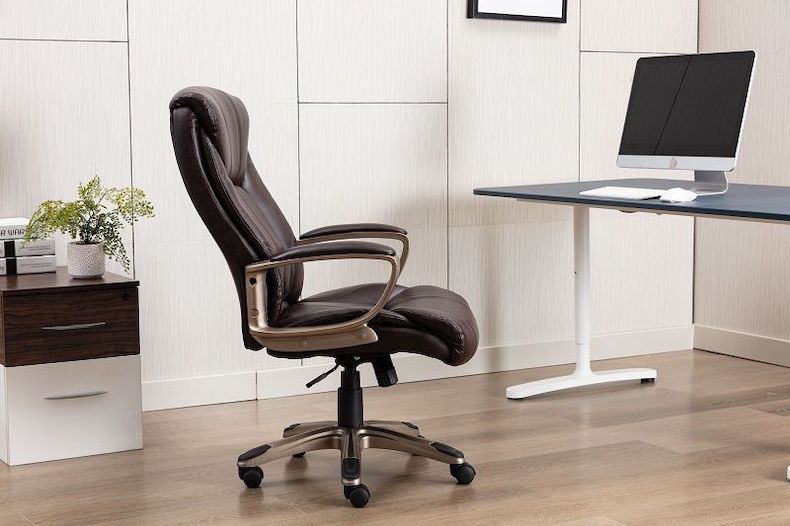
Bonded Leather
Made from leftover scraps of genuine leather bonded together with polyurethane adhesive. Around 20% genuine leather content. The most affordable option — but the least durable.
Faux Leather
Entirely synthetic, typically made from PU (polyurethane) or PVC. It closely mimics the look of genuine leather. Great value, though it may not age as gracefully.
Genuine Leather
Real leather made from animal hides. The most durable, luxurious, and expensive of the three. Full-grain genuine leather develops a beautiful patina over time.
Bonded Leather — In Detail
Bonded leather isn't entirely artificial, but it's far from genuine. About 20% of its composition consists of leftover scraps from genuine leather manufacturing. The remaining 80% is made up of chemicals and binders. These scraps are rolled and bonded together using adhesives onto a paper backing, then coated with a layer of polyurethane — giving it a texture and appearance that resembles genuine leather at first glance.
Faux Leather — In Detail
Faux leather is entirely artificial — there are zero traces of genuine leather in it. It's most commonly made from thermoplastic polymers, such as PU leather (also known as polyurethane leather). Because it so closely mimics the look and feel of genuine leather, it can be easy to mistake one for the other. Always read the product label carefully before purchasing, as sellers sometimes market faux leather products without clearly distinguishing them from genuine ones.
Genuine Leather — In Detail
As the name implies, genuine leather is made from real animal hides — most commonly cowhide. Full-grain genuine leather is the most durable of all leather types. You can identify it by the natural irregularities in its texture: no two pieces look exactly alike. Genuine leather is the most sought-after option for office chairs, bags, and shoes — but working with it is an extremely complex and costly process, which is reflected in its price.
Differences Between Real, Bonded & Faux Leather
Bonded, faux, and genuine leather differ not just in composition, but in cost, durability, texture, and maintenance. Here's a side-by-side look at how they stack up:
Cost
Genuine leather is the most expensive of the three types — and for good reason. It's sourced from real animal hides, processed through a complex tanning procedure, and built to last for years. Faux leather sits in the middle ground: it produces a convincing look at a fraction of the cost. Bonded leather is the cheapest of all, and while it's popular among budget-conscious shoppers, it's also the least resilient.
Durability
Leather office chairs come at a premium — so you want to be sure you're getting lasting value. Genuine leather is the most durable of all three types, offering the highest return on investment over time. Faux leather performs decently and sits between genuine and bonded in terms of longevity. However, since it's entirely synthetic, cracking and peeling can become an issue, and it's generally not the best long-term choice for heavily-used office chairs.
Bonded leather ranks last in durability. Made from scraps and adhesives, it develops a brown-toned film over its top surface that ruins the appearance over time. The same polyurethane layer that mimics genuine leather is also what makes bonded leather most susceptible to damage. It can wear out quite easily — so while the price tag is attractive, the lifespan often isn't.
Texture
If you look closely, all three types of leather differ in texture. Genuine leather has the most natural surface — it's made from real animal hide, so it won't be perfectly consistent. That variation is actually a sign of authenticity. Faux leather tends to be smooth and uniform across its entire surface. Bonded leather shares this uniform appearance, making it one of the easier types to identify. You can also distinguish genuine leather from the others by feel — and by holding it up to a light source to examine the grain.
Maintenance
Maintenance is one of the most important factors when choosing office furniture — especially when you're investing in a chair you'll use daily. Genuine leather is the most beautiful and durable, but it does absorb moisture and requires periodic conditioning to stay supple. If you're in a humid environment, this is worth keeping in mind.
Faux leather, on the other hand, doesn't absorb moisture as readily — making it easier to wipe clean. Bonded leather can be more problematic: it's known to release small amounts of harmful chemicals over time, and cleaning it improperly can accelerate peeling. If you're weighing which type to invest in, genuine leather remains the most rewarding long-term — and faux leather is a solid mid-range compromise.
Bottom line: If budget allows, genuine leather is always the superior choice. If you're looking for a great-looking chair at a more accessible price point, a quality faux leather or bonded leather chair — like the Alexis — can still deliver excellent comfort and style for your home or office.
Looking for a stylish and comfortable leather chair that fits your space and your budget? The Alexis Bonded Leather Chair by New Pacific Direct is a standout choice — refined design, solid construction, and an inviting feel from day one.
Alexis Bonded Leather Chair