

The glutes are a critical muscle group for both motion and appearance. These six targeted exercises build real strength, sculpt definition, and protect your lower back — without compromising form or safety.
 Whether your goal is stronger performance in the gym, a better-looking backside, or simply a body that moves the way it should, the glutes deserve far more attention than most training plans give them. Weak or underused glutes are one of the leading causes of lower back pain, hip tightness, and poor posture — all problems that compound over time.
The good news: the glutes are the largest and most powerful muscle group in the body, which means they respond quickly to focused work. With the right exercises, proper alignment, and a willingness to push with real intensity, you can unlock meaningful results in weeks rather than months.
In this article we walk through six of the highest-yield glute movements you can do in a home gym or commercial facility — and the equipment that makes each one safer and more productive.
What Muscles Make Up The Glutes?
Your gluteal complex is actually three distinct muscles working together:
- Gluteus maximus — the largest of the three and the primary driver of hip extension. This is the muscle responsible for explosive movements like sprinting, jumping, and lifting. It also gives the buttocks their shape.
- Gluteus medius and gluteus minimus — the smaller stabilizing muscles on the sides of the hips. They control hip abduction, keep the pelvis level while walking or running, and play a major role in preventing knee and lower-back pain.
A balanced routine has to train all three. Skip the medius and minimus and you'll end up with a stronger maximus sitting on top of an unstable hip — a recipe for injury.
Safe & Effective Glute Exercises
Below is a list of highly effective movements that target the glutes and are safe on the knees.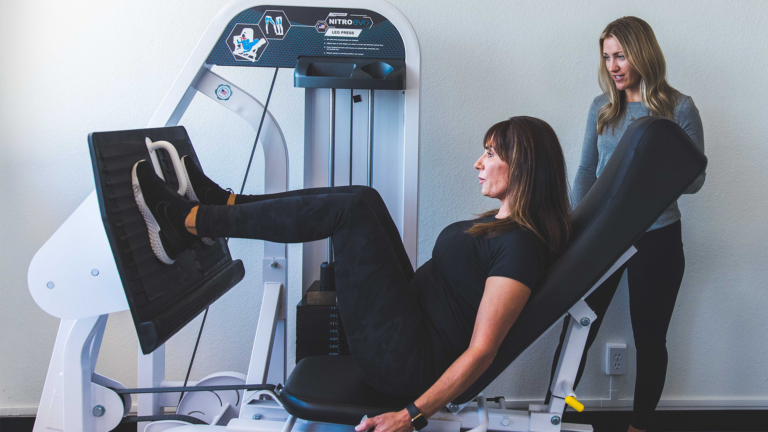
Leg Press
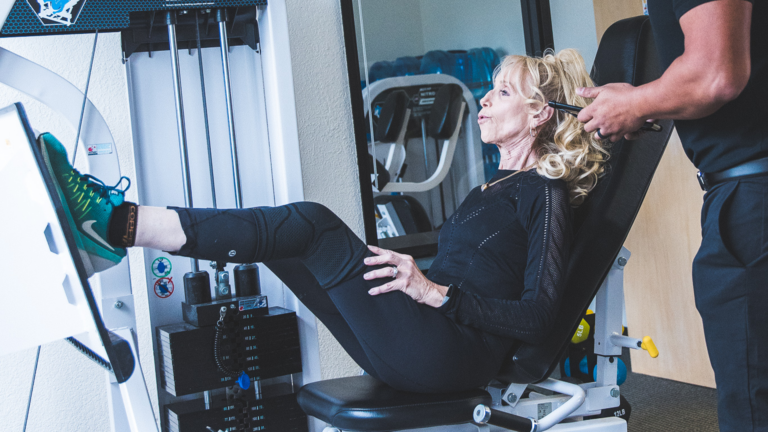
The leg press is probably one of the safest pieces of equipment for anyone chasing serious lower-body strength. Because you're seated and supported, your spine and knees stay in a controlled position while the glutes, quads, and hamstrings do the heavy lifting. When programmed correctly, it's one of the most effective tools for pure strength gains.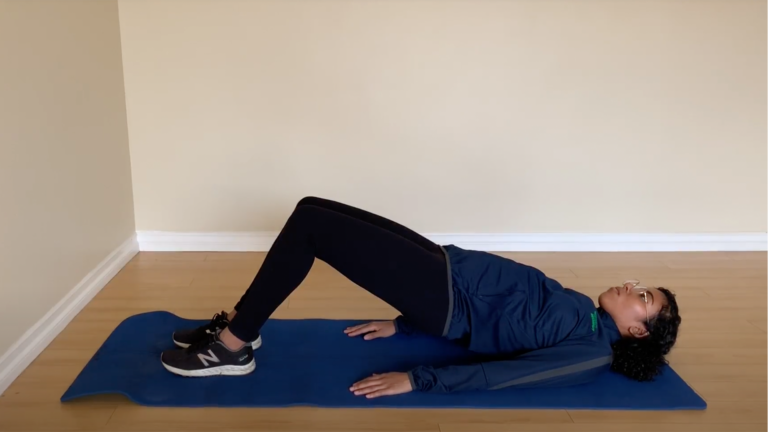
How to do it
- Using a seated leg press machine, begin with feet hip-width apart on the footplate.
- Slowly push the platform upward until your legs are nearly straight — do not lock out the knees.
- Place the feet high and wide on the platform to emphasize the glutes and hamstrings.
- Lower under control until your knees reach roughly 90 degrees.
- Repeat for your chosen rep and set range.
Read about how Michelle targeted, tightened, and lifted her glutes.
Glute Bridge
The glute bridge is one of the purest hip-extension exercises you can perform, and it requires almost no equipment. For anyone looking to wake up dormant glutes before a workout, or to finish off a session with a focused burn, this is the movement.
How to do it
- Lie flat on the floor or a mat with knees bent and feet flat on the ground, hip-width apart.
- Place your arms at your sides with palms down.
- Drive through your heels and lift the hips upward until the body forms a straight line from shoulders to knees.
- Squeeze the glutes hard at the top for a full second.
- Lower slowly to the starting position without letting the hips touch the floor between reps.
Tip: If the bodyweight version feels too easy, rest a dumbbell or weight plate across your hips to add resistance. The movement is simple, but the load can scale with you for years.
Seated Hip Abduction Machine
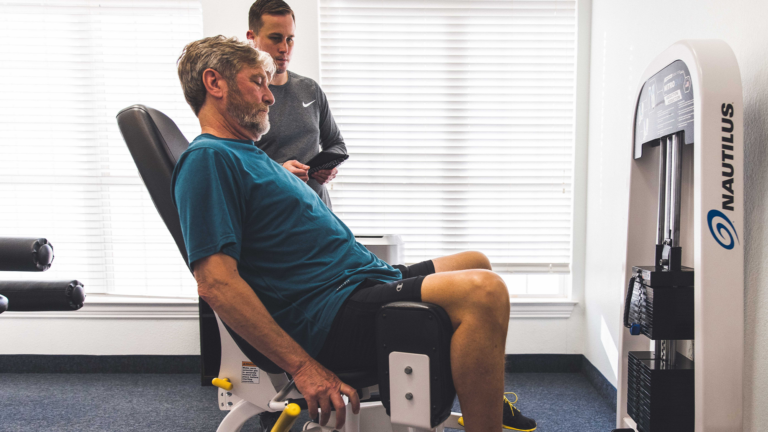
This machine is purpose-built for the gluteus medius and minimus — the muscles most home programs neglect. If you want hips that stay level under fatigue and knees that track correctly during squats and deadlifts, this movement matters more than most people realize.
How to do it
- Sit on the machine with your back firmly against the pad and feet resting on the platforms.
- Place the outside of your knees or thighs against the resistance pads.
- Adjust your hands to a comfortable grip on the handles.
- Slowly press your legs outward against the resistance, pushing the pads apart.
- Pause briefly at the fully abducted position.
- Return to the start under control, never allowing the pads to slam back together.
Use the heaviest weight you can handle while maintaining strict form. Because this is a small-range movement, going too light is easier than you think — and a wasted set in the process.
Note: If you're still unsure about alignment, consult the machine's guide or ask a trainer at your facility.
Standing Hip Abduction With A Resistance Band
This version is effective for training the glutes medius and minimus without equipment. It works with anywhere — home, gym, or on the road — and costs almost nothing.
How to do it
- Wrap a resistance band around both ankles or just above the knees.
- Stand tall with feet about hip-width apart, hands resting on your hips or a stable surface for balance.
- Keeping the working leg straight, lift it out to the side as far as feels comfortable — you'll feel the glute engage immediately.
- Pause briefly at the top, then lower slowly and under control.
- Perform the desired number of reps, then switch to the other leg.
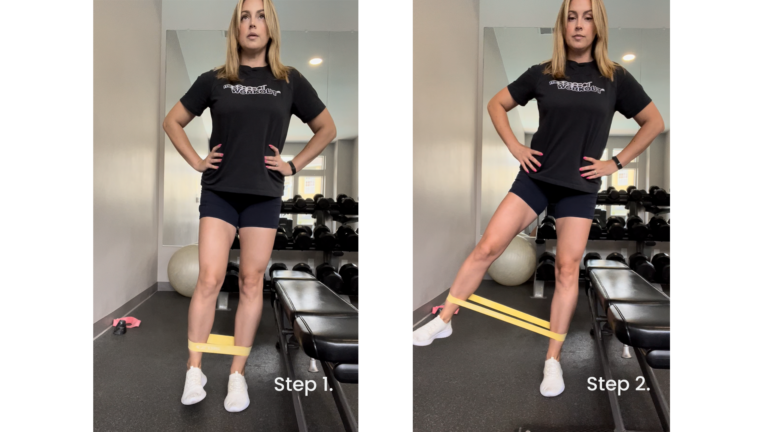
Pro tip: Keep the motion slow and deliberate. Swinging the leg defeats the purpose — your glute should be doing the work, not momentum.
Bulgarian Split Squat
Hard to love on the first attempt, harder to avoid once you realize what it does. The Bulgarian split squat is one of the most honest glute-and-quad movements in existence — you cannot fake it.
How to do it
- Stand in front of a bench, box, or low platform, holding a dumbbell in each hand or a barbell racked on the back (advanced).
- Place the top of one foot on the bench behind you, keeping the forward foot roughly 2–3 feet ahead of the bench.
- With your chest tall and core braced, slowly lower the back knee toward the floor.
- Descend until the front thigh is roughly parallel with the ground — or as far as your mobility safely allows.
- Drive through the heel of the front foot to return to the starting position.
- Complete your reps on one side before switching.
 It's normal to wobble for the first few sessions — that's stabilizer work, and it's part of the value. Your balance will improve faster than you expect.
Barbell Hip Thrusts
The hip thrust is the undisputed king of glute training. Popularized by strength coach Bret Contreras, it allows for heavy, glute-specific loading that few other exercises can match — and the transfer to real-world strength is enormous.
How to do it
- Sit on the floor with your upper back resting against a sturdy bench.
- Roll a loaded barbell (with a pad or towel wrapped around it) over your hips.
- Plant your feet flat, hip-width apart, knees bent near 90 degrees.
- Drive through your heels and push the hips upward until your body forms a straight line from shoulders to knees.
- Squeeze the glutes hard at the top for a full second.
- Lower slowly under control to the starting position.
If you find yourself needing a dedicated setup — and serious lifters eventually do — a purpose-built hip thrust machine removes the hassle of balancing the barbell, shortens your setup time, and lets you train heavier with far less risk. For a gym that gets real use, it's a tool that pays for itself in results.
These Glute Exercises Are Easy On The Knees
Because knee-joint training is as important to lift with muscle as it is to gain appearance, when you begin to apply time, attention, and consistency to your weight sessions — with virtually all glute exercises being safe on the knees — you set yourself up for long-term progress instead of short-term breakdown.
Want proof?
Nearly every glute exercise on this list places the bulk of the load where it belongs: on the hips. The knees act as hinges rather than primary movers, which means less cartilage wear, less inflammation, and a training routine you can keep running for decades instead of quitting after a season.
Another principle to remember: avoid any glute exercise that requires the knees to bend at a sharper angle than the hips. That kind of joint loading turns a glute movement into a knee-stress test, and the glutes stop doing most of the work.
At that point, other than the obvious soreness being carried out in the legs, something more quietly dangerous happens: the muscles surrounding the knee begin to overcompensate, leading to imbalances and the kind of overuse injury that sidelines you for weeks or months.
When It Comes To Training The Glutes…
The most important thing to know about glute training is quality over quantity. There are many ways to train these muscles, but you will not get great results with 5 uninspired reps and a machine set to its lightest load. If you want to see the glutes change, you have to demand change with challenge, intention, and recovery to match.
Choose 2–3 of the exercises above, run them at an intensity that genuinely tests you, and give the muscles enough rest to rebuild. A couple of focused sessions a week will take you further than hours of half-effort work.
The glutes are important for how we look, feel, and function. We often judge athletic ability by their shape and size. Strong glutes support the spine, drive nearly every lower-body movement, and contribute more to functional strength than almost any other muscle group. Investing in your glutes is one of the best things you can do for your body.
If you have any questions, please reach out at support@backyardprovider.com.
References
- Contreras, B., Cronin, J., Schoenfeld, B. (2011). Barbell Hip Thrust. Strength & Conditioning Journal.
- Reiman, M.P., Bolgla, L.A., Loudon, J.K. (2012). A literature review of studies evaluating gluteus maximus and gluteus medius activation during rehabilitation exercises.
- Neto, W., Soares, E., et al. (2020). Gluteus Maximus Activation during Common Strength and Hypertrophy Exercises: A Systematic Review.