

Clean energy has a compelling new contender. Could sodium be the answer to our power storage challenges?
The conversation around battery technology has long centered on lithium — but that dialogue is rapidly shifting. Those in the know are starting to ask whether we can achieve the same results with a far more accessible and earth-friendly alternative.
Most of today's batteries rely on lithium-ion technology. We use them in electric vehicles, solar panel storage systems, and the stationary power grids that keep homes and businesses running. The demand for lithium spans from residential panels all the way to utility-scale energy farms.
But lithium isn't without its complications. The element requires hundreds of millions of liters of water during extraction — a significant burden in already water-stressed regions. Many of the world's largest reserves sit in politically sensitive areas, bringing with them a host of social, environmental, and logistical concerns.
Mining in ecologically sensitive zones — such as parts of Central Africa — can trigger deforestation, destabilize water sources, and release pollutants and toxic particles into surrounding communities. Meanwhile, the processing and refining of lithium and cobalt demand enormous amounts of energy, which ironically undermines the environmental goals that clean energy technology is meant to serve.
These are not trivial trade-offs. They have fueled significant interest in finding an alternative — and that's where sodium steps into the spotlight.

Jean-Marie Tarascon, a pioneering physicist and professor at the Collège de France, has championed sodium as a superior battery material for over three decades. His research team developed a cell not reliant on any of the resources currently driving lithium's supply chain concerns.
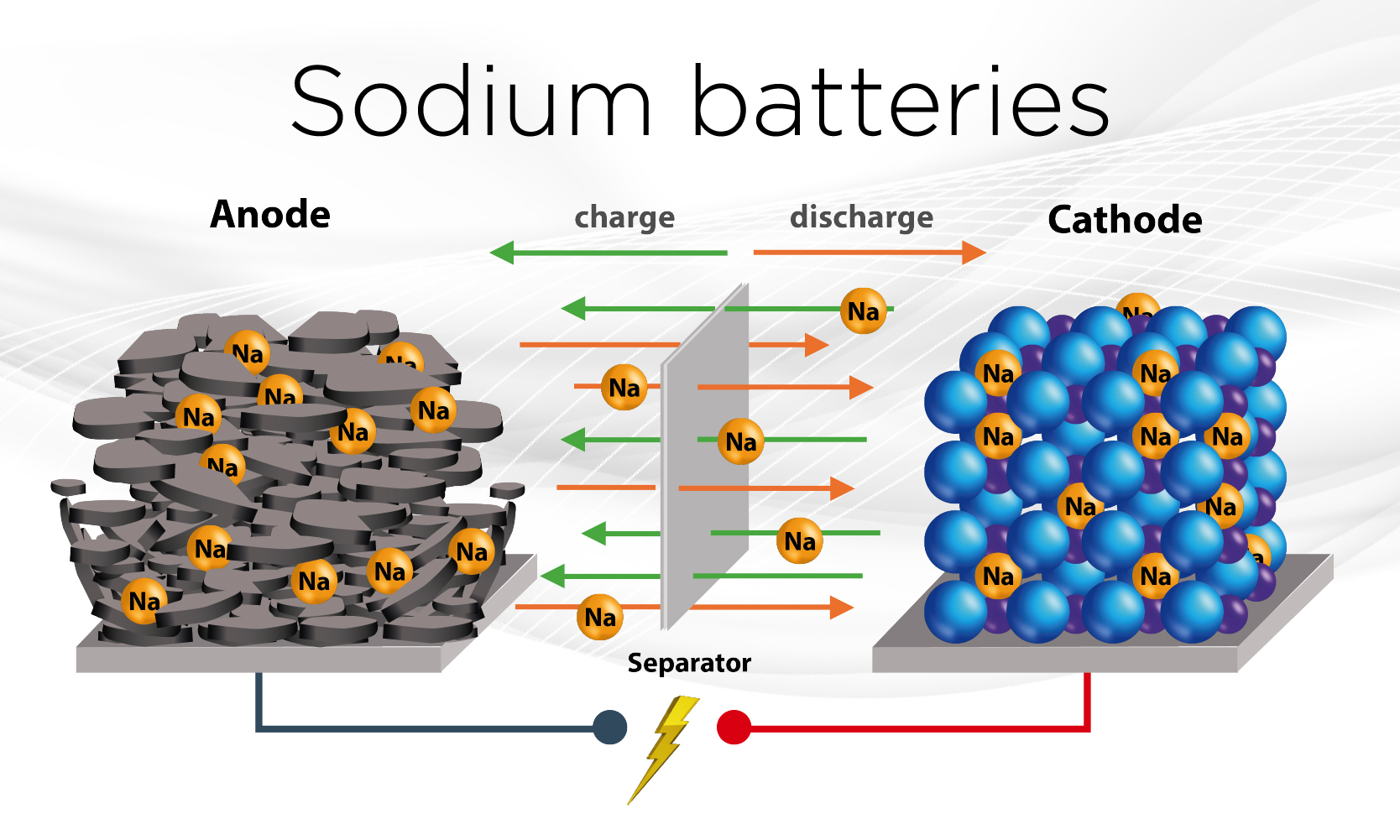
"The solution was in the phenomenon itself — which is why we moved to sodium," Tarascon has noted. Sodium-ion batteries share nearly identical chemical behavior with lithium-ion batteries, but sidestep many of the negative environmental impacts that have plagued the lithium supply chain.

Sodium battery cells — a lithium alternative gaining ground
The manufacturing process also offers a meaningful advantage: sodium-ion cells are safer and easier to transport, and are far less prone to the thermal runaway failures that have made lithium batteries a concern in enclosed or residential environments.
"Sodium-ion technology could dramatically reduce the climate cost of making a battery — from the sourcing of raw materials all the way through to the upstream processes."
— Researcher, Chalmers University of Technology, Gothenburg, SwedenFrom mine to production line, the environmental footprint of sodium-ion batteries is substantially leaner. This distinction matters more as global demand for energy storage accelerates into the next decade.
What's holding sodium-ion batteries back from immediate, widespread adoption? In practical terms, it comes down to energy density. Sodium cells hold less energy per kilogram than lithium — meaning you need more space and more weight to achieve the same storage output. This creates a real challenge for applications like electric vehicles, where compact and lightweight power is critical.
However, for stationary energy storage — exactly the use case that matters most for off-grid homes, solar installations, and backup power systems — energy density is far less critical. What matters is reliability, cost-effectiveness, and safety. Sodium scores well on all three.
Why Sodium Works for Off-Grid & Stationary Storage
- Significantly lower material costs — sodium is one of the most abundant elements on earth
- Does not require cobalt or nickel, reducing ethical sourcing concerns
- Chemically stable, with reduced risk of thermal events compared to lithium
- Can be fully discharged without damage — ideal for irregular usage cycles
- Better performance in cold-weather environments
- Compatible with existing lithium-ion manufacturing infrastructure
As an alternative to lithium in stationary applications, sodium offers the ability to store energy from solar or wind generation and discharge it when demand rises — exactly what remote and off-grid power systems require.
In the United States, silicon valley-based firms are actively manufacturing sodium-ion cells for stationary use. Sodium batteries are also appearing in commercial EV charging infrastructure as grid buffers.
Sodium-ion cells on a production line — manufactured at scale in China
China is currently the dominant force in sodium-ion battery development. The country already has hundreds of billions of dollars invested in the technology, with over 25 manufacturing plants in various stages of construction. Companies including CATL — the world's largest battery manufacturer — have made sodium a strategic pillar of their long-term roadmap.
Major automotive and technology brands in China have already incorporated sodium-ion packs into commercial electric vehicles currently on the road, giving real-world validation to a technology that just a few years ago was still largely academic.
Beyond the Yangtze delta, companies in India, France, Sweden, and the United States are all racing to build their own sodium supply chains. From partnerships with tribal communities for ethical material sourcing, to investments in U.S.-based sodium battery centers attracting hundreds of millions in federal funding, the ecosystem is rapidly maturing.
Notably, one Indian venture recently signed a major licensing deal with a European tech incubator, positioning sodium battery manufacturing as a key pillar of regional energy independence. Elsewhere, a Chinese manufacturer recently secured over $400 million from international investors to scale operations.
 Electric vehicles powered by sodium-ion batteries are already on Chinese roads
For homeowners, off-grid enthusiasts, and backyard energy independence seekers, the rise of sodium-ion batteries represents a genuine shift in what's available — and what's affordable. A battery chemistry that was once a laboratory curiosity is now shipping in commercial units.
Over the next decade, analysts expect sodium batteries to claim a growing share of the stationary storage market globally. For anyone building or upgrading an energy system today, understanding the trade-offs between lithium and sodium is no longer an academic exercise — it's a practical buying decision.
The future of power storage may not be buried in a lithium mine at all. It might be as close as your kitchen table — dissolved in a glass of saltwater.
Ready to Explore Sodium Battery Technology?
Experience next-generation energy storage with the Limitless Lithium NoLi Sodium 50Ah Battery — engineered for off-grid, solar, and stationary power applications.
NoLi Sodium 50Ah Battery