

So how exactly does a sodium-ion battery work, and what makes it genuinely exciting? This guide breaks it all down — from the fundamental chemistry to the practical strengths and limitations you need to know before making an informed energy storage decision.
What Is a Sodium-Ion Battery?
A sodium-ion battery is a rechargeable electrochemical cell that stores and releases energy by moving sodium ions (Na⁺) between its two electrodes — the anode and the cathode — through an electrolyte medium. The fundamental operating principle mirrors that of lithium-ion batteries, yet it relies on sodium, one of the most abundant elements on Earth, rather than the comparatively scarce and expensive lithium.
Sodium sits directly below lithium on the periodic table, meaning the two elements share many chemical properties. This structural similarity is exactly why sodium-ion chemistry can be adapted from decades of lithium-ion research — at a fraction of the raw material cost.

How Does It Compare to a Lithium-Ion Battery?
Sodium-ion and lithium-ion batteries share the same working principle but differ substantially in materials, cost, and performance characteristics. Here is a side-by-side look at what sets them apart:
| Feature | Sodium-Ion (Na-Ion) | Lithium-Ion (Li-Ion) |
|---|---|---|
| Charge Carrier | Sodium ions (Na⁺) | Lithium ions (Li⁺) |
| Anode Material | Hard carbon or other non-graphite materials | Graphite |
| Cathode Material | Layered oxides, Prussian blue analogues | NMC, LFP, NCA, cobalt oxides |
| Electrolyte | Sodium salt solution | Lithium salt solution |
| Energy Density | Lower (improving rapidly) | Higher (mature technology) |
| Raw Material Cost | Significantly lower | Higher; subject to price swings |
| Abundance of Source | Extremely abundant (ocean, earth crust) | More limited; geographically concentrated |
| Cold Weather Performance | Better at low temperatures | Degrades more noticeably in cold |
| Safety Profile | Lower risk of thermal runaway | Higher thermal runaway risk |
| Cycle Life | Comparable, still maturing | Well-established cycle data |
| Commercial Maturity | Emerging; growing fast | Mature, widely available |
| Best Applications | Grid storage, off-grid, EVs (emerging) | Portable electronics, EVs, residential |
Core Components of a Sodium-Ion Battery
Every sodium-ion cell is built around four essential components. Each plays a distinct chemical and mechanical role in enabling energy to be stored and released reliably and safely.
The negative electrode where sodium ions are stored during charging. Hard carbon is the most widely used anode material in sodium-ion cells today, valued for its disordered structure that accommodates the larger sodium ion more effectively than traditional graphite. Research is actively exploring alternative anode materials — including tin-based alloys and organic compounds — capable of delivering higher capacity and longer life.
The positive electrode where sodium ions are extracted during charging and re-inserted during discharge. Common cathode materials include layered transition metal oxides (NaMnO₂, NaCoO₂) and Prussian blue analogues — both of which are far cheaper and more globally accessible than the cobalt-heavy compounds used in lithium-ion chemistry. The cathode is one of the most active areas of sodium-ion research today.
A microporous membrane positioned between the anode and cathode that physically prevents the two electrodes from touching while permitting sodium ions to pass through freely. Without the separator, a short circuit would occur, generating dangerous heat. Modern separators are engineered from polymer or ceramic materials chosen for their chemical stability and consistent ion permeability across a wide temperature range.
The ion-conducting medium that allows sodium ions to travel between electrodes. Sodium-ion electrolytes are typically composed of sodium salts dissolved in organic solvents, though solid-state and aqueous variants are under active development. Unlike lithium-based electrolytes, sodium electrolytes can be formulated using less reactive, lower-cost salt compounds — a meaningful advantage for large-format energy storage manufacturing.
How Does a Sodium-Ion Battery Function?
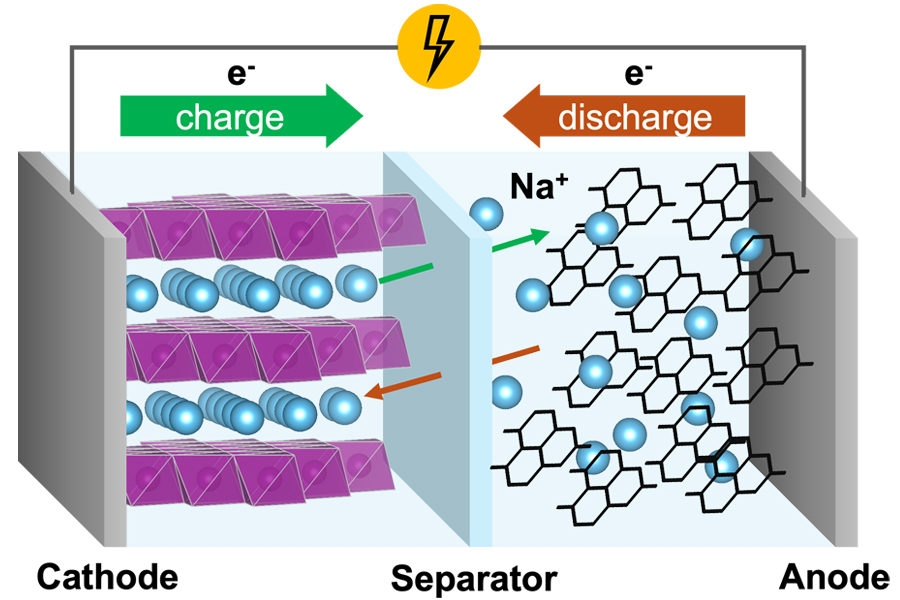
The chemistry of a sodium-ion battery is elegantly straightforward. Ions shuttle back and forth between electrodes — a process that is completely reversible, which is what makes the battery rechargeable. Here is what happens at each stage:
Discharging — Powering a Device or Appliance
Sodium ions stored within the anode's hard carbon structure are released into the electrolyte, beginning their journey toward the cathode.
Simultaneously, electrons stripped from the sodium atoms flow through the external electrical circuit — this electron flow is the electrical current that powers your device or appliance.
Sodium ions arrive at the cathode and are absorbed into its layered crystal structure, completing the electrical circuit and sustaining the flow of current until the cell is depleted.
Charging — Restoring the Battery
An external power source — such as a solar array, grid power, or a generator — applies voltage to the battery terminals, driving the process in reverse.
Sodium ions are pulled out of the cathode material and pushed back through the electrolyte toward the anode.
Sodium ions re-insert themselves into the anode structure, restoring the cell's energy capacity and making it ready for the next discharge cycle.
Strengths and Limitations of Sodium-Ion Batteries
- Raw materials are extraordinarily abundant and affordable — sodium is the sixth most common element in the Earth's crust
- Significantly lower material costs compared to lithium-ion equivalents
- Reduced geopolitical risk — no dependency on concentrated lithium or cobalt supply chains
- Superior low-temperature performance — retains capacity and discharge efficiency in cold climates
- Lower risk of thermal runaway makes large-format packs inherently safer
- Can be discharged to zero volts for safer shipping and storage without permanent damage
- Manufacturing processes are largely compatible with existing lithium-ion production lines
- Lower gravimetric energy density than lithium-ion — larger or heavier packs needed for equivalent capacity
- Graphite cannot be used as an anode — hard carbon and alternatives add complexity
- Long-term cycle life data is still accumulating as the technology matures commercially
- Fewer commercially proven cathode chemistries compared to the extensive lithium-ion library
- Solid-state sodium-ion variants remain largely in the research phase
- Not yet ideal for weight-sensitive applications such as aviation or ultra-compact portable devices
Applications and the Future of Sodium-Ion Batteries
Sodium-ion technology is finding its footing quickly in applications where its unique strengths — low cost, cold-weather resilience, and safety — matter more than maximizing energy density per kilogram.
Current and Near-Term Applications
Grid-scale and commercial energy storage where system weight is not a constraint and cost per kilowatt-hour is paramount.
Residential and cabin solar setups where deep discharge capability and cold-climate reliability deliver a real-world advantage.
Entry-level EV segments and short-range urban vehicles where pack cost matters more than maximum range per charge.
Research Frontiers Pushing Energy Density Forward
New layered oxide and Prussian blue analogue formulations targeting energy densities that approach current lithium iron phosphate benchmarks.
Tin, antimony, and phosphorous-based anodes being developed to replace hard carbon with higher-capacity, longer-lasting alternatives.
Multi-cell packs and modular rack systems designed for scalable deployment across residential, commercial, and utility-scale installations.
Ready to Experience Sodium-Ion Technology?
The Limitless Lithium NoLi Sodium 50Ah Battery delivers proven sodium-ion performance for off-grid, RV, and backup power applications — at a competitive price point that makes advanced energy storage accessible today.
NoLi Sodium 50Ah Battery
Frequently Asked Questions
Sodium-ion batteries are not a compromise — they are an evolution. Built on abundant, affordable raw materials and capable of delivering safe, reliable energy storage across a wide range of temperatures and applications, this technology is earning its place in the energy storage landscape. As research accelerates and production scales, sodium-ion cells will become an increasingly attractive choice for anyone serious about sustainable, cost-effective power.
Shop NoLi Sodium 50Ah Battery