

In this technical guide, you'll discover everything you need to know about the batteries powering electric scooters — the different chemistries used, how capacity ratings work, why voltage sag happens, and the storage practices that keep packs healthy for the long haul.
For an in-depth look at how to charge an electric scooter for maximum battery life, see our dedicated charging guide.
The battery is your scooter's fuel tank. It holds the energy that's drained by the motor, lights, controller, and every connected accessory on the ride.
Most electric scooters and e-bikes today rely on some variation of lithium-ion battery packs thanks to their excellent energy density and long service life. These packs are built from individual lithium-ion cells that are grouped together to form what's known as a battery management system — allowing each cell to be monitored and balanced for safe operation.
Bigger battery packs carry more capacity, weigh more, and also push the scooter to a higher price point. They additionally raise total vehicle weight, which slightly dulls acceleration and top speed. On the upside, larger packs unlock more of the motor's potential and dramatically extend overall range — a trade-off worth weighing before you buy.
Types of Batteries
- Lithium-ion
- Lithium Manganese (INR, NMC)
- Lead-acid
- Battery Packs
- Voltage & % Remaining
- Voltage Sag
- Capacity Ratings
- Electric Scooter Battery Brands
- Swappable Electric Scooter Batteries
- Battery Management System
- C-rate
- Electric Scooter Battery Life
- Summary
Types of Batteries
 18650 Li-ion cells, shown alongside coin and AA cells for scale — a common format inside scooter packs.
Scooter battery packs are assembled from many individual cells. Most commonly, they use 18650 cells — a cylindrical lithium-ion standard measuring about 18 mm × 65 mm.
Each 18650 cell inside a battery pack is effectively a tiny power source — generating an electric potential of roughly 3.6 volts nominal and storing somewhere around 2.6 amp-hours (about 9.4 watt-hours at a full 15.4 Wh peak when fully charged).
Packs are built from anywhere between 3.0 volts (at 0% charge) up to 4.2 volts (at 100% charge).
Lithium-ion
Lithium-ion batteries have fantastic energy density, meaning the amount of energy stored per unit of physical weight is impressive. They also feature excellent longevity — they can be discharged and recharged, or "cycled," many hundreds of times before their storage capacity meaningfully drops.
Li-ion actually describes a family of chemistries that share the lithium-ion core. Here's a shortlist of what's used in the industry:
- Lithium manganese oxide (LiMn2O4; aka IMR, LMO), Li–manganese
- Lithium manganese nickel (LiNiMnCoO2; aka INR, NMC)
- Lithium nickel cobalt aluminum oxide (LiNiCoAlO2; aka NCA), Li–aluminum
- Lithium nickel cobalt oxide (LiCoO2; aka NCO)
- Lithium cobalt oxide (LiCoO2; aka ICR, LCO), Li–cobalt
- Lithium iron phosphate (LiFePO4; aka IFR, LFP), Li–phosphate
Each of these battery chemistries represents a trade-off between various performance attributes.
Lithium Manganese (INR, NMC)
Fortunately, many quality electric scooters today use the INR battery chemistry — which is one of the safest options on the market. The cells deliver strong capacity as well as respectable output current. The presence of manganese reduces the internal resistance of the cells, which enables higher current output while keeping temperatures low. Crucially, this also minimizes the likelihood of thermal runaway. As a result, the chances of dangerous overheating and fire are significantly reduced.
Some of the scooters paired with INR chemistry include the WePed GT 5Ste and Dualtron models.
Lead-acid
Lead-acid is a very old battery chemistry that's commonly found in cars and some larger electric vehicles — as well as in golf carts. They are also used in a few electric scooters, typically the most inexpensive children's scooters sold in stores like Razor.
Lead-acid batteries have the benefit of being inexpensive — but they do suffer from two major downsides: poor energy density, meaning that they weigh a lot compared with the amount of energy they can hold. By comparison, Li-ion batteries have about 10x the energy density compared to lead-acid batteries.
Battery Packs
To build a battery pack with hundreds (or thousands) of watt-hours of capacity, many individual 18650 Li-ion cells are assembled together into a brick-like structure. The brick-like battery pack is monitored and regulated by an electronic circuit called a battery management system (BMS), which controls the flow of electricity into and out of the pack.
 Schematic diagram of parallel and series battery connections.
Individual cells in the battery pack are connected in series (end to end) which sums their voltage. This is how it's possible to have scooters with 36 V, 48 V, 52 V, 60 V, or even bigger battery packs.
These individual strands (many batteries in series) are then connected in parallel to increase output current.
By adjusting the number of cells in series and parallel, electric scooter manufacturers can increase output voltage or max current and amplify your capacity.
Changing the battery configuration will not increase total energy stored, but it effectively allows a battery to offer more range and lower voltage and vice versa.
Voltage & % Remaining
Each cell in a battery pack is generally operated from 3.0 volts (0% charge) all the way up to 4.2 volts (100% charge).
This means that a 36 V battery pack, (with 10 batteries in series) is operated from 30 V (0% charge) up to 42 volts (100% charge). You can see how % remaining corresponds with battery voltage (some scooters display this directly) for every type of battery in our battery voltage chart.
Voltage Sag
Every battery is going to suffer from a phenomenon called voltage sag.
Voltage sag is caused by several effects, including lithium-ion chemistry, temperature, and electrical resistance. It always results in non-linear behavior of the battery voltage.
As soon as a load is applied to the battery, the voltage will instantaneously drop. This effect can lead to incorrectly estimating battery capacity. If you were directly reading out battery voltage, you'd think you had instantly lost 10% of your capacity or more.
Once the load is removed, the battery voltage will return to its true level.
Voltage sag also occurs during long discharge of the battery (such as during a long ride). The lithium chemistry in the battery takes some time to catch up with the discharge rate. This can result in the battery voltage dropping even more rapidly during the tail end of long rides.
If the battery is allowed to rest, it will return to its true and accurate voltage level.
Capacity Ratings
E-scooter battery capacity is rated in units of watt-hours (abbreviated Wh), a measure of energy. This unit is quite easy to understand. For example, a battery with a 1 Wh rating stores sufficient energy to supply one watt of power for one hour.
More energy capacity means higher battery watt-hours which translates to longer electric scooter range, for a given motor size. An average scooter will have a capacity of around 250 Wh and be able to travel about 10 miles at an average of 15 miles per hour. Extreme performance scooters can have a capacity reaching into the thousands of watt-hours and ranges of up to 80 miles.
Electric Scooter Battery Brands
Individual Li-ion cells in an e-scooter battery pack are made by just a handful of different internationally-known companies. The highest-quality cells are made by LG, Samsung, Panasonic, and Sanyo. These types of cells tend to be found only in battery packs of higher-end scooters.
Most budget and contender electric scooters have battery packs made from generic Chinese-manufactured cells, which vary greatly in quality.
The difference between scooters with branded cells and generic Chinese ones is a greater guarantee of quality control with established brands. If that is not within your budget, then make sure you are buying a scooter from a reputable manufacturer who is using quality parts and has good quality control (QC) measures in place.
Some examples of companies that are likely to have good QC are Xiaomi and Segway.
Swappable Electric Scooter Batteries
Most high-quality electric scooters have replaceable lithium-ion batteries (more on that below). Many also feature Li-ion batteries that can easily be swapped out without unplugging cables or opening enclosures.
This configuration basically doubles the scooter's available range and eliminates the need to wait for a single battery to charge before riding.
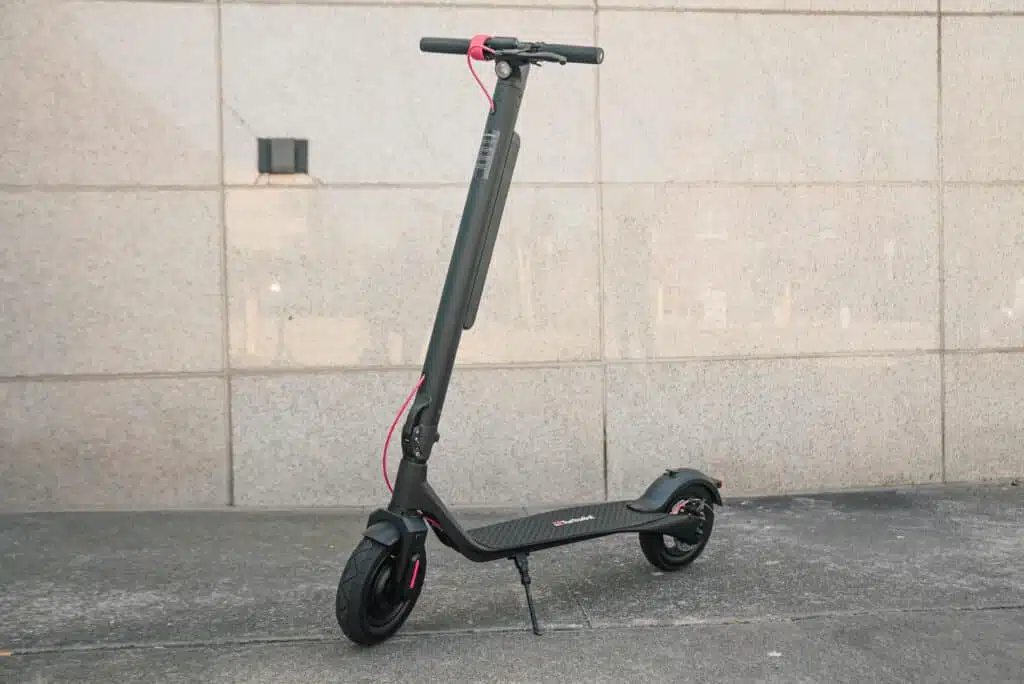 Turbowheel X7 Max (Richard S. for MS) — a standing scooter equipped with a swappable battery system.
There are two main designs for standing electric scooters with swappable batteries. Stem-mounted batteries can be found on scooters like the Turbowheel X7, X7 Pro, and X7 Max.
Stem-mounted battery replacement packs are inexpensive, lightweight, and easy to remove, carry and store. They can sometimes make a scooter feel a little wobbly or top-heavy.
The Dualtron Storm's removable battery base (a shelf of the deck).
Other electric scooters like the Arashi GR and WePed have a battery in a cargo that functions as part of the deck. The Dualtron Storm (a scooter favored by delivery drivers and professional electric scooter racers alike) also uses this design for its massively powerful, 72 V 35 Ah swappable battery.
The replacement battery for the Dualtron Storm is pricey and heavy, at 29 lb, so it's unlikely most Storm owners are carrying one around with them. In this case, the swappable battery enables the Storm's rider to step on track without swapping vehicles.
Looking for a heavy-duty swap-ready pack? The Kaabo Wolf King GT Pro 72V 35Ah battery delivers the same elite-grade storage favored by pro-level riders.
The EMOVE Roadrunner — a swappable battery only weighs 15 pounds.
A third design for a swappable electric scooter battery is seen in Voro Motors' EMOVE Roadrunner, whose 48V 26.1Ah battery pack slots into the frame diagonally under the seat. The battery takes no more than 10 seconds to swap out and only weighs 15 pounds.
Battery Management System
Though Li-ion 18650 cells have amazing benefits, they are less forgiving than other battery technologies and can explode if used improperly. It is for this reason that they are nearly always assembled into battery packs that have a battery management system.
The battery management system (BMS) is an electronic component that monitors the battery pack and controls charging and discharging. Li-ion batteries are designed to operate between about 2.5 to 4.0 V. Overcharging or completely discharging can shorten battery life or trigger dangerous thermal runaway conditions. The BMS should prevent overcharging. Many BMS also cut power before the battery is fully discharged in order to prolong life. Despite this, many riders still baby their batteries by never fully discharging them and also use special chargers to finely control charging speed and amount.
More sophisticated battery management systems will also monitor the temperature of the pack and trigger a cutoff if overheating occurs.
C-rate
If you're doing research on battery charging, you're likely to encounter C-rate. C-rate describes how quickly the battery is being fully charged or discharged. For example, a C-rate of 1C means the battery is charged in one hour, 2C would mean fully charged in 0.5 hours, and 0.5C would mean fully charged in two hours. If you fully charged a 100 Ah battery using 500 A current, it would take a one hour and the C-rate would be 1C.
Electric Scooter Battery Life
A typical Li-ion battery will be able to handle 300 to 500 charge/discharge cycles before diminishing in capacity. For an average electric scooter, this is 3000 to 10,000 miles. Keep in mind that "diminish in capacity" doesn't mean "lose all capacity," but means a noticeable drop of 10 to 20% that will continue to get worse.
Modern battery management systems help to prolong the life of the battery and you shouldn't worry too much about babying it.
However, if you're keen on stretching the battery life as much as possible, there are some things you can do to exceed 500 cycles. These include:
Best Practices for Long Battery Life
- Don't store your scooter fully charged or with the charger plugged in for prolonged periods.
- Don't store the electric scooter fully discharged. Li-ion batteries degrade when they drop below 2.5 V per cell. Most manufacturers recommend to store scooters with a 40–50% charged, and top them up to this level periodically for very long-term storage.
- Don't operate the scooter battery to its temperature extremes. Below 32°F or above 113°F.
- Charge your scooter at a slower C-rate, meaning charge the battery at a lower rate relative to its maximum capacity to preserve/improve battery life. Charging at a C-rate less than ½ is better. Some of the fancier or high-speed chargers let you dial up or down the charging rate, which can make a huge difference for long-term battery health.
Upgrade With the Ultimate Swappable Battery
Unlock professional-grade power and range with the Kaabo Wolf King GT Pro original 72V 35AH battery — the same swappable energy source trusted by elite riders.
Kaabo Wolf King GT 72V35AHSummary
Electric scooter batteries are the beating heart of every ride — dictating range, power delivery, weight, and long-term ownership cost. Whether you choose a budget scooter with a modest pack or a performance monster with a swappable high-voltage system, understanding the chemistry, the voltage curve, and proper care practices will help you get the absolute most out of your investment. Treat the battery well, and it will reward you with thousands of smooth, consistent miles.