

Explore every type of paper cutter available, what to look for before buying, and how to match the right machine to the way you actually work.

TL;DR
Paper cutters are some of the most overlooked yet hardest-working tools in any print or office setup. In this buyer's guide, we cover the main types of paper cutters, the key factors to weigh before purchasing, and how to determine which one is right for your workflow. Whether you're trimming occasional documents or cutting large volumes daily, there's a cutter built for exactly that — and this guide will help you find it.
Can you get clean, accurate cuts with scissors or a utility knife? Technically, yes. But if you've ever tried to trim a tall stack of handouts, produce sharp-edged business cards, or deliver presentation materials that look truly polished — you already know that manual methods fall short. Paper cutters exist because precision at volume matters, and no shortcut quite replaces the right tool.
It doesn't matter whether you're a marketer, a teacher, an office administrator, or someone who simply handles paper frequently — having the right cutter in your workspace changes what's possible. In this guide, we'll cover the main types of paper cutters, what to consider when choosing one, and tips drawn from years of hands-on experience with these machines.
"The right paper cutter doesn't just trim paper — it transforms the quality of everything you produce."
In this guide, we'll cover:
- The main types of paper cutters and how each one works
- What to look for when selecting the best paper cutter for your needs
- Expert tips to help you get the most out of your machine
Know Your Options
Types of Paper Cutters
When it comes to paper cutters, you might be surprised by how many options are available. Each type is built with a different use case in mind — here's how they compare.
Guillotine Cutters
The most recognisable type. A long handle lifts and drops a straight blade through the paper stack. Guillotines are affordable, straightforward to use, and handle stacks of up to around 20 sheets at a time. Because the blade slides through the stack, thicker piles may be slightly less consistent from top to bottom — still a great all-rounder for most offices and home environments.
Rotary Blade Trimmers
Rotary trimmers are the go-to for precision trimming of slim edges — think removing the white border from a printed photo or cleaning up the edge of a poster. A small circular blade rolls along a track, making them excellent for single sheets or very small stacks. Many models also offer interchangeable blades for scoring, perforating, and decorative cuts.
Stack Cutters
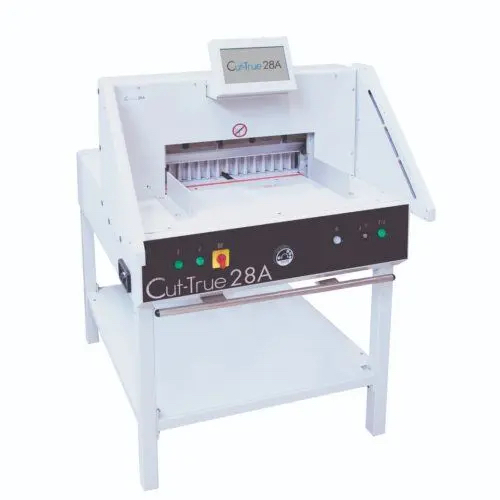
Built for volume. Stack cutters handle large quantities of paper in a single pass — often used in print shops and production environments. Manual stack cutters are popular for general use, while electric models speed up the process significantly. If you're cutting materials for a thousand recipients, a stack cutter is the machine for the job.
Business Card Slitters
Designed specifically for cutting sheets into perfectly uniform business cards. These machines deliver clean, consistent edges at a size where even minor imperfections are immediately visible. Models range from manual to electric, and some can process full sheets in a single pass.
Making the Right Call
What to Consider When Choosing a Paper Cutter
Choosing a paper cutter comes down to understanding the specifics of your work — cutting capacity, the widths and lengths you work with most, and how precise your results need to be. Here's what to weigh up before you commit.
Cutting Capacity, Width & Length
One of the most fundamental considerations is whether the machine can handle your paper dimensions. If you regularly cut large-format material, you need a cutter with a correspondingly long cutting arm. Sheet capacity matters too — a cutter rated for 10 sheets won't serve you well when you're processing mailers for 1,000 recipients.
Safety Features
Different cutter types have different safety profiles. Guillotine cutters should include a blade guard, a locking mechanism when not in use, and a paper clamp to keep your hands clear of the blade path. Stack cutters often incorporate blade shields and some feature two-hand operation so the blade can never descend with a hand near the cutting surface.
Accuracy & Precision
Manual guillotine cutters can deliver precise results, but consistency depends heavily on the operator. More advanced manual cutters include precision grids and ultra-sharp blades for cleaner, more repeatable cuts. Electric stack cutters take this further with automated clamping and digital readouts that allow cuts accurate to within a fraction of an inch.
Durability & Build Quality
Options span from budget-friendly entry-level models to professional-grade machines built for years of continuous use. More expensive cutters typically offer higher-quality blade materials and smoother mechanical action. If you're cutting frequently and professionally, the investment in a better-built machine pays for itself over time.
Key Features to Look For in a Paper Cutter
Beyond basic performance — cutting capacity, width, and length — there are specific features worth examining closely before making a purchase decision.
- Blades & Replacement Parts: Higher-end cutters use sophisticated, longer-lasting blade materials. Self-sharpening blades, like those found in the Formax Professional Series, are available on some models. Regardless of the type, always buy the highest quality blade your budget allows — consistency and durability depend on it.
- Cutting Discs & Mats: Beyond the blade, consider available replacement parts. Cutting mats absorb impact from the blade's edge and extend its useful life. Cutting discs can be upgraded based on the user's specific cutting needs.
- Backstop / Alignment Guide: A backstop is a significant precision tool — it sits at the back of the cutting platform and reduces human error by allowing you to register your paper consistently. Digital backstops are far more accurate than manual ones and can deliver cuts within 1/1000th of an inch on professional models.
A Non-Negotiable Priority
Safety Features to Keep in Mind
Modern paper cutters have high-tech safety systems built in — and this should be a genuine factor in your decision. A guillotine cutter, for example, requires less training and fewer precautions compared to a stack cutter. Electric stack cutters, however, incorporate features that actually make them safer for high-volume use than operating a manual stack cutter repeatedly under fatigue.
Essential Safety Considerations
- Always use the blade guard — this keeps your hands safely away from the cutting zone during operation
- Engage the safety lock whenever the machine is not in active use, including brief interruptions
- Use the paper clamp to secure your stack before every cut — this prevents shifting and keeps fingers clear
- On stack cutters, look for models with a blade shield and automatic stopping if hands enter the safety zone
- Two-hand operation mechanisms prevent the blade from descending unless both hands are on designated controls
- Store your cutter with the blade locked and the guard in position at all times when not in use

Who Makes the Best
Trusted Brands in the Paper Cutter Market
Brand reputation carries real weight when investing in a professional paper cutter. The leading names in the industry have built their reputations on consistent quality, reliable engineering, and products that perform day after day in demanding environments.
Challenge Machinery, Duplo USA, MBM, and Standard Horizon are among the most respected manufacturers in the industry. Reviews and recommendations from professionals are especially useful for understanding how these machines perform in real daily workflows. That said, if you're purchasing from any of these established brands, you're already in reliable territory.
From the Experts
Tips from the Experts
At Binding101, our team has used every machine available — and seen firsthand the mistakes that cost time and money. Here are the tips we wish every buyer knew before getting started.
Watch for Blade Wear
When your blade goes dull, it will start producing poor-quality cuts before it fails completely. Keep spare blades on hand so you can swap immediately — a fresh blade is a fast fix and a long wait for a replacement is a disruption you can avoid.
Clean the Cutter Regularly
If you don't remove cut clippings and paper scraps regularly, they will interfere with the cutting process. A quick clean after each session takes seconds and protects your blade and cutting surface from unnecessary wear.
Read the Manual First
This sounds obvious, but it's often skipped. These machines are built for a long service life — reading the manufacturer's operating and maintenance instructions takes minutes and prevents most common operational errors before they happen.
Don't Overload the Blade
Cutting more sheets than your model is rated for forces the blade unevenly through the stack. This degrades cut quality, shortens blade life, and puts unnecessary strain on the machine's mechanism. Work within the rated capacity every time.
Fan Your Paper First
Before loading a stack, fan the sheets to separate them. This prevents sheets from sticking together mid-cut, which causes tearing and misalignment. It's a simple habit that consistently improves your results.
Use the Grid, Every Time
Even experienced users are tempted to eyeball a cut. The built-in measurement grid exists for a reason — using it consistently eliminates accumulated errors and keeps your output looking genuinely professional.
Final Word
The Right Cutter Makes All the Difference
Paper cutters are workhorses. They're used daily, relied on under pressure, and taken for granted until they're gone. The difference between a machine that frustrates and one that performs is usually a matter of buying with the right information in hand — which is exactly what this guide set out to give you.
Whether you're trimming business cards, producing marketing materials, or processing hundreds of documents a week, there's a cutter designed for your exact situation. The Formax Cut-True 15M is a compelling choice for home offices and small businesses that need reliable, precise, safe cutting without the complexity or footprint of an industrial machine.
Find Your Perfect Cut
The Formax Cut-True 15M delivers professional-grade precision for everyday environments. Clean edges, safe manual operation, and a compact footprint — built for those who take quality seriously.
Cut-True 15M Cutter