


Your e-bike's battery is the heart of every ride. Here's everything you need to know about how it's built, how long it lasts, and how to choose the right one.
What Is an Electric Bike Battery?
Electric bike batteries are built by assembling lithium-ion cells — most commonly the 18650 or 21700 formats — and wiring them together in series and parallel configurations. This arrangement produces the exact voltage and amp-hour capacity your e-bike requires to deliver smooth, reliable power.
Understanding Voltage and Amp Hours
The voltage of a battery tells you its baseline and peak output power, while the amp-hour (Ah) rating reveals how much energy the pack can actually hold. In simple terms, the higher the Ah rating, the farther your e-bike will travel on a single charge.
Take a 48V 13Ah electric bike battery as a practical example. Multiplying voltage by amp-hours (48V × 13Ah) gives you 624 watt-hours of total energy. Paired with a 250-watt rear hub motor, this setup can generally deliver 40+ miles per charge — though real-world range depends on rider weight, wind, incline, and other conditions. To keep things simple: a 250W motor running on a 48V, 13Ah pack should give you around 40+ miles, or roughly 64 kilometers, per ride.
Determines the peak power output available to your motor.
Defines how long the pack can sustain that power.
Voltage × Amp-hours equals your ride's watt-hours.
Roughly 64 km on a 250W motor under average conditions.
Lithium-Ion Battery Cells
Lithium-ion cells are the preferred choice for e-bike batteries thanks to their lighter weight and superior internal composition compared to older battery chemistries.
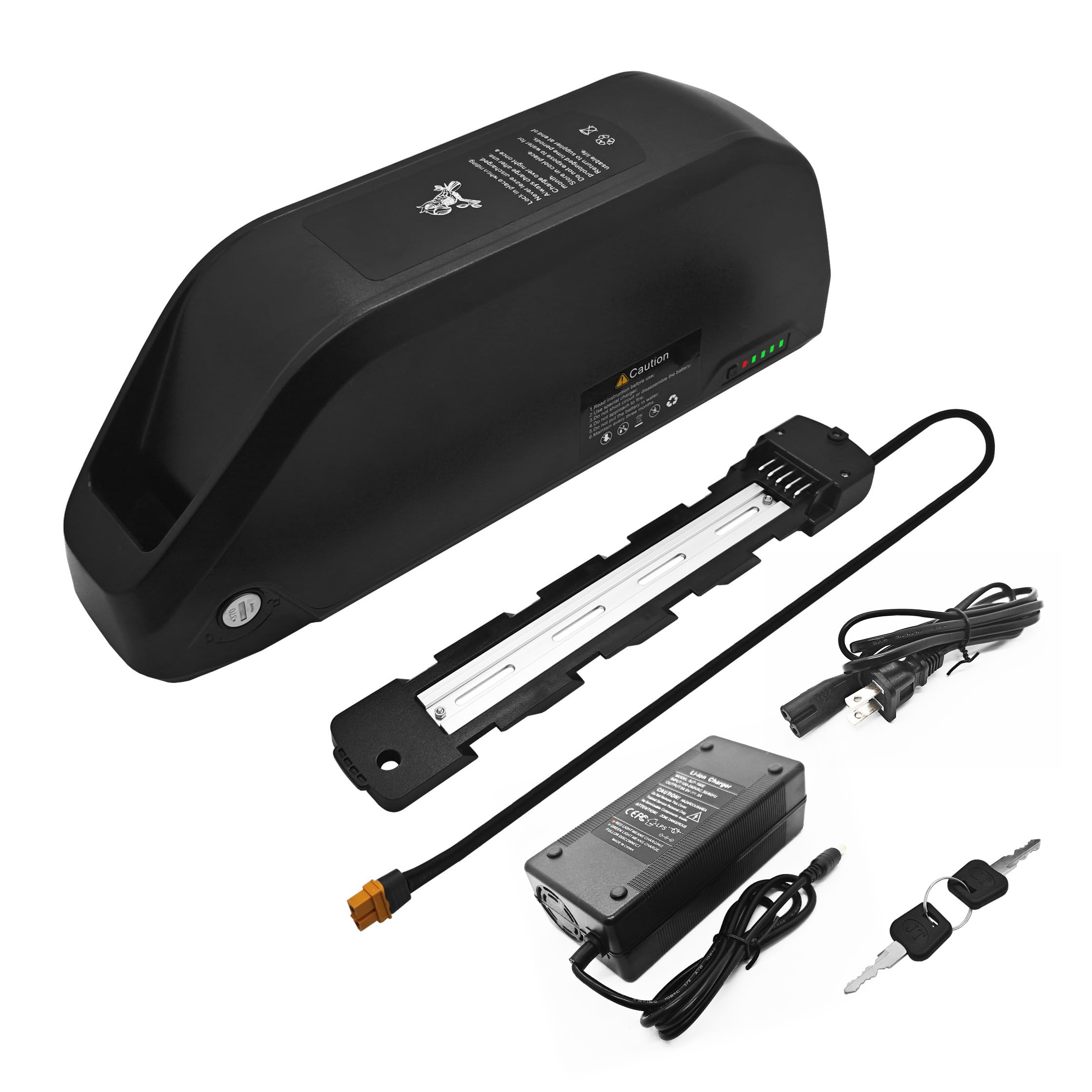
Common lithium-ion cell chemistries include Lithium Cobalt Oxide, Nickel Manganese Cobalt, and Lithium Iron Phosphate. Each of these materials is carefully selected to meet specific energy requirements so that the pack can:
- Maximize the range you get out of every charge
- Deliver the specific power needed to climb hills and push through obstacles with ease
- Provide safe, stable performance under demanding conditions
What Is the Lifespan of an E-Bike Battery?
An e-bike battery naturally loses capacity over time, even when it is not actively in use. This means that lithium-ion packs will gradually lose some of their capacity regardless of riding habits.
A Quick Story to Illustrate
- George purchases a 250W electric bike conversion kit and installs a 48V 13Ah battery. He converts his regular bicycle into an e-bike and rides it for a week, charging it twice. When rainy season begins, he stores the bike in his garage.
- Exactly 365 days later, George pulls the bike out for a neighborhood ride. The pack was left fully charged, but capacity has dropped to 80%. George now covers roughly 20% less distance than he did on day one.
Lithium-ion battery packs have varying lifespans depending on the quality of cells used and several key factors, such as:
How quickly or slowly the battery is charged each cycle.
How far down the battery is drained before recharging.
The voltage level applied during each charge cycle.
Ambient temperature during charging and discharging.
Lithium-Ion Cell Manufacturers
Panasonic and LG have built strong reputations for high-quality cells, largely because of their excellent charge-cycle counts. Their lithium-ion cells typically deliver around 1,000 charge cycles, while top-grade Chinese premium cells reliably hit 850+ cycles.
This means that if George rode and charged his bike daily, a quality e-bike battery pack should power him through roughly three years of everyday commuting.
Replacing Your Electric Bike Battery
Swapping an old e-bike battery for a new one is straightforward once you confirm three essential details about the pack you're replacing:
If you need extra range, choose a pack with a higher amp-hour rating. Remember that the battery's voltage and Ah rating directly affect the price, and the cell chemistry chosen by the manufacturer also plays a role in the final cost.
Ready for Off-Road Freedom?
Experience long-range adventure with a 48V 13Ah (or 26Ah) pack built into a rugged all-terrain frame.
Shop ENGWE M20Explore our full range of e-bikes and find the one that fits your ride, your route, and your lifestyle.