

"Less is more" — a principle that increasingly guides how we think about off-grid adventures. When it comes to portable power, the goal is always to find the most capable solution that also happens to be the lightest, most compact, and most affordable.
Over the years we've tested a wide variety of portable power stations, each offering a unique blend of strengths and trade-offs. There truly is no one-size-fits-all answer — it depends entirely on your specific camping setup and power needs.
Our mission when evaluating gear is not to hunt for flaws, but to work with inherently well-built products and explore how their features perform in real-world conditions — particularly the kind of multi-day, off-grid road trips that we love.
Portable power independence is central to off-grid travel. The unit we tested sits in a sweet spot: enough AC output for serious appliances, sufficient battery capacity for overnight stays, compact dimensions, reasonable weight, and a price that doesn't break the bank. Let's explore what it offers in detail.
Key Highlights at a Glance
✓ 1000W continuous AC inverter with 2000W power lifting
✓ 768Wh LiFePO4 battery capacity
✓ 3,000+ charge cycles at 80% capacity
✓ 950W turbo AC charging — 0 to 80% in 45 min
✓ 500W solar input — full charge in ~2 hours
✓ Just 10.2kg — compact and portable
✓ 5-year manufacturer warranty
1000W Continuous AC Inverter
With a 1000-watt pure sine wave inverter built in, this unit can deliver clean AC power capable of running a surprisingly wide range of appliances. That is significantly more headroom than many smaller units offer.
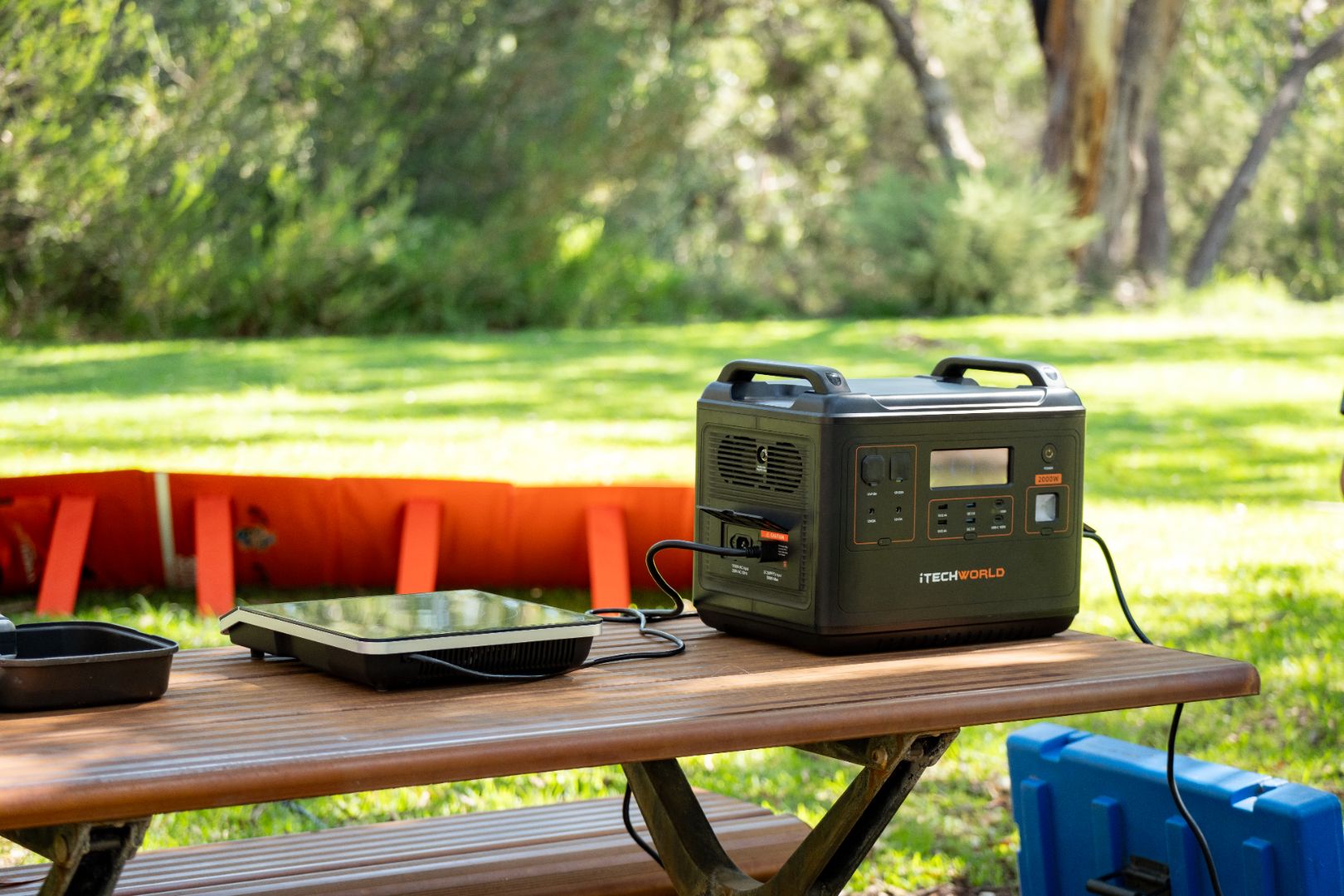
An induction cooktop, for instance, may pull up to 2000W at full blast — but by dialing it down to the 600W–1000W range, it runs comfortably within the station's output. That means you can genuinely cook full meals at camp: fajitas for dinner, bacon and eggs for breakfast.
The clean sine wave output also makes it safe for sensitive electronics — laptops, CPAP machines, camera chargers, and video projectors all run without issue.

2000W Power Lifting Mode
Certain appliances that technically draw more than 1000W can still be operated using the Power Lifting feature, which is toggled through the companion smartphone app.
This mode is designed for high-draw resistive loads — devices that primarily use a heating element rather than complex electronics. Think hair dryers, electric kettles, fan heaters, toasters, and electric blankets.
Naturally, running devices at these higher wattages will drain the battery faster. On cold nights, it may be smarter to heat water for a hot water bottle than to run an electric blanket all night.
768Wh Battery Capacity
Battery capacity is one of those things you can never have too much of when camping — but in practice, more capacity means more weight and more cost. The key is finding the right balance for your style of trip.
For multi-day road trips where you stay one or two nights at each location before moving on, 768Wh turns out to be a solid sweet spot. You need enough power to handle camp duties — cooking meals, charging devices, running lights — before recharging on the drive to the next stop.

During a real-world camping test, cooking dinner and breakfast the next morning consumed roughly 75% of the battery. The remaining 25% went toward boiling a kettle and recharging camera batteries. The conclusion: 768Wh is enough — but you do need to be mindful of your power consumption habits.
Using a heavier-based frying pan that retains heat better and keeping the induction cooktop on the lowest 600W setting would squeeze even more efficiency from the battery. Pair that with solar top-ups during the day, and it becomes a very workable setup.
Expand Your Capacity with Add-On Batteries
If 768Wh isn't quite enough, the system supports expansion batteries connected via a dedicated cable to form a modular power system.

The modular approach has several practical advantages:
▶ Budget-friendly phasing: Buy the main unit now and add expansion batteries later as your needs grow.
▶ Flexible packing: If a shorter trip doesn't need the extra power, simply leave the expansion battery at home.
▶ Independent DC power: The expansion battery can run 12V devices like a camping fridge on its own.
▶ Manageable weight: Two 10kg units are far easier to move than one 20kg+ monolith.
Larger expansion batteries offering 2048Wh or even 3072Wh are also compatible for those who need serious off-grid capacity.
3,000+ Charge Cycles & Long-Lasting LiFePO4
The unit employs Lithium Iron Phosphate (LiFePO4) battery chemistry — the gold standard for longevity in portable power. You can drain and recharge it 3,000 times and it will still hold around 80% of its original capacity.
To put that in perspective: even if you fully cycled the battery every single day, it would take over 8 years before reaching that threshold. Compare that to traditional lead-acid or deep-cycle batteries, which typically degrade significantly within just a few years of regular use.
Compact Design — Just 10.2kg
Larger portable power systems can easily exceed 20kg, making them awkward to move around and difficult to store. At just over 10kg, this unit is light enough to reposition easily and compact enough to tuck behind a seat — out of sight and out of direct sunlight.
When every kilogram counts in your rig, hauling a massive battery pack just for the sake of surplus capacity defeats the purpose. A lighter, properly-sized system paired with reliable recharging options — solar and in-vehicle AC charging — is the smarter approach.

5-Year Warranty Included
While most consumer electronics ship with a standard 1-year warranty — sometimes extendable at extra cost — this unit arrives with a full 5-year warranty right out of the box.
Combined with the 3,000-cycle battery, this means you could use it daily for the entire warranty period without wearing out the battery, and you'd be fully covered against defects the whole time. That's genuine peace of mind for a piece of gear you're relying on in the field.
950W Turbo AC Charging — 0% to 80% in 45 Minutes
When plugged into a standard wall outlet and set to Turbo Mode, the unit pulls up to 950W of charging power. That takes the battery from empty to 80% in roughly 45 minutes and reaches a full charge in about an hour.
For on-the-road charging, a 1000W AC inverter installed in the vehicle can deliver 400–500W in Standard Charging Mode, which takes the battery from zero to full in under two hours without overloading the alternator. That makes between-camp top-ups effortless.
500W Solar Charging — Full Charge in 2 Hours
One of the biggest leaps forward in this generation of portable power stations is the dramatically faster solar charging. With up to 500W of solar input, a full charge from zero takes approximately two hours in good conditions.
This makes rooftop-mounted solar panels on your vehicle, van, or trailer a game-changer. Even a quality portable panel can keep the battery topped up throughout the day, effectively giving you unlimited power on extended off-grid trips.

Smartphone App Control
A companion smartphone app provides remote monitoring and control of the entire system. From your phone, you can check the charge level, see real-time power input and output, and toggle the AC or DC outputs on and off — which is worth doing when they're not in use, since leaving them active causes a slow battery drain.
The app also lets you switch between charging modes, enable or disable the Power Lifting feature, activate ECO mode, configure the auto sleep function, and install firmware updates.

UPS Mode — Uninterruptible Power at Home
When you're not out in the field, the unit doubles as an uninterruptible power supply (UPS) for your home. Plug in critical devices — like your internet modem or home computer — and keep the station connected to mains power.
Under normal conditions, mains power flows straight through to your devices while the internal battery stays at 100%. If there's a power outage, the station switches instantly to battery mode, keeping everything running seamlessly until power is restored.
This is particularly handy during local blackouts caused by storms or accidents — your broadband connection often stays active even when the power lines go down, so maintaining power to your modem means you keep internet access while the neighborhood goes dark.
Three AC Charging Modes
The unit offers three distinct AC charging modes, each balancing speed and noise differently:
Silent Mode — The slowest charge rate, producing only 45dB from the cooling fan. Perfect for overnight charging at camp or in the vehicle when you need near-silence.
Standard Mode — The default balanced mode, suitable for everyday charging situations.
Turbo Mode — Maximum charging speed when mains power is available and time is short. Best used sparingly, as rapid charging generates more heat and can reduce long-term battery life.
What Can It Power?
With a 768Wh LiFePO4 battery and 1000W pure sine wave inverter, the station delivers clean AC power through its outlets. This is ideal for sensitive electronics like laptops and camera chargers. In Power Lifting Mode, it can handle resistive loads up to 2000W — hair dryers, kettles, toasters, and similar appliances.
Keep in mind that total output is shared across all connected devices. If one appliance is near the maximum, others may need to wait their turn. The general rule: choose low-wattage versions of appliances whenever possible to stretch battery life further.
| Works Great ✓ | Possibly ? | Not Recommended ✗ |
|---|---|---|
| LED Lights | Small Microwave | Air Conditioner |
| Phones & Tablets | Electric Frypan | Large Kettle (2000W+) |
| Laptops | Electric Grill / BBQ Plate | Large Microwave |
| Camping Fridge/Freezer | Air Fryer | |
| Fans | Espresso Machine | |
| Small Kettle (1000W) | Electric Wok |
Final Thoughts
For off-grid adventurers who value a balance between power, portability, and price, a 1000W portable power station with 768Wh of LiFePO4 battery capacity hits a genuine sweet spot. It can cook meals, charge devices, run lights, and even serve as a home UPS — all in a package that weighs about 10kg.
Pair it with solar panels and in-vehicle AC charging, and you have a reliable, self-sustaining power system that lets you stay off-grid for as long as the road stretches ahead. With a 5-year warranty and 3,000+ charge cycles, it's built to be a long-term companion for your outdoor adventures.