

Getting Started with Battery Banks
When you're building an off-grid power system, understanding how batteries connect together becomes absolutely crucial. A single battery might work fine for small applications, but larger setups demand multiple batteries working in harmony. The way you wire these batteries together determines both the voltage output and the overall capacity of your system.
Many newcomers to solar and off-grid living find battery configuration confusing at first. Should you wire in series? Parallel? Perhaps a combination of both? Each approach has distinct advantages and specific use cases. This guide breaks down everything you need to know about connecting batteries properly.
Before diving into the technical details, it's worth noting that proper battery configuration can mean the difference between a system that runs smoothly for years and one that fails prematurely. Taking time to understand these concepts pays dividends in system reliability and longevity.
Why Configuration Matters
The way batteries connect directly impacts two critical specifications: total voltage and total amp-hour capacity. Getting this wrong doesn't just reduce efficiency—it can damage your batteries and connected equipment, potentially creating safety hazards.
Understanding the fundamentals of series and parallel connections allows you to design systems tailored to your exact requirements. Whether you need higher voltage for specific inverters or greater capacity for extended runtime, proper configuration makes it possible.
Series Connection: Boosting Voltage
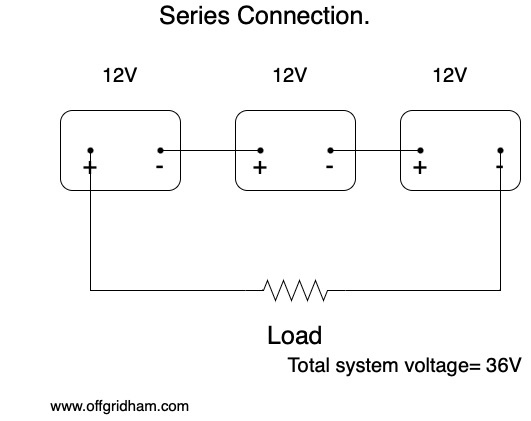
A series connection links batteries by connecting the positive terminal of one battery to the negative terminal of the next. This daisy-chain arrangement increases the total system voltage while keeping amp-hour capacity unchanged.

For example, connecting three 12-volt batteries in series produces a 36-volt system. If each battery has a 100Ah capacity, the combined system still offers 100Ah—but at 36 volts instead of 12. This higher voltage is essential for certain applications, particularly larger inverter systems and some specialized equipment.
Key Point: Series connections add voltages together. Three 12V batteries = 36V total. Amp-hour capacity remains the same as a single battery.
The primary advantage of series wiring is achieving the voltage requirements of your inverter or charge controller without purchasing expensive high-voltage batteries. Most residential solar systems operate at 24V or 48V, making series connections nearly universal in these applications.
Parallel Connection: Expanding Capacity
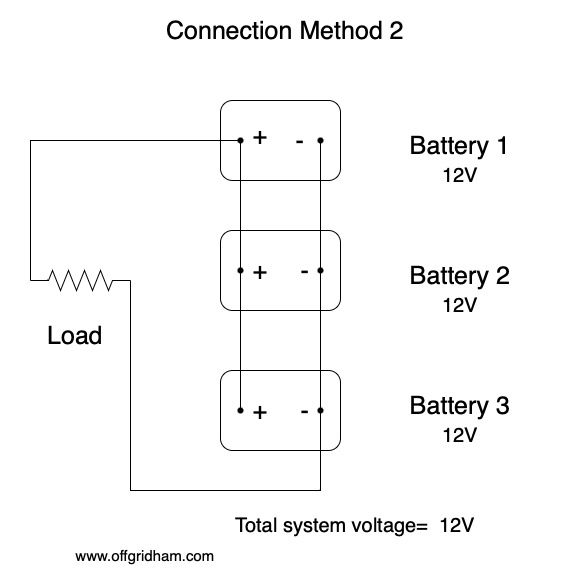
Parallel connections take a different approach. Here, you connect all positive terminals together and all negative terminals together. This configuration increases amp-hour capacity while maintaining the original voltage.
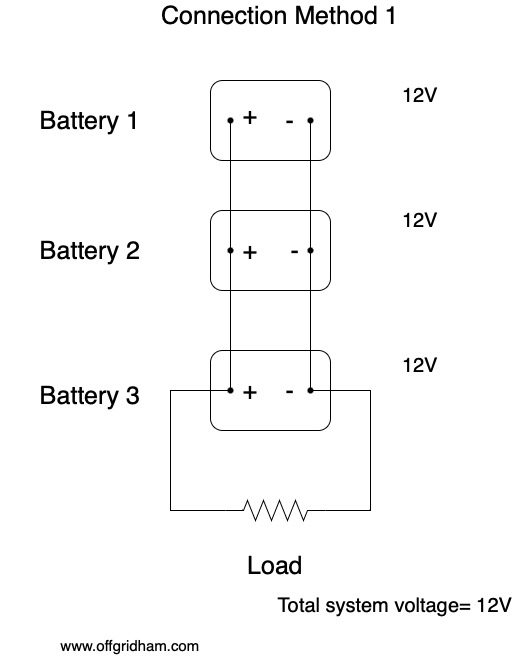
Consider three 12-volt, 100Ah batteries wired in parallel. The resulting bank delivers 12 volts with a combined capacity of 300Ah. This tripled capacity means significantly longer runtime before recharging becomes necessary.
Key Point: Parallel connections add amp-hour capacities together. Three 100Ah batteries = 300Ah total. Voltage stays the same.
Parallel configurations excel when you need extended battery life at a specific voltage. They're particularly useful for 12V systems powering RVs, boats, or small cabins where the equipment operates at 12 volts but demands substantial capacity for off-grid periods.
Combining Series and Parallel Connections
Real-world installations often require both higher voltage and greater capacity. This is where series-parallel configurations shine. By combining both connection methods, you can achieve virtually any voltage and capacity combination.
The approach is straightforward: first create series strings to achieve your desired voltage, then connect multiple strings in parallel to build capacity. For instance, if you need a 24V system with 200Ah capacity using 12V 100Ah batteries, you would create two series pairs (each producing 24V at 100Ah), then wire those pairs in parallel.
This method provides tremendous flexibility in system design. Large off-grid homes and commercial installations routinely use series-parallel configurations with dozens of batteries to meet demanding power requirements.
Critical Considerations for Battery Banks
Matching Batteries
Never mix batteries of different ages, capacities, brands, or types in a bank. Mismatched batteries create imbalances that accelerate degradation and can cause premature failure. When one battery in a bank performs differently than others, it drags down the entire system's performance and lifespan.
Wire Sizing
Proper wire gauge is non-negotiable. Undersized wires create resistance, generate heat, and waste energy. Worse, they pose fire hazards. Always size your interconnect cables appropriately for the current they'll carry, and keep cable lengths as short and uniform as possible.
Balance Charging
Battery banks benefit from charge controllers or battery management systems that ensure even charging across all cells. This is especially important for lithium battery banks, where cell imbalance can lead to undercharging some cells while overcharging others—a recipe for reduced lifespan and potential safety issues.
Common Mistakes to Avoid
Mixing old and new batteries: Even batteries of the same model perform differently as they age. Adding new batteries to an old bank forces the new ones to compensate for degraded cells, shortening their lifespan dramatically.
Incorrect terminal connections: Double-check every connection. Reversing polarity or creating accidental short circuits can damage batteries instantly and create dangerous situations.
Ignoring temperature considerations: Batteries perform differently at various temperatures. Systems should account for temperature variations and may need compensation settings on charge controllers.
Skipping fuses and disconnects: Every battery bank needs appropriate overcurrent protection and a means to safely disconnect for maintenance. This isn't optional—it's essential for safety.
Practical Applications
Understanding when to use each configuration helps you design better systems:
RVs and Marine: Typically use 12V parallel systems for compatibility with existing 12V equipment. Capacity needs vary based on usage patterns and shore power availability.
Off-Grid Cabins: Often benefit from 24V or 48V series-parallel configurations. Higher voltages reduce wire losses over distance and work efficiently with larger inverters.
Whole-Home Solar: Frequently operate at 48V with substantial series-parallel battery banks. These systems demand careful design to handle high power loads reliably.
Portable Power Stations: Most use internal parallel configurations to maximize capacity in compact form factors, with built-in management systems handling the complexity.
Power Your Off-Grid System
Pair your battery bank with high-quality solar panels for reliable, sustainable energy generation. Our rigid solar panels deliver exceptional efficiency and durability for permanent installations.
EcoFlow 400W Rigid Solar PanelFinal Thoughts
Mastering battery connections opens up possibilities for building robust, efficient power systems tailored to your specific needs. Whether you're setting up a simple backup system or designing a comprehensive off-grid installation, the principles remain the same: series for voltage, parallel for capacity, and combinations for both.
Take time to plan your battery bank carefully. Consider your voltage requirements, capacity needs, available space, and budget. Invest in quality batteries from reputable manufacturers, and always prioritize safety with proper fusing and disconnects.
With the knowledge from this guide, you're equipped to make informed decisions about your energy storage system. Start with understanding your load requirements, choose the appropriate configuration, and build a system that serves you reliably for years to come.