


Every square foot of warehouse space carries a cost. How you organize that space can make or break your daily workflow — whether you're juggling bulk raw materials, seasonal inventory, or finished goods ready to ship. That's exactly why storage racking systems have become a non-negotiable part of modern operations. They're far more than metal frames collecting dust; they're the structural backbone of efficient logistics.
Consider what happens when storage is disorganized: products get damaged, picking times balloon, and your team grows frustrated. On the other hand, the right racking setup — whether stackable or traditional — can slash errors, boost throughput, and reduce labor overhead. With the rise of flexible, on-demand warehousing, selecting the proper system has never been more critical.
Whether you're constructing a brand-new warehouse or refreshing an existing layout, understanding the distinctions between stackable rack systems and fixed pallet racking is essential. It's not simply about choosing a shelf — it's about engineering a system that actively supports your business goals.
A Quick Look at Racking and Stacking in Modern Warehouses
"Racking and stacking" isn't just warehouse jargon — it represents the evolution of storage from basic shelving to high-capacity systems engineered to handle massive loads while squeezing the most out of both vertical and horizontal space.
At the core, there are two major categories. Stackable rack systems are portable, modular units that can be placed on top of one another when loaded and nested compactly when empty. Traditional pallet racks, in contrast, are permanent installations with standardized beam-and-frame construction designed for long-term use.
Each approach carries distinct advantages. Stackable racks are prized for mobility and ease of reconfiguration — just pick them up with a forklift and rearrange. Pallet racks, meanwhile, deliver exceptional durability and support for heavy-duty, high-volume environments. Understanding these core differences is the first step toward making the best investment for your facility.
What Exactly Is Stack Racking?
Core Features of Stackable Racks
Stackable racks — sometimes called stacking racks or conduit racks — are modular storage units built for easy stacking, storage, and transport of palletized goods. Unlike traditional fixed racks that are bolted to the floor, stackable racks are freestanding. They typically feature removable posts or frames, allowing them to stack vertically when loaded or nest together when idle, freeing up valuable floor space.
Constructed from heavy-gauge steel, these racks can handle substantial weight while still being mobile enough to reposition with a forklift — no unloading necessary. Whether you opt for a portable stacking rack or a heavy-duty conduit rack, you're investing in operational agility.
Portability
Effortlessly repositioned anywhere inside the warehouse using standard forklifts.
Custom Configurations
Tailored to accommodate specific load sizes, product types, or conduit dimensions.
Stackability
Multiple units can be stacked when full or nested compactly when empty.
Durability
Engineered to bear heavy loads while maintaining full mobility and structural integrity.

Why Stackable Racks Are a Game-Changer
The defining advantage of stackable racking is versatility. Picture this: you need to completely reconfigure your warehouse layout to handle a seasonal surge. With traditional pallet racking, that could take days of labor and downtime. With stackable racks, your crew can reorganize the floor in hours — sometimes even faster.
Here's what makes them stand out:
Flexibility — When inventory runs high, stack them vertically. When demand drops, nest them and reclaim the floor space.
Mobility — Since they're not bolted down, moving them from one zone to another is as simple as loading with a forklift.
Scalability — Expanding operations? Just add more racks. No structural redesign required.
Space Optimization — Particularly effective in smaller or irregularly shaped warehouses where every square foot counts.
These traits make stackable racks a natural fit for industries dealing with fluctuating stock levels, seasonal demand spikes, or rapid-pace logistics — including construction, automotive, and manufacturing operations.
Where Stackable Racks Excel: Common Use Cases
Stackable racks thrive in environments where adaptability and space conservation are top priorities. Some of the most popular applications include:
Seasonal Inventory
Retailers and distributors prepping for holiday rushes can deploy stackable racks for temporary stock, then nest them when the season passes.
Cross-Docking Operations
Perfect for short-term holding during inbound and outbound logistics at transfer hubs.
Cold Storage & Freezers
Non-permanent design allows layout adjustments in temperature-controlled zones without major disruption.
Construction Parts & Conduit
Stackable conduit racks are a favorite among contractors and suppliers who need quick, organized access to rotating stock.
Overflow Storage
Portable stacking racks are ideal for absorbing surplus stock when your permanent racks are at capacity.
What Are Traditional Pallet Warehouse Racks?
Key Components and Construction
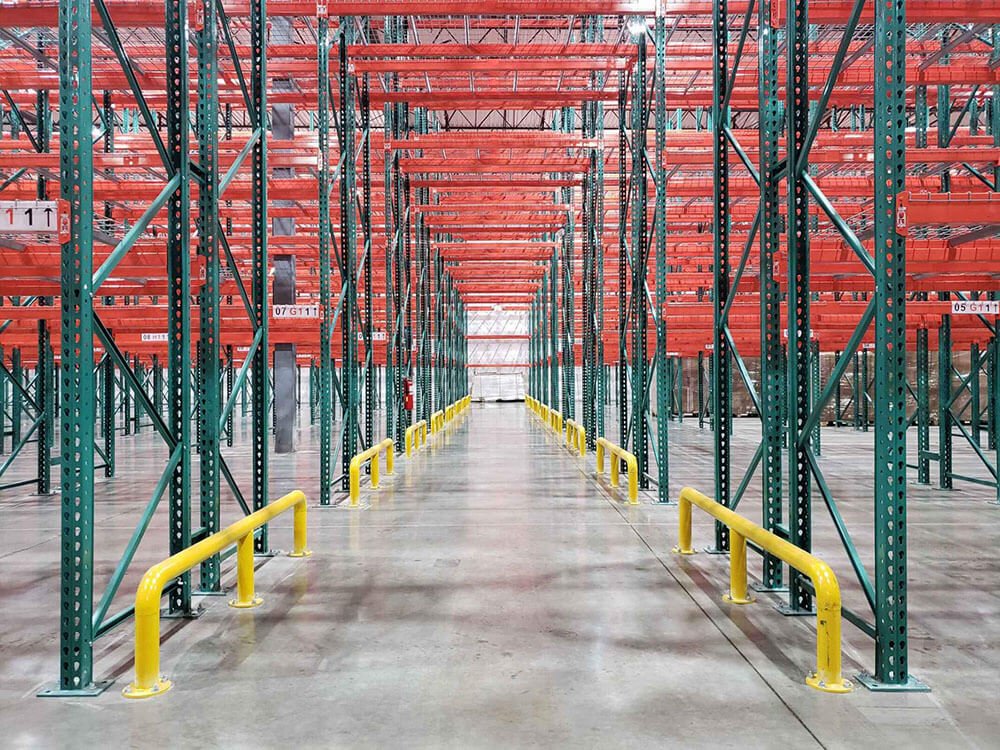
Traditional pallet racking systems are the time-tested workhorses of warehouse storage. Typically constructed from upright frames, horizontal beams, and wire decking, these systems form structured aisles of shelves designed to hold palletized goods with direct forklift access.
These racks are permanently installed and usually require floor anchoring for safety and proper load distribution. They're the default choice for warehouses storing heavy, slow-moving, or non-seasonal inventory.
Common configurations include:
Selective Racks — Provide direct access to every single pallet in the system.
Drive-In / Drive-Thru Racks — Maximize storage density by minimizing aisle space.
Push-Back & Pallet Flow Racks — Support FIFO and LIFO inventory management strategies.
Stackable Racks vs. Traditional Pallet Racking: The Full Comparison
Flexibility & Portability
When it comes to adaptability, stackable racks dominate. They can be repositioned, relocated, and reconfigured without tools or heavy equipment — ideal for businesses facing fluctuating inventory levels, seasonal shifts, or temporary warehousing demands.
Traditional pallet racks, by contrast, are built to remain fixed. Once installed, moving them requires significant labor, downtime, and sometimes professional assistance. While this permanence offers stability, it severely limits flexibility in fast-changing environments.
Stackable racks are also the clear winner for businesses leasing temporary spaces or running pop-up warehouse operations. Since they're not anchored, disassembly and transport is straightforward — a true plug-and-play storage solution.
Stackable Racks
Mobile · Modular · Adaptable
Traditional Racks
Fixed · Stable · Structured
Space Efficiency & Scalability
Operating in a tight footprint? Stackable racks offer efficiency that permanent systems struggle to match. When not in use, they nest together compactly, releasing valuable floor space for other operations.
Fixed pallet racking, however, occupies its footprint whether fully loaded or completely empty. Those unused racks still consume square footage — a real drawback in smaller or more flexible facilities.
Scalability also tips in favor of stackable systems. Need extra capacity? Simply add more racks. They grow alongside your inventory without requiring a full structural overhaul.
Cost & Investment Considerations
Upfront, stackable racks can appear comparable in price — or even marginally higher per unit — than traditional pallet racks. But the long-term savings tell a different story. Reduced installation costs, minimal maintenance, and reusable flexibility across locations create significant value over time.
Traditional systems often demand professional installation, anchoring, and structural reinforcement — particularly for large-scale setups. Stackable racks bypass all of that, requiring minimal assembly and zero permanent installation.
For temporary warehousing or project-based storage, stackable racks deliver an ROI that fixed systems simply can't compete with. The ability to buy, use, relocate, or resell them adds a layer of financial flexibility that permanent racking lacks.
Safety & Load Management
Both systems are safe when used correctly. However, stackable racks offer a unique perk: the ability to move loaded racks without unloading first. For time-sensitive logistics operations, that's a major efficiency win.
Pallet racks, meanwhile, provide superior support for ultra-heavy, static loads. Their anchored foundation maintains stability even during seismic events or very high stacking scenarios, making them the go-to for large, dense inventory facilities.
That said, stackable rack systems do require careful weight distribution planning. Improper loading or over-stacking can lead to safety incidents. Traditional racks, once properly installed, generally offer more consistent stability for long-term, heavy-load applications.
How to Choose the Right Racking System for Your Warehouse
Assess Your Warehouse Layout and Available Space
Before committing to either option, take a thorough inventory of your physical space. How much floor area is available? What's the ceiling height? Are there structural irregularities or layout constraints to work around?
Stackable racks perform exceptionally well in small, irregular, or multi-purpose facilities. Since they can be moved at will, they adapt to your layout rather than forcing you to redesign around them. They're especially valuable in temporary warehouse setups or overflow zones where permanent construction doesn't make sense.
Traditional pallet racks, while excellent for high-density storage, work best in large, open environments with consistent layouts. They need forklift aisles and adequate headroom for vertical stacking to function properly.
Pro Tip
If your operation is growing or evolving rapidly, flexibility is worth its weight in gold. Stackable racks let you test and refine your warehouse flow before committing to permanent installations.
Evaluate Your Inventory Type and Load Requirements
What you store should directly influence what you use. Are you handling heavy raw materials, fragile goods, or lightweight packaged products? Different inventory profiles demand different racking solutions.
Stackable Racks Shine With:
• Bulky or awkwardly shaped items
• Frequently rotating inventory
• Seasonal or promotional goods
• Items requiring on-site mobility
Traditional Racks Handle:
• Heavy or high-volume goods
• Long-term static storage needs
• High-reach forklift access
• FIFO/LIFO inventory systems
If your warehouse handles a blend of fast-moving and slow-moving products, combining both systems is often the smartest play for maximum efficiency.
Consider Your Operational Workflow and Access Needs
Think carefully about how your team interacts with stored products. Is access frequent or infrequent? Do you need multi-directional access, or do forklifts typically approach from a single aisle?
Stackable racks offer 360-degree access, making them ideal for manual picking, reorganization, and quick load/unload cycles. Their open design minimizes handling time and reduces bottlenecks.
Traditional racks are structured for orderly, repeated access from a consistent direction — typically a single aisle. This makes them well-suited for systematic storage and predictable, routine workflows. The bottom line: the right system is the one that supports your daily operations rather than working against them.
Final Verdict: Finding the Best Fit for Your Operation
So which system deserves a place in your warehouse — stackable racks or traditional pallet racking?
The honest answer: it depends on your operation. If you need flexibility, mobility, and the ability to scale up or down rapidly, stackable racks are tough to beat. They're purpose-built for dynamic environments, seasonal inventory swings, and facilities with limited or shared space.
If your priority is unshakeable stability, maximum density, and heavy-load capacity for long-term storage, traditional pallet racking remains the gold standard. It's the ideal pick for large facilities with predictable inventory patterns and fixed layouts.
But here's a thought: why choose just one? Many of today's top-performing warehouses run a hybrid system — stackable racks absorb the chaos and handle fluctuation, while fixed pallet racks provide the permanent backbone. By understanding your inventory, layout, and growth trajectory, you can build a storage system that delivers on efficiency, safety, and real value.
Frequently Asked Questions
1. How much weight can a stackable rack support?
Most stackable racks are rated between 2,000 and 4,000 pounds per unit, depending on the design and material specs. Always check the manufacturer's load ratings and ensure balanced loading for safe operation.
2. Can stackable racks and pallet racks coexist in the same warehouse?
Absolutely. Many operations run a hybrid setup where stackable racks handle temporary or seasonal stock while fixed pallet racks manage long-term inventory. It's one of the most effective ways to balance flexibility with stability.
3. How easy is it to move and reconfigure stackable racks?
Very easy. Stackable racks are designed for portability — most can be repositioned with a standard forklift even while loaded. Reconfiguring your entire layout takes minutes, not the hours or days required by traditional systems.
4. What's the typical lifespan of a stackable rack?
With proper care, stackable racks can last 10 to 15 years — and often longer. Routine inspections and staying within rated load limits will significantly extend their useful life.
5. Which industries benefit most from stackable racking?
Stackable rack systems are especially valuable for industries dealing with seasonal inventory, fluctuating stock volumes, or space limitations — including construction, retail, automotive, logistics, and food service.
© Backyard Provider — Your source for outdoor living, construction equipment, and backyard solutions.