


Since the beginning of modern manufacturing, businesses have searched for the most efficient methods to store their inventory — raw materials, finished products, tooling, consumables, and supplies. For many standard-sized goods, the humble pallet does the job beautifully. Palletizing standardizes and unitizes storage, making items simpler to handle and organize. When pallet sizes align with rack dimensions and forklifts can manage the weight, the result is excellent storage density with easy access.
However, long loads like pipe and tubing are the exception. They are typically too lengthy and too heavy to be palletized efficiently. The good news is that multiple storage systems have been developed specifically for these kinds of materials. Selecting the right one depends on balancing several key factors: safety, storage density, accessibility, and cost — ranked here from 1 (least favorable) to 5 (most favorable).
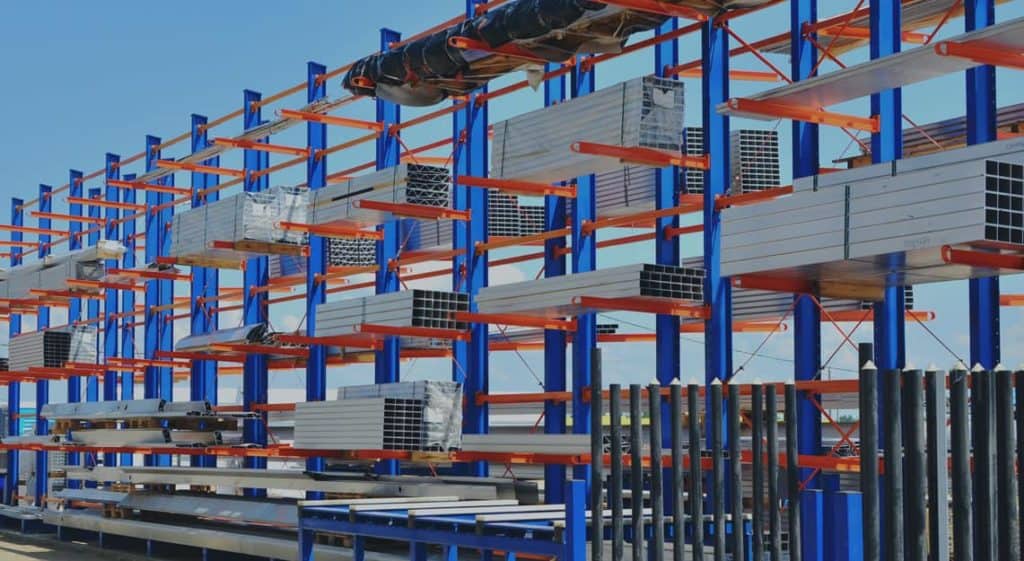
Cantilevered Tube and Pipe Racks
A cantilevered system is the go-to solution for storing long parts. These racks can be set up indoors or outdoors, come in virtually limitless configurations and load capacities, and are cost-effective given their blend of storage density, accessibility, and safety.
Cost — Cantilevered racks are among the most affordable pipe storage methods available. Pricing can range from a few hundred dollars to several thousand per rack, depending on the height, weight capacity, and overall length. Even when a standard off-the-shelf unit does not match the application, having one custom-engineered is typically not cost-prohibitive. Because of the inherent durability of these structures, they tend to last for many years, even under harsh outdoor conditions.
Space Efficiency — While cantilevered racks can accommodate a broad variety of product shapes and sizes, long items like pipe and tubing are truly their sweet spot. The rack excels at utilizing vertical space, meaning it takes up less floor or yard area compared to alternative methods. The rack allows users to store items vertically, and if there is a need for more capacity, additional levels can simply be built upward. The only real limit is the reach height of the forklift or crane used to load and retrieve materials.
Load Accessibility — A cantilevered system provides excellent access to every storage level on the rack at all times. Items can be loaded or unloaded with forklifts, overhead hoists, or by hand. Certain positions may present minor challenges when handling operations are performed at ground level, but this is a small trade-off given the ease of access overall.
Safety — When properly specified for the intended load, cantilevered racks can support extremely heavy materials. They are widely regarded as a safe option for storing, loading, and unloading. Workers should always exercise caution when handling large, unwieldy, long items regardless of the rack type in use. While elevated loads can potentially fall due to mishandling or equipment malfunction, such incidents are rare when the rack is correctly specified, properly used, and routinely inspected.
Crank-Out Cantilevered Racks
Crank-out racks share many of the same design features and accessibility benefits as standard cantilevered racks, but with the added advantage of potentially greater storage density for heavy, long loads.
Cost — Crank-out racks tend to be more expensive than their static counterparts. These racks are typically deployed in high-density applications where maximizing floor space is more important than minimizing cost. They are often found in manufacturing environments where rapid access to stored materials is critical to keeping production lines running smoothly. As such, they represent the most premium option among pipe storage rack systems.
Space Efficiency — This is where crank-out racks truly shine. They retract the load directly into the rack structure, enabling tight, unitized storage of long items like steel tubes and pipes. When positioned near fabrication equipment, they help minimize machine idle time and maximize the usable square footage in and around work cells.
Load Accessibility — Crank-out racks provide complete access to all stored items, 100% of the time. Lighter loads are typically retrieved by hand, while heavier or bulkier materials are handled using hoists. The ability to extend the rack arms outward ensures workers can access materials without overreaching, reducing the risk of strain injuries.
Safety — Crank-out racks have an excellent safety record. Because materials are retracted into a single rack unit, the risk of loads spilling or dropping is greatly reduced. The extendable arms allow workers to position themselves properly rather than reaching into awkward angles, which contributes to fewer workplace injuries and lower workers' compensation claims. Additionally, only one level of a crank-out rack can be extended at a time — a built-in safety feature that prevents the rack from tipping over.
Stacking Pipe and Tube Storage Racks
Stacking racks come in a wide variety of configurations and are designed to handle long-load storage applications. Unlike cantilevered systems, stacking racks are not permanently anchored in place, giving them an edge in environments where inventory is frequently rotated and the storage layout needs to adapt quickly.
Cost — Stacking racks generally cost less than cantilevered racks, though they are not always inexpensive. The initial investment must account for additional units if the operation requires higher stacking heights or heavier weight capacities. They offer good capabilities that support loads ranging from 2,500 to 7,500 pounds. For heavier loads, additional racks can be added to expand capacity.
Space Efficiency — Stacking racks can deliver fairly dense storage. Depending on the type, they can be layered four to six levels high. While they do not match the vertical utilization of a cantilevered system, they do not require the same degree of permanent infrastructure either. Their modular nature makes them well suited for facilities that frequently rearrange their storage layout.
Load Accessibility — Accessibility is somewhat limited. Stacking racks can be stacked up to 10 units high, depending on the configuration. However, most stacking rack designs only allow access to the top layer, meaning the layer above must be removed before reaching the load beneath. The pipe or tube must also be pulled out from the end. One useful option is to forego the uppermost layers entirely, keeping all materials at lower, more accessible levels — though this sacrifices some storage density.

Safety — Stacking racks are loaded and unloaded by hand or with mechanical equipment. This is generally safe as long as the racks are not overfilled or stacked beyond the manufacturer's recommended limits. Racks should never be loaded with materials that are too long or heavy for their rated capacity. Forklifts can be used to load and unload stacking racks by sliding the forks beneath the pipe and between two columns of the rack. Because the racks are modular and not anchored, a driver must exercise care — one wrong move can topple a stacking rack or series of racks.
When applied to the right load and the right situation, stacking racks are a solid, cost-effective storage solution within their capacity range. The key is to always verify that the rack specifications match the load requirements.
Floor and Ground Storage
When tube, pipe, and other long products are placed on a floor, they are often arranged on or between structures such as pillars, bollards, or posts to prevent sliding and rolling. Floor storage is a practical option when the materials are too heavy or bulky for conventional racking, or when items need to be near processing equipment for quick hand access.
Cost — Placing inventory directly on the floor or ground is about as inexpensive as it gets — essentially free. The main requirement is having a large enough area to accommodate the load. Ideally, the secondary requirement is an organized system of bollards or similar barriers to keep things from shifting or rolling.
Space Efficiency — A stock of inventory laid flat on the floor has a natural vertical limit, meaning this method makes poor use of overhead space. It also consumes floor area that could otherwise be used for other purposes. Storing loads in a single stack is problematic because it wastes vertical space when items at the bottom of the pile are needed first.
Load Accessibility — Depending on the size and number of items, the load may or may not be easy to access. Most floor-stored pipe is picked by hand or with a forklift. A fork truck's tines can sometimes struggle to get beneath a pipe within a stack, and reaching the right item from a pile is not always straightforward. Lighter loads that can be hand-picked are more manageable, but heavier floor storage is generally less ideal for quick retrieval.
Safety — Floor storage carries some inherent risk. Uncontained stacks of round objects can shift and roll. Any floor surface used for pipe storage must have structural barriers to prevent movement, and workers who need to access items from tall stacks must do so carefully. A benefit is that loads stored on the ground cannot fall far, but the risks associated with sliding, shifting, and falling pipes as workers retrieve items from the stack should not be underestimated.

Safety Comes First When Storing Pipe and Tube
Cantilevered racks, crank-out racks, stacking racks, and floor storage are among the most widely used methods for storing pipe, tube, and other long products — but they are not the only options. Some long loads have been stored using I-beam and welded cube structures, while smaller items sometimes find a home on pallet racks, vertical racks, or hand-loaded applications. Some fabricators even design and build their own custom solutions. No matter the method, finding the right fit for every application takes careful evaluation. Whether using an A-frame, a floor-mounted cage, or a full-scale cantilever system, factors such as cost, space, and budget should always be the first considerations. As the dimensions and weight of stored products increase, so do the risks associated with rolling, shifting, and falling — making safety an absolute priority in every storage system.
Finding the best storage solution for every application requires some research. An A-frame or cage-style system may work for one facility, while a cantilevered or stacking rack system could be the better fit for another. The key is to evaluate the specific needs of your operation — the size, weight, and quantity of materials you handle daily — and match them to a system that balances accessibility, density, safety, and budget.
At Backyard Provider, we carry storage equipment built for the demands of real job sites and work environments. Whether you need stackable conduit racks, pipe stands, or other material handling solutions, our catalog is designed to keep your workspace organized, efficient, and safe.