

Why Operators Choose Roll-Ins
Roll-in refrigerators are frequently specified for high-volume operations because they dramatically improve both back-of-house workflow and front-of-house service speed. They are also an essential component of cook-chill systems — once food has been cooked, blast-chilled, and placed into pans, staff simply roll it into the unit for safe, organized holding.
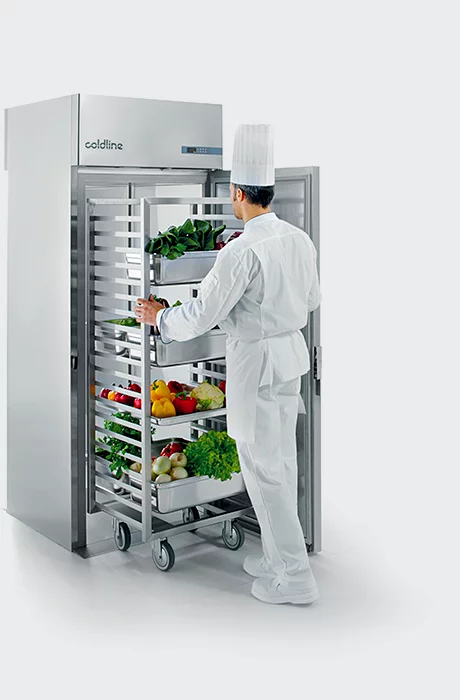
Holding Cold Food — Not Cooling Hot Food
These units can also serve as a prep-area extension, keeping pre-chilled items transferred from a walk-in readily accessible to the line. However, there is a widespread misconception worth addressing: roll-in refrigerators are not designed to bring down the temperature of freshly cooked food. Placing items with internal temperatures above 160°F inside these units creates a dangerous environment for pathogen growth and puts food safety at serious risk. They are built exclusively to maintain the chill on food that is already cold.
Temperature Range
36°F – 38°F
Consistent holding temperatures to keep perishables safe and fresh throughout service.
Cart Height
54" – 85"
Accommodates a wide variety of standard rack cart sizes for maximum flexibility.
Size, Capacity & Door Configurations
While roll-ins may rival or even exceed conventional refrigerators in overall footprint, they offer substantially greater storage volume and far more operational flexibility. Classification is typically based on internal cubic capacity, which dictates how many full-size pans the unit can accommodate at once.
Door configuration is another key distinction. Roll-in models are available in one-, two-, and three-door layouts with either solid or glass panels. The right choice depends on throughput: a two-door model generally handles around 15 sheet pans, while a three-door unit can manage approximately 30. For kitchens pressed on space, 180-degree door hinges provide full clearance for loading trays and pans without obstruction. The hinge orientation itself should be chosen based on the specific layout of the workspace.
Construction & Materials
Buyers can select from full stainless steel construction for maximum durability, full aluminum for lighter weight, or a hybrid approach featuring stainless steel exteriors paired with aluminum interior panels. Each option carries its own advantages depending on the environment and budget.
Cooling & Compressor Systems
Every roll-in refrigerator relies on a compressor, evaporator coil, and evaporator fans to maintain consistent temperatures. The metering device — which regulates refrigerant flow — can vary between models. Some units utilize a capillary tube, while others employ a thermostatic expansion valve that delivers faster temperature recovery, a notable advantage in high-traffic kitchens. Compressor placement is offered in both self-contained and remote configurations to suit different installation requirements.

Electrical Requirements & Controls
Most roll-in models run on a standard 115-volt circuit. The exception is three-door units, which often require 208 or 230 volts to drive their larger cooling systems. Compressor sizes generally fall between ½-hp and ¾-hp depending on overall cabinet volume. Temperature management can be handled via a traditional thermometer or a more precise electronic control system, which many operators now prefer.
Standard & Optional Features
Feature packages differ across manufacturers, but common inclusions are built-in ramps for smooth cart loading, interior bumper guards to shield walls from impact damage, and electronic controllers that actively monitor cabinet temperature and automate defrost cycles. Additional touches may include heavy-duty door locks and magnetic gaskets designed for quick, tool-free replacement — a significant convenience during routine maintenance.
HACCP Compliance & Proper Sizing
It is critical that operators size their refrigeration to match both the volume and type of product being stored. Per HACCP guidelines, roll-ins must hold internal temperatures at or below 40°F consistently, and they must recover temperature swiftly even when doors are being opened and closed repeatedly during peak service hours.
Physical space planning deserves equal attention. Because roll-in units vary widely in size, operators should carefully evaluate the available floor area — not just the kitchen footprint itself, but also the path the unit must travel to reach its final position. Clearance through doorways, hallways, and around tight corners should all be measured well in advance of delivery.
Featured Product
Chef AAA 72" Commercial Reach-In Freezer
6 Solid Half Doors • SCD-660F • Commercial Grade
Chef AAA SCD-660F FreezerThis guide is brought to you by Backyard Provider — your trusted source for commercial-grade kitchen and outdoor equipment. Browse our full catalog for more solutions built for professionals.