

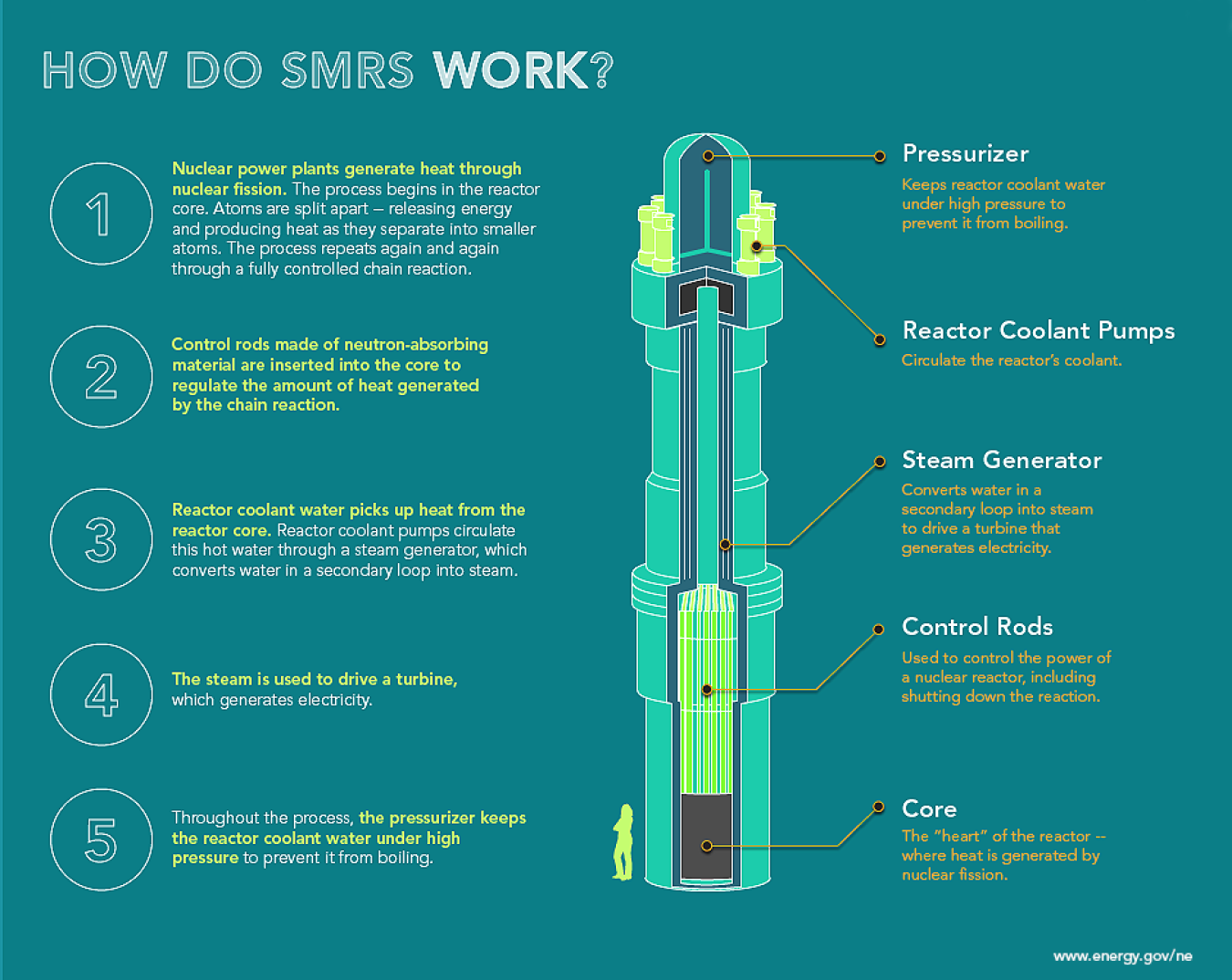
Small Modular Reactors, commonly known as SMRs, represent a groundbreaking shift in how we think about nuclear power generation. These advanced reactors are designed to produce up to 300 megawatts of electrical output per unit — roughly one-third the capacity of a conventional large-scale nuclear power plant. Despite their compact footprint, they hold enormous promise for reshaping the global energy landscape.
Unlike their larger counterparts, SMRs are engineered for flexibility and scalability. Their components can be manufactured in factories, transported with relative ease, and assembled on-site — opening the door to nuclear energy in regions that previously lacked the infrastructure to support it.

What Makes SMRs Different?
The defining characteristics of Small Modular Reactors can be distilled into three key qualities that set them apart from traditional nuclear power plants:
Small
Physically more compact than conventional reactor designs, they occupy a significantly smaller footprint — making them viable for locations where space is a limiting factor.
Modular
Built using factory-fabricated components that can be shipped and assembled on location, dramatically reducing construction complexity and project timelines.
Reactors
Harness controlled nuclear fission to generate heat, which is then converted into reliable, carbon-free electricity on a continuous basis.
Key Advantages of Small Modular Reactors
SMRs address many of the logistical and financial barriers that have historically made nuclear energy difficult to deploy. Their benefits extend well beyond their reduced size.
Accessibility for Remote Areas: One of the most significant advantages is their ability to serve locations where building a full-scale nuclear facility would be impractical. Remote communities, island nations, and rural areas with limited grid connectivity can all benefit from the distributed power that SMRs provide. A single unit can generate enough electricity for a small city, and multiple units can be installed incrementally as demand grows.
Lower Upfront Costs: Traditional nuclear plants require enormous capital investments and long construction timelines, often spanning a decade or more. SMRs can be constructed more quickly and at a fraction of the cost, thanks to their modular design and factory-based manufacturing approach. This makes nuclear energy financially accessible to a wider range of countries and utilities.
Enhanced Safety: Modern SMR designs incorporate passive safety mechanisms that rely on natural physical phenomena — such as gravity, convection, and natural circulation — rather than complex engineered systems requiring human intervention or external power. This means that in the event of an emergency, many SMR designs can safely shut themselves down without operator action, significantly reducing risk.
Reduced Fuel Requirements: Some SMR models are engineered to operate for extended periods — in certain cases up to 30 years — without the need for refueling. Conventional reactors typically require refueling every one to two years, making SMRs a far more efficient long-term solution.
Nuclear Energy: Paving the Way to a Carbon-Free World
Nuclear power currently accounts for roughly 10 percent of the world's total electricity production. However, as the urgency of climate change intensifies, there is growing consensus that clean and dependable energy sources must be expanded dramatically. Around 30 nations currently operate nuclear power facilities, and more than twice that number are actively exploring nuclear energy as a pathway to meeting their climate and energy security goals.
In the United States alone, dozens of municipalities and regional utilities are evaluating nuclear expansion — and SMRs are at the center of that conversation. Their ability to be deployed gradually, their compatibility with existing grid infrastructure, and their minimal carbon emissions make them an ideal complement to renewable energy sources like solar and wind.
For those who are already investing in off-grid and energy-independent lifestyles, understanding SMR technology provides valuable context for where the broader energy market is heading — and how backup power solutions fit into the bigger picture.
Where Do SMRs Stand Today?
The development of Small Modular Reactors is no longer just theoretical — it is well underway across both the public and private sectors. Governments and energy companies around the globe are committing substantial resources to bring this technology from the drawing board to reality.
Russia made history by launching the world's first floating nuclear power station — a vessel powered by SMR technology that began commercial operations and now delivers electricity and heat to remote Arctic communities. This milestone demonstrated that SMR deployment is not only feasible but already operational.
Meanwhile, more than 80 distinct SMR concepts are in various stages of development worldwide. Countries including Argentina, Canada, China, South Korea, and the United States all have active SMR programs, with some designs already undergoing licensing review. Although the technology has proven its potential, achieving widespread commercial deployment will depend on continued investment, regulatory progress, and international cooperation.
SMRs and the Push for Sustainable Development
Nuclear power plants — and SMRs in particular — bring a unique combination of efficiency, reliability, and flexibility that few other energy sources can match. Unlike solar panels and wind turbines, which are dependent on weather conditions, nuclear reactors produce a steady and predictable stream of electricity around the clock, regardless of the season.
This dependability makes SMRs an excellent partner for renewable energy systems. They can serve as a stable baseload power source while renewables handle peak demand — or they can step in as backup when solar and wind generation dips. In this way, SMRs have the potential to accelerate the global transition to cleaner energy by filling the gaps that intermittent renewables cannot cover on their own.
Beyond electricity, SMR technology also has applications in water desalination, district heating, and industrial processes — expanding the value proposition well beyond the power grid.
Global efforts toward universal energy access have made notable strides, yet billions of people remain without reliable power. SMRs offer a scalable, low-carbon solution that can help bridge this gap while supporting the broader Sustainable Development Goals.

The Role of International Oversight
As with any nuclear technology, the safe and responsible deployment of SMRs requires robust international cooperation and regulatory oversight. Organizations like the International Atomic Energy Agency (IAEA) play a central role in setting safety standards, facilitating knowledge exchange between countries, and supporting the development of regulatory frameworks that can keep pace with rapidly evolving reactor designs.
The IAEA has established dedicated platforms and working groups specifically focused on SMR technology, including forums that bring together experts from around the world to discuss challenges, share best practices, and coordinate research efforts. This collaborative approach helps ensure that as SMRs move closer to widespread commercial deployment, they do so with the highest standards of safety and environmental responsibility.
What This Means for Energy Independence
The rise of SMR technology signals a broader shift toward distributed, resilient energy systems — a trend that aligns closely with the growing movement toward off-grid living and personal energy independence. While SMRs themselves are utility-scale solutions, the principles behind them — modularity, efficiency, and reliability — are the same principles that drive today's best portable power stations and home energy systems.
Whether you are preparing for power outages, setting up an off-grid cabin, or simply looking for a dependable backup energy solution, having the right equipment makes all the difference. Investing in high-quality, portable power ensures you are ready for whatever comes next — and puts the power quite literally in your hands.
Featured Product
Take Control of Your Power Supply
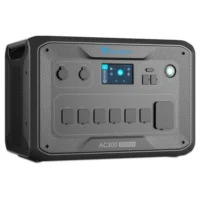
The future of energy is modular — and you can start building yours today with a powerful, expandable inverter system designed for serious off-grid performance.
Small Modular Reactors represent one of the most exciting frontiers in clean energy technology. While it may be years before they are widely deployed, the trajectory is clear: the future of power generation is smaller, smarter, and more adaptable. For those of us already committed to energy resilience and self-sufficiency, that future feels remarkably familiar.
Stay informed. Stay prepared. Stay powered.