

Living off the grid means relying on multiple energy sources that must operate together in complete harmony. When solar panels fall short of demand and battery banks dip dangerously low, a backup generator becomes your most critical lifeline. However, connecting generators to Energy Storage Systems (ESS) and inverters calls for careful engineering to prevent equipment damage and guarantee smooth power transitions.
This in-depth blueprint walks you through the precise steps, wiring layouts, and compatibility requirements needed to assemble a dependable generator-ESS-inverter system that delivers steady, reliable power exactly when you need it most.
In This Guide
1. System Architecture Fundamentals
2. Electrical Integration Strategies
System Architecture Fundamentals
Core Component Relationships
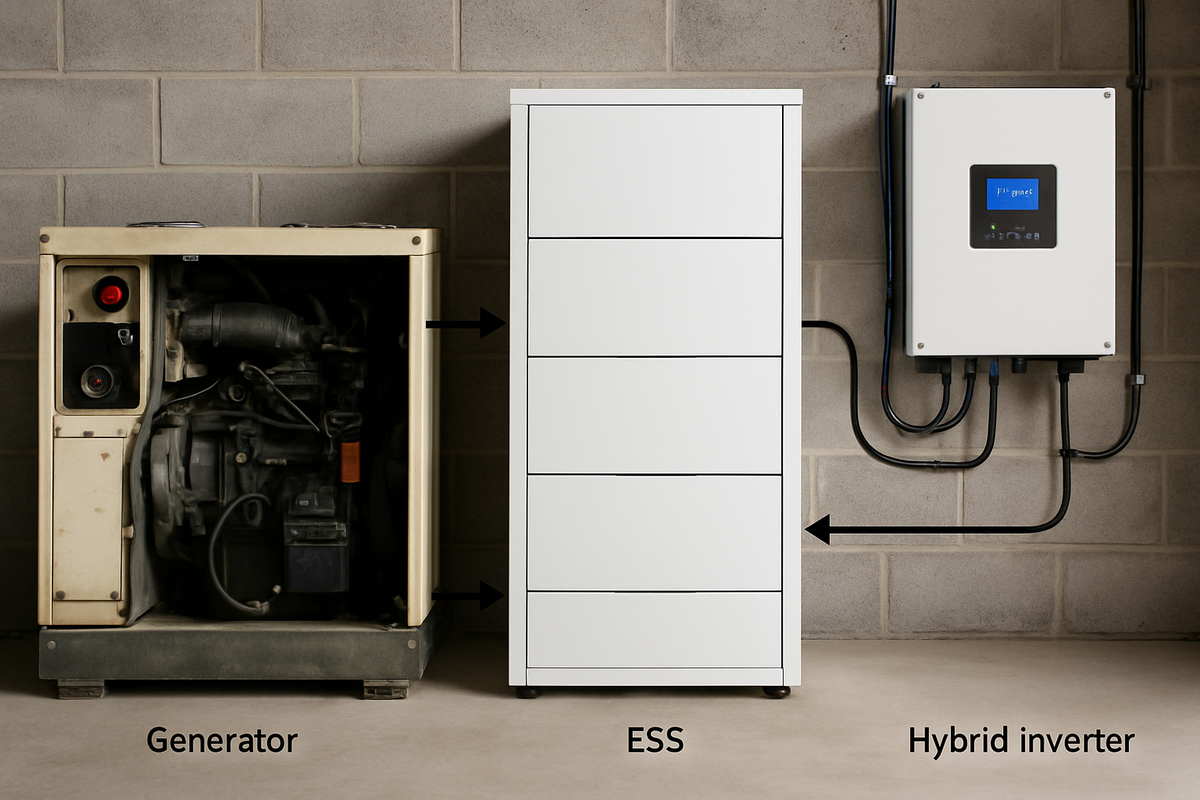
A well-integrated generator-ESS-inverter setup functions as a unified power ecosystem. The generator acts as the primary backup source, the ESS handles energy buffering and load leveling, and the inverter takes charge of power conversion along with overall system control.
Your generator ties into the system through an Automatic Transfer Switch (ATS) or connects straight to the inverter's AC input. The ESS governs energy storage and release, while the hybrid inverter coordinates every operation. This three-part relationship demands precise voltage matching, compatible power ratings, and aligned communication protocols.
Today's hybrid inverters can kick generators on automatically once battery voltage falls beneath a set threshold. This automation removes the need for manual intervention and keeps power flowing continuously through long stretches of overcast weather or periods of heavy demand.
Power Flow Management
Sound power flow management eliminates conflicts between generator output and battery charging. The inverter needs to serve connected loads first while simultaneously charging batteries at the ideal rate. Without proper coordination, you end up with excessive generator cycling, wasted fuel, and premature wear on critical components.
Electrical Integration Strategies
Achieving a solid electrical integration means getting to grips with voltage compatibility, proper grounding, and layered protection systems. The generator's voltage output has to match the inverter's input specs—usually 120V/240V for residential setups.
Wiring Configuration Options
There are two main wiring strategies to consider: AC coupling and DC coupling. With AC coupling, the generator feeds into the inverter's AC input, letting the inverter handle both charging and load distribution. DC coupling requires a dedicated charge controller but rewards you with higher efficiency during battery charging.
AC coupling is generally simpler to install and provides better load management. The generator sends AC power directly to your loads, and any surplus capacity charges the batteries via the inverter's onboard charger. This approach pairs well with generators sized about 20% above your peak load requirements.
Protection and Safety Systems
Robust protection stops equipment damage caused by voltage spikes, frequency shifts, and ground faults. Fit surge protectors, circuit breakers, and ground fault interrupters at key junction points. Generator output must also be filtered to strip out harmonics that could harm sensitive electronics.
| Protection Device | Purpose | Installation Point |
|---|---|---|
| Surge Protector | Guards against voltage spikes | Generator output |
| Circuit Breaker | Overcurrent protection | All major connections |
| Ground Fault Interrupter | Electrical safety | AC panel connections |
| Frequency Filter | Power quality improvement | Generator-inverter interface |
Control System Programming
Intelligent control programming squeezes maximum efficiency from your system and extends the life of every component. Modern hybrid inverters pack advanced generator management features such as automatic start/stop, load prioritization, and battery charging optimization.
Automatic Start Parameters
Set your generator's start parameters according to battery state of charge, current load demand, and time of day. A common configuration triggers generator start when batteries drop to 20–30% capacity, then stops the generator once batteries climb back to 80–90%. These boundaries protect against deep discharge while eliminating unnecessary runtime.
Thoughtful scheduling prevents the generator from running during quiet nighttime hours while still keeping enough battery reserve for overnight loads. You can also program different start thresholds for weekdays versus weekends to reflect changing usage patterns.
Load Management Protocols
Deploy load shedding protocols that automatically cut non-essential loads as the generator nears its capacity ceiling. High-priority loads such as refrigeration and lighting stay powered, while water heaters and HVAC units are temporarily shed.
Progressive load connection guards against generator overload at startup. The system adds loads in stages as the generator's output stabilizes, cutting mechanical stress and boosting fuel efficiency.
Performance Optimization Techniques
Optimization centers on three pillars: fuel efficiency, battery longevity, and overall system reliability. Choosing the right generator size prevents both overloading and wasteful low-load operation.
Fuel Efficiency Strategies
Generators hit peak efficiency at roughly 70–80% of their rated capacity. Size your unit to cover peak loads plus battery charging needs within this sweet spot. An oversized generator guzzles fuel at partial load, while an undersized one struggles under surge demand.
In cold climates, consider battery pre-conditioning that warms cells before the generator begins charging. Cold batteries accept charge sluggishly, which forces the generator to run longer and burn extra fuel.
Battery Integration Best Practices
LiFePO4 batteries call for charging profiles that differ markedly from conventional lead-acid chemistry. Adjust the generator's charging voltage and current limits to align with battery specifications. Overaggressive charging rates produce excess heat and shorten battery life.
Temperature compensation dynamically tweaks charging parameters based on real-time battery temperature. Hot batteries demand lower charging voltages, while cold batteries need slightly elevated voltages for efficient charging.
Maintenance and Monitoring
Consistent maintenance delivers long-term reliability and heads off expensive breakdowns. Build monitoring systems that log generator runtime, fuel consumption, and battery health metrics.
Preventive Maintenance Schedules
Generator upkeep includes oil changes every 100 operating hours, air filter swaps every 200 hours, and annual spark plug replacement. Record every maintenance task and track performance trends over time.
Battery maintenance involves routine capacity testing, terminal cleaning, and voltage monitoring. Keep an eye on individual cell voltages within your battery banks to catch failing cells before they compromise the entire system.
Performance Monitoring Systems
Set up remote monitoring that tracks critical performance indicators—fuel consumption rates, battery charging efficiency, and generator start frequency. These data points reveal optimization opportunities and help you predict maintenance needs before problems arise.
Configure automated alerts for urgent conditions such as low fuel levels, extreme battery temperatures, and generator fault codes. Early warnings prevent outright system failures and keep repair bills in check.
Future-Proofing Your Integration
Architect your system with room to grow and absorb new technology. Modular components let you scale capacity upward without tearing out and replacing the entire setup.
Factor in smart grid integration for the possibility of future utility interconnection. Many modern inverters already support grid-tie functionality, which can slash generator dependence if utility power becomes available down the road.
Prepare for the next wave of battery technology by choosing inverters that work with multiple battery chemistries. This flexibility means you can adopt newer, higher-performance batteries without overhauling your entire power management system.
Bringing a generator, ESS, and inverter together successfully takes deliberate planning, well-chosen components, and continuous optimization. Apply the strategies outlined in this blueprint to build a dependable off-grid power system that performs consistently for years. Regular maintenance and proactive monitoring ensure your investment keeps delivering energy independence while holding operational costs to a minimum.
Ready to Build Your Off-Grid Power System?
BLUETTI AC300 Inverter Module