

Choosing the right portable power station can feel overwhelming. With dozens of models flooding the market and a wall of technical jargon to decode, it is easy to either overspend on features you will never use or settle for a unit that leaves you stranded when it counts. Whether you are preparing for a weekend camping trip, outfitting your RV, or safeguarding your household against power outages, making the right call comes down to understanding a handful of critical factors.
In this guide, we cut through the confusion and lay out a clear, actionable checklist built on real-world performance and practicality. We will walk you through capacity, portability, and the essential features most buyers tend to overlook. Let us get into it.
Determining Your Specific Power Requirements
Before you commit to any portable power station, the first order of business is figuring out exactly how much energy you actually need. Whether your goal is a lightweight companion for short outdoor excursions or a serious backup system for your home during emergencies, the answer depends entirely on the appliances and devices you plan to run. Our power solutions are built for a wide range of scenarios, but knowing your specific load is the foundation of energy independence.
Identifying Devices and Their Wattage Needs
Start by looking at the power rating stamped on every device you intend to plug in. You are searching for two numbers: Running Watts (the continuous power a device draws) and Surge Watts (the initial burst of energy needed to start up). Heavy-draw appliances such as refrigerators and power tools often demand a surge that can be two to three times their steady running wattage.
Below is a quick reference chart for commonly powered devices:
| Device | Wattage Range | Surge Demand |
|---|---|---|
| Smartphones & Tablets | 5W – 20W | Minimal |
| CPAP Machine | 40W – 60W | Low |
| Laptop Computer | 60W – 100W | Low |
| Mini Refrigerator | 60W – 100W | High (2x–3x startup) |
| Electric Grill / Microwave | 1000W – 1500W | Moderate |
Calculating Your Total Energy Consumption (Wh)
Battery capacity is measured in Watt-hours (Wh), and you can think of it as the size of your fuel tank. To estimate your total daily consumption, simply multiply each device's wattage by the number of hours you plan to use it.
Example: A 60W CPAP machine running for 8 hours consumes 480Wh. Charging a 60W laptop twice uses roughly 120Wh. If your combined daily requirement lands around 500Wh, an entry-level unit may fall short on multi-day trips without recharging. Stepping up to a 1,000Wh or 2,000Wh station provides the buffer needed for extended off-grid use.
Estimating Real-World Runtime
Theoretical capacity and actual runtime are not the same. Internal components and inverter losses eat into total available energy, so we recommend applying an efficiency factor of around 85% when planning.
Example: A 1,000Wh station powering a 100W television delivers approximately 8.5 hours of continuous use. Quality stations feature intelligent LCD screens that display real-time remaining capacity and draw, taking the guesswork out of power management.
Core Technical Specifications to Consider
Battery Capacity (Wh) vs. Power Output (W)
It is easy to confuse capacity with output, but they govern two completely different things. Capacity (Wh) is your fuel tank—it determines how long you can keep a device running. Output (W) is your engine—it determines which devices you can actually turn on in the first place.
A high-capacity station with low output might charge a phone a hundred times over but fail to fire up a coffee maker. On the other hand, a high-output unit with limited capacity will run that coffee maker for only a few minutes before dying. Achieving the right balance between capacity and output is essential, especially if you plan to power appliances like microwaves or refrigerators during an outage.
Wh (Watt-hours): Total stored energy. Higher numbers translate to longer runtimes.
W (Watts): Maximum simultaneous load. Higher numbers mean you can power heavy-duty tools and appliances.
Battery Chemistry: LiFePO4 vs. Standard Lithium-Ion
The chemistry inside the battery is the single most important factor affecting lifespan and safety. LiFePO4 (Lithium Iron Phosphate) technology offers a dramatically better return on investment than standard lithium-ion cells. Where conventional lithium batteries begin degrading after 500 to 800 charge cycles, LiFePO4 cells maintain their health for well over 3,500 cycles. That means daily use for years without meaningful capacity loss. On top of that, LiFePO4 chemistry is inherently more stable, making it significantly safer to store in your home, garage, or vehicle.
| Specification | LiFePO4 | Standard Lithium-Ion |
|---|---|---|
| Cycle Life | 3,500+ cycles (to 80%) | 500 – 800 cycles |
| Safety | High thermal stability | Prone to overheating |
| Lifespan | 7–10+ years | 2–3 years |
| Weight | Slightly heavier | Lighter |
Pure Sine Wave Inverters vs. Modified Sine Wave
The quality of the electricity your station produces matters just as much as the quantity. Always insist on a Pure Sine Wave inverter. This technology outputs clean, smooth electrical current that mirrors the power from your home wall outlet. Budget units with modified sine wave inverters produce choppy power that can cause audible buzzing in speakers, overheating in motors, and outright damage to sensitive electronics.
If you rely on a power station for medical devices like CPAP machines or oxygen concentrators, a Pure Sine Wave inverter is absolutely non-negotiable. It keeps your critical equipment running quietly and safely without any risk of electrical interference.
Portability and Physical Design Factors
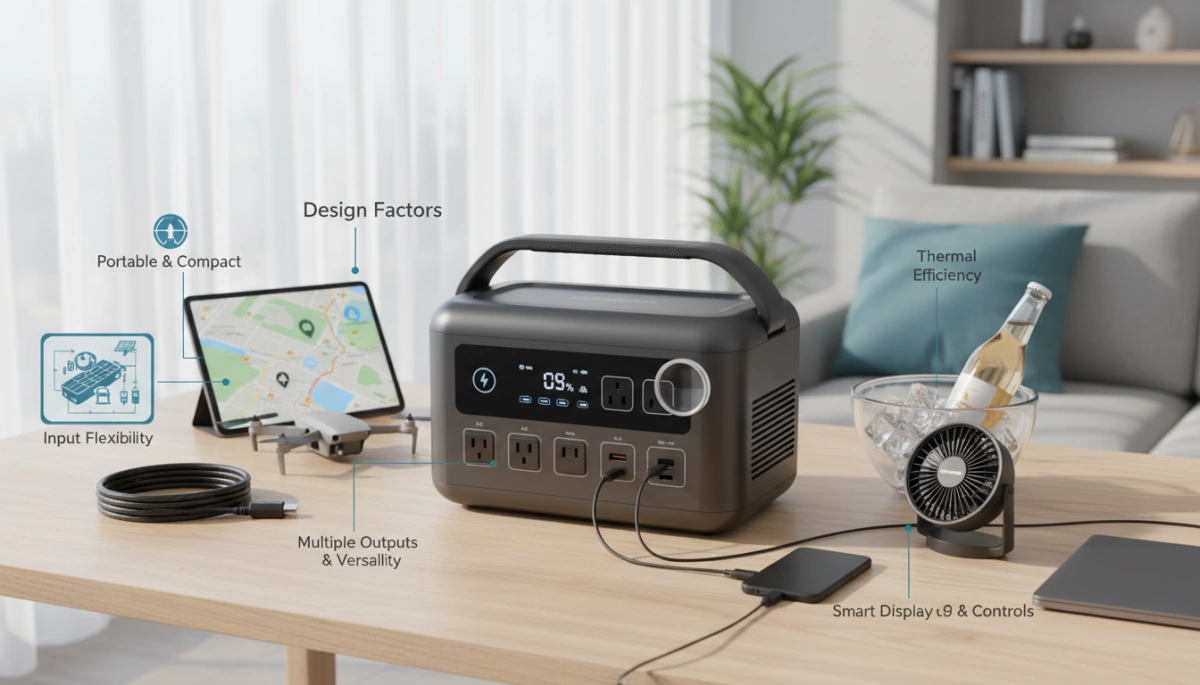
Portable & Compact
Designed for easy transport with optimized power-to-weight ratios.
Input Flexibility
Charge via solar, AC wall, or 12V car outlet for total versatility.
Multiple Outputs
AC, DC, USB-C, and USB-A ports to power all your devices at once.
When it comes to portable power stations, the word "portable" deserves as much attention as "power." You need to weigh the energy capacity you want against the physical reality of carrying and transporting the unit. A massive battery sounds great on paper until you have to haul it from the garage to your campsite or wrestle it into a truck bed. The best designs maximize energy density, packing the most power into the smallest and lightest form factor possible.
Weight and Dimensions for Travel
The trade-off is simple: higher capacity generally means more weight. That said, modern LiFePO4 battery technology has meaningfully improved the power-to-weight ratio compared to older chemistries.
- Lightweight Needs: For weekend camping or tailgating, compact models in the 300Wh range tuck into a crowded trunk without weighing you down.
- Heavy-Duty Needs: For RV travel or job-site power (up to 2,000W), the unit will be heavier. In these cases, check the dimensions carefully to ensure it fits inside your vehicle's storage compartments or under a seat.
Build Quality and Weather Resistance
Outdoor environments punish electronics. You want a chassis that can absorb the vibrations of travel and the occasional knock. A well-built station protects its internal Battery Management System (BMS) and cells with a robust casing. Proper airflow is also critical—efficient cooling fans maintain safe operating temperatures while staying quiet enough for indoor use. Keep in mind that while these units are built tough, most still require shelter from direct rain and extreme moisture.
Handle Design and Ease of Transport
Ergonomics make a real difference when you are lifting and carrying a 30-pound unit. A poorly designed handle can make any station feel twice as heavy. The best handles offer a solid, comfortable grip and distribute weight evenly to reduce strain on your wrist and back.
- Fixed Handles: Generally sturdier—ideal for heavier units.
- Foldable Handles: Save valuable space when stacking gear in a vehicle.
- Grip Texture: Ensures the unit stays secure in your hand, even when wearing work gloves.
Input and Output Connectivity Options
The variety of ports on a power station determines what gear you can actually run. Having a massive battery means nothing if the unit lacks the right interfaces to access that stored energy efficiently. The best stations handle everything from sensitive medical devices to heavy-duty power tools simultaneously.
Number and Types of AC and DC Outlets
The AC wall outlet is the most critical output to verify. Ensure the station uses a Pure Sine Wave inverter—unlike cheaper modified sine wave units, Pure Sine Wave delivers the same clean power you get from your home's electrical grid. This is essential for safely running laptops, CPAP machines, and audio equipment without interference or overheating.
For DC power, look for a regulated 12V car port (cigarette lighter style). This is crucial for RV travelers and campers who depend on 12V appliances such as portable fridges, vacuums, and tire inflators.
| Outlet Type | Common Devices | Standard |
|---|---|---|
| AC (Pure Sine Wave) | Laptops, CPAP, Drills, Blenders | 110V US Standard |
| 12V DC Car Port | Car Fridges, Air Pumps, Fans | Regulated 12V |
| DC5521 Barrel | LED Lights, Routers, Modems | Standard DC Output |
USB-C PD and Fast Charging Ports
Modern devices demand speed. Hauling bulky AC adapters for every gadget is a hassle, which makes high-speed USB ports a major convenience factor. Look for USB-C Power Delivery (PD) ports rated between 60W and 100W. This lets you charge a MacBook, drone, or tablet directly from the station using a single USB-C cable, freeing up AC outlets for larger appliances. USB-A Quick Charge 3.0 ports are equally important for topping up smartphones and cameras fast.
Expandability and External Battery Support
For users with serious energy demands, total capacity is a deciding factor. High-density internal storage is the most convenient route—larger models in the 1,000Wh to 2,000Wh range are built for extended runtimes without needing cumbersome external battery modules.
Expandability also applies to charging input. Consider how many solar panels a station can support. Stations equipped with MPPT (Maximum Power Point Tracking) technology can accept high-wattage solar input, effectively turning your setup into a self-sustaining power supply for as long as the sun is shining.

Recharging Methods and Efficiency
Solar Charging Capabilities and MPPT Controllers
When you are off the grid, the sun is your most dependable fuel source. A quality portable power station must feature an MPPT controller. This technology continuously monitors voltage and current in real time, extracting the maximum power possible from your solar panels and significantly reducing charge times compared to older PWM controllers. Pairing a high-efficiency unit with a robust solar array ensures you can keep critical appliances running indefinitely during extended camping trips or prolonged outages.
AC Wall Outlet and Car Charging Speeds
Charging input versatility is just as important as output. You want a station that supports fast AC recharging so you can get back to full capacity quickly before heading out. For RV travelers and van lifers, a 12V car charging port is essential—it lets you recharge the battery while driving so you arrive at your destination fully topped up.
Pass-Through Charging and UPS Functionality
Efficiency also means usability while the unit is actively recharging. Pass-through charging lets you power your devices while the station itself is plugged in and recharging—vital when you are relying on solar input during the day. For home emergency use, look for UPS (Uninterruptible Power Supply) functionality. This feature switches to battery power within milliseconds of a grid failure, protecting sensitive equipment like desktop computers and CPAP machines from sudden shutdowns.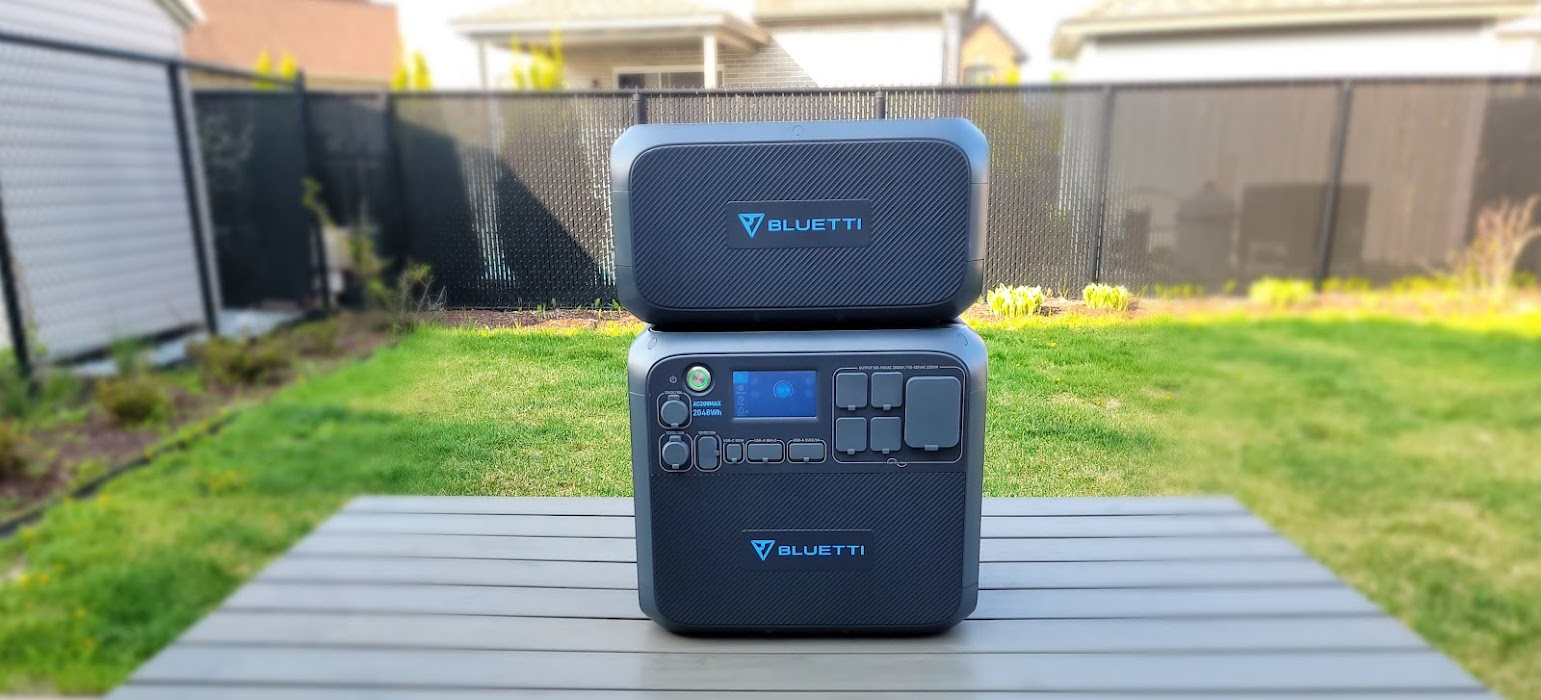
Choosing the Right Size for Your Use Case
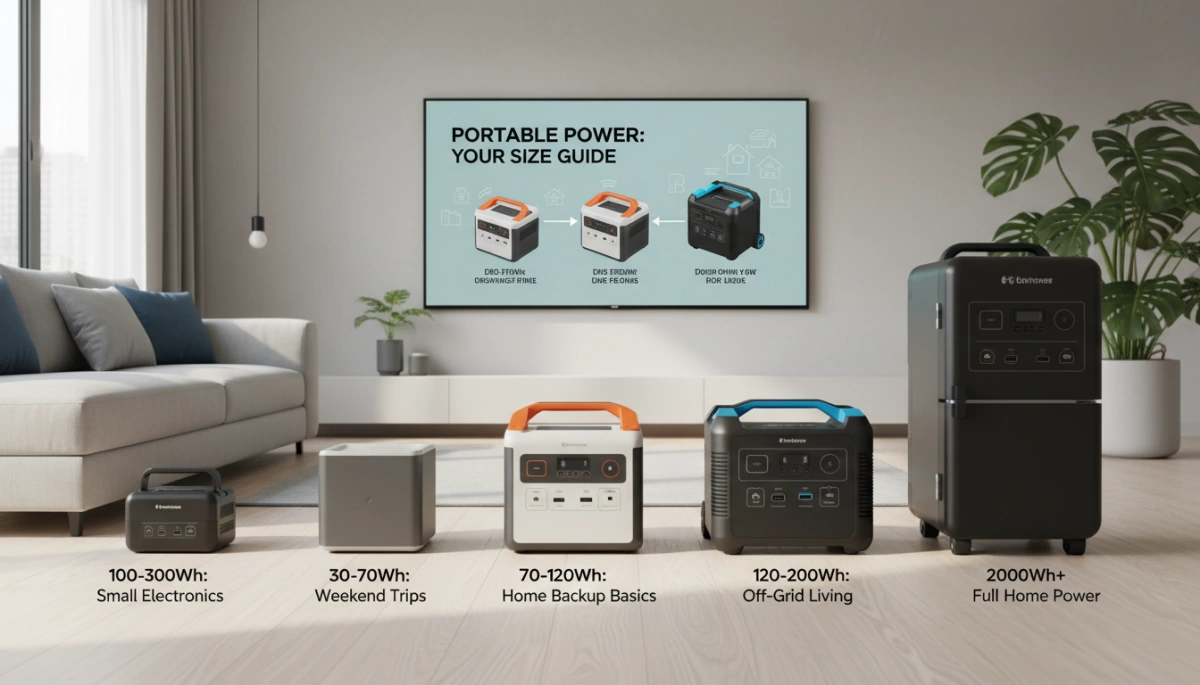
Selecting the ideal portable power station is not about buying the biggest battery on the shelf. It is about matching the capacity and output to your specific lifestyle. Going too big means unnecessary weight and cost. Going too small means getting left in the dark when it matters most.
⛺ Compact Units for Camping & Outdoor Adventures
When you are hiking or setting up a light campsite, every ounce counts. You do not need a heavy generator just to charge phones, power LED lanterns, or run a CPAP machine for a couple of nights. Entry-level models in the 300Wh to 500Wh range are purpose-built for this scenario. They are grab-and-go designs with a single handle, multiple USB ports, and reliable DC output—just toss one in the backseat and head out.
Ideal for: Weekend camping, CPAP backup, charging phones, drones, and cameras.
💻 Medium Capacity for Remote Work & Digital Nomads
If your office is wherever you park your van, you need more serious power. Remote workers and digital nomads require enough energy to sustain laptops, monitors, and internet terminals like Starlink for a full workday. A 1,000Wh capacity with 1,000W output is generally the sweet spot. This size handles higher-wattage appliances like a portable coffee maker for short bursts while maintaining steady power for sensitive electronics throughout the day.
Key needs: Pure Sine Wave AC outlets, fast recharging (AC + Solar), sufficient wattage for small appliances.
🏠 High-Capacity Units for Emergency Home Backup
When the grid goes down, small batteries will not cut it. Keeping a household running during a blackout demands a high-capacity unit capable of handling heavy loads. Models with 2,000Wh capacity and 2,000W output (surging to 4,000W) are built for this purpose—powering full-size refrigerators, microwaves, and sump pumps. Because these units are often stored for long periods between emergencies, LiFePO4 battery chemistry is essential to ensure the battery retains its health over years of standby and thousands of charge cycles.
Critical features: High output for fridge compressor surges, sustained load capacity for hours or days, BMS protection against overheating during heavy use.

Frequently Asked Questions About Portable Power Stations
Can a portable power station run a refrigerator?
Absolutely. Most mid-to-high capacity units handle this task with ease. The key is making sure the station's continuous power output exceeds your refrigerator's running watts and that the surge peak can handle the compressor kicking on. A 2,000W station with a 4,000W surge rating is more than capable of powering most full-size home refrigerators during a blackout. For outdoor use, smaller car fridges run comfortably on lighter, more compact models for extended periods.
How long will a portable power station last on a single charge?
Runtime depends on two factors: the station's total capacity (Wh) and the wattage of the devices you are running. Apply the 85% efficiency rule—multiply the battery capacity by 0.85 and divide by your device's wattage. For example, a 2,000Wh station powering a 100W device will run for approximately 17 hours continuously.
Is LiFePO4 worth the extra cost?
Without question. LiFePO4 batteries deliver over 3,500 charge cycles compared to just 500–800 for standard lithium-ion cells. They are also safer and maintain their capacity far longer. Over the lifetime of the product, LiFePO4 is significantly more economical and reliable, especially for units used daily or stored for emergency backup.
Can I charge the station while using it?
Yes—this is known as pass-through charging. It allows you to power your devices while the station simultaneously recharges via solar panels, AC wall outlet, or car charger. Some models also include UPS functionality, which automatically switches to battery power within milliseconds of a grid failure.