

Selecting the right pool heater comes down to understanding how long it will take to bring your water to a comfortable temperature. Whether you're leaning toward a gas heater or an energy-efficient heat pump, the key factors that influence your decision remain the same. Knowing your pool's surface area, preferred water temperature, local climate conditions, how quickly you want the water to warm up, and whether you plan to use a solar cover will help you make the smartest choice.
How Large Is Your Pool?
The very first thing you need to figure out is your pool's surface area measured in square feet. For a standard rectangular pool, simply multiply the length by the width. If your pool is 18 feet long and 36 feet wide, for instance, you're working with a surface area of 648 square feet.
Example Calculation
18 ft × 36 ft = 648 sq. ft.
Your Pool's Surface Area = 648 sq. ft.
Understanding Minimum BTUs
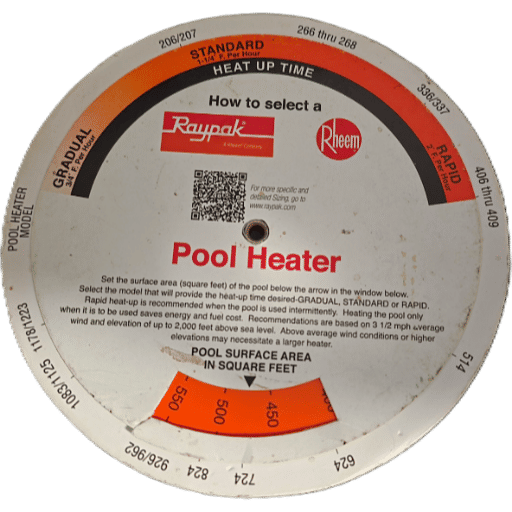
Pool heaters are rated using British Thermal Units, commonly referred to as BTUs. A single BTU represents the amount of energy required to raise one pound of water by one degree Fahrenheit. To find the baseline BTU requirement for your pool, divide the surface area by three — this gives you the minimum BTUs needed to heat your water effectively.
648 sq. ft. ÷ 3 = 216
216 × 1,000 = 216,000 BTUs
Minimum Required BTUs for Your Pool = 216,000 BTUs
While this number tells you the bare minimum energy output needed, keep in mind that selecting a heater at exactly this threshold means slower heating times. It's worth understanding how other factors — especially pool volume and temperature goals — play into your final decision.
How Long Will It Take to Heat Your Pool?
The bigger the pool, the more time it needs to reach your ideal temperature. Choosing a more powerful heater shortens that wait considerably. If patience isn't your strong suit, investing in a higher-output unit can make a real difference.
Here's how to estimate your pool's heating time:
1 Subtract the average air temperature in your area from your desired swimming temperature to find the degree difference.
2 Calculate the gallon capacity of your pool and multiply it by 8.34 to find the total weight of the water in pounds.
3 Divide the pounds of water by the minimum BTU rating to find out how many hours it takes to raise the temperature by one degree.
4 Multiply the per-degree heating time by the total degree difference to get your overall heating duration.
Putting It Into Practice
Let's walk through a real example using our 18×36 foot pool with an average depth of 5 feet. To figure out the gallon capacity, multiply length × width × average depth × 7.5.
Degree Difference: 85°F – 70°F = 15°F
Pool Dimensions: 18 × 36 = 648 sq. ft.
Volume: 648 × 5 = 3,240 cu. ft. → 3,240 × 7.5 = 24,300 gallons
Weight of Water: 24,300 × 8.43 = 202,662 lbs
Hours per 1°F: 202,662 ÷ 216,000 = 0.94 hours
Total Time to Heat Pool: 0.94 × 15 = ~14 hours
At roughly 14 hours of continuous operation, heating with just the minimum BTU output would take quite a while — especially if you're only running the pump 8 to 10 hours a day. This is where upgrading to a more powerful unit or combining a heater with a solar cover can really pay off.
Use an Online BTU Calculator
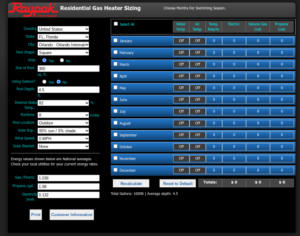
Not everyone enjoys crunching numbers by hand, and that's perfectly okay. Several heater manufacturers offer free online calculators where you plug in your pool's dimensions and local climate data, and the tool instantly recommends the ideal heater size. It's a quick, hassle-free way to confirm your calculations or get a starting point.
The Simple 2-Step BTU Formula
If you prefer to do it yourself, this straightforward formula will give you exactly what you need:
Step 1: Take your desired number of hours to heat the pool and divide it by the degree difference. This gives you your target rate.
Step 2: Divide the total pounds of water in your pool by that number. The result is the BTU output you need.
Example
1. 9 ÷ 15 = 0.6
2. 202,662 ÷ 0.6 = 337,770 BTUs
Based on these numbers, a heater rated around 339,000 BTUs would be the ideal fit.
Should You Add a Solar Cover?
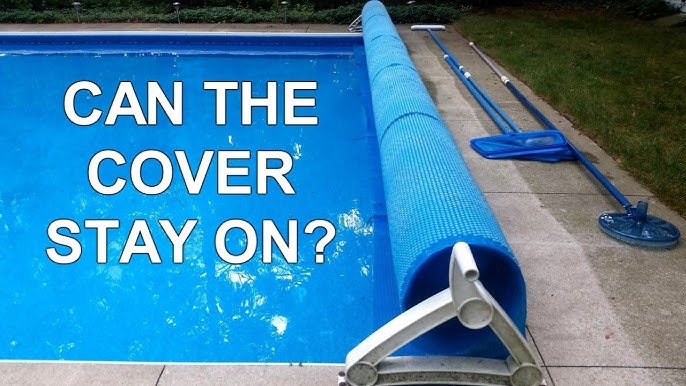
A solar cover is one of the smartest investments you can make alongside a pool heater. It works by trapping heat in the water and preventing it from escaping overnight or during cool, windy conditions. If you're choosing between a larger, more expensive heater and a smaller one paired with a solar cover, the second option often delivers comparable performance at a fraction of the cost. It's an easy way to maximize efficiency and keep your energy bills in check.
Featured Product
Energy-Efficient Pool Heating Made Easy
Upgrade your backyard experience with a powerful, energy-saving heat pump designed to keep your pool at the perfect temperature all season long.
Blue Torrent Pool Heat Pump 110K BTU