

If you have ever spent an afternoon chainsawing through a fallen tree or trimming back overgrown limbs, you already know the aftermath: a sprawling mountain of branches, twigs, and leafy debris scattered across your yard. Some of those branches are green, flexible, and loaded with foliage. Others are bone-dry, brittle sticks that snap underfoot. Either way, they create an eyesore and a cleanup headache you did not plan for.
A chainsaw is unbeatable when it comes to felling trees and bucking logs. But anything under about two inches in diameter? That is where a chainsaw starts to lose its charm. Small limbs bounce away from the bar, thin whips refuse to stay still, and you end up chasing scraps around the yard instead of making real progress.
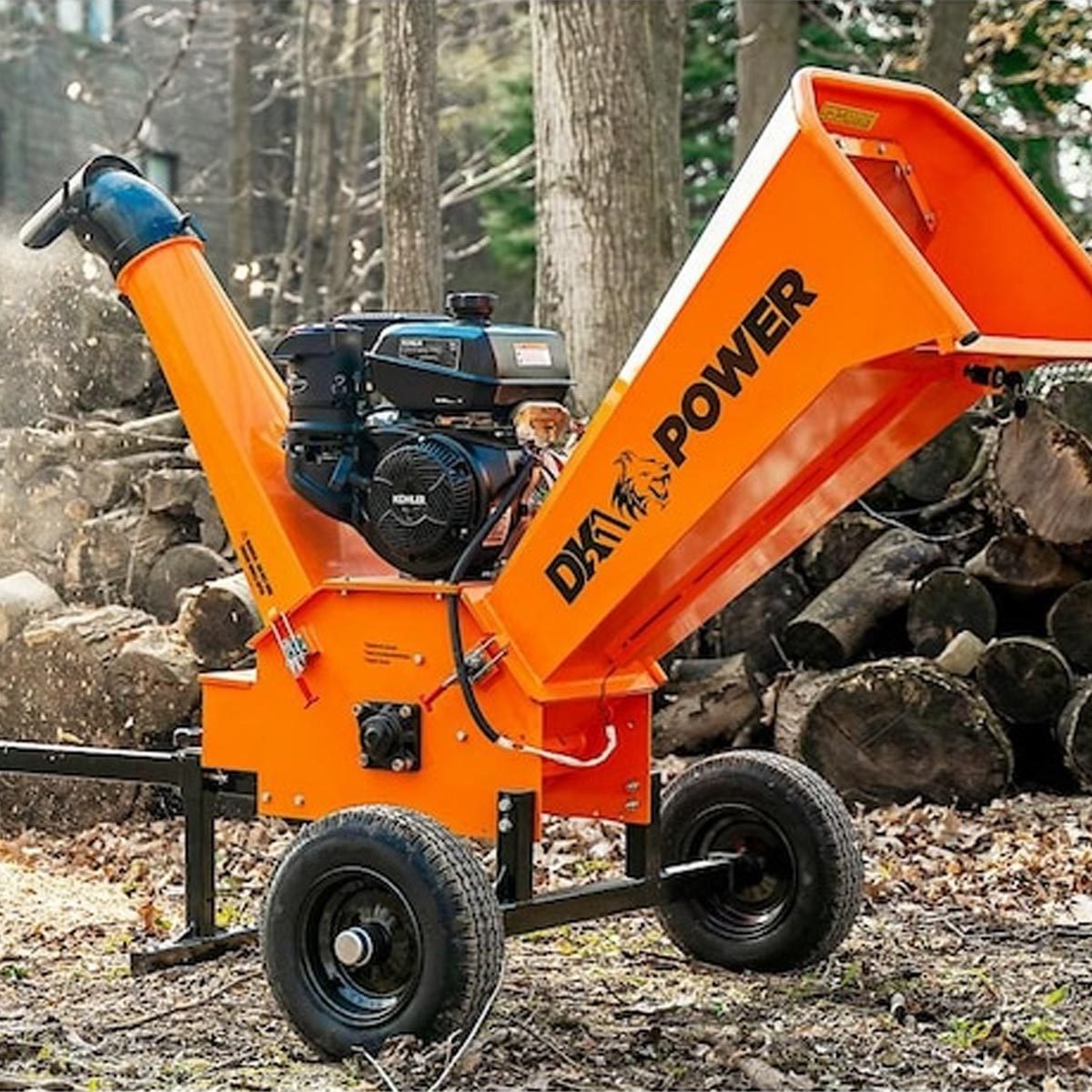
On top of that, limbs and offshoots never cooperate. They grow in every direction imaginable — curved, kinked, forked — and they are a nightmare to stack neatly, haul away, or even stuff into a burn barrel. The simple truth is that all of that smaller material needs a different kind of tool.
That tool is a wood chipper. Or more precisely, a chipper-shredder combo unit that can handle both the chunky branches and the leafy green waste in a single pass.
Chipper or Shredder — What Is the Difference?
Before you dive into shopping, it helps to understand the distinction. A shredder grinds up softer material — leaves, thin stems, green garden waste — into fine mulch. A chipper tackles the heavier work, slicing through thicker branches and reducing them to wood chips. Many modern machines combine both functions into a single unit, giving you versatility without doubling up on equipment.
You might be tempted by an electric model, and they do have their place. They are quieter and lighter. But the reality is that battery-powered and corded chippers often lack the raw torque needed to power through anything beyond pencil-thin branches. Gas engines still dominate this category for good reason: they start reliably, run continuously, and deliver enough force to chew through real-world yard debris without bogging down.
Plug-in chippers also suffer from limited reach — you are either tethered to an extension cord or stuck recharging batteries every thirty minutes. If you are clearing storm damage across a large property or hauling the machine to a job site, gas power is the practical choice.
What to Look For
Durable build quality without excessive weight. A powerful engine rated at 7 HP or above. Easy oil checks and air filter access. Polyurethane no-flat tires for rough terrain. A solid reduction ratio — 15:1 or better — so branches actually get processed, not jammed. And above all, a chute that can handle branches up to 3 inches in diameter for real-world versatility.
Why a Gas-Powered Chipper Belongs in Your Backyard
After testing several options and reading countless owner experiences, gas-powered chipper-shredders around the 7 to 7.5 HP range consistently come out on top for homeowners and weekend warriors alike. These machines hit a sweet spot: powerful enough to handle branches up to three inches thick, yet compact enough to wheel around your property or toss in the back of a truck.

Machines in this class typically weigh somewhere between 85 and 140 pounds depending on the model. That is heavy enough to feel substantial and stable during operation but still manageable for one person to position. They generally sit around 23 inches high by 32 inches wide, making storage in a garage or shed straightforward.
The 7 HP engine class delivers plenty of grunt. Starting is usually as easy as a pull cord, oil and fuel checks are quick, and maintenance stays minimal if you follow the manufacturer's schedule. These are not complicated machines — they are designed to be used hard, cleaned off, and put away until the next pile of brush appears.
One thing worth noting: gas chippers are loud. Electric alternatives are considerably quieter, so if noise is a major concern in your neighborhood, you may want to invest in a good set of ear muffs and be mindful of when you run it. That said, the tradeoff in power and convenience is well worth it for most users.
Real-World Performance You Can Count On
With a reduction ratio around 15:1 and dual cutting blades, a quality gas chipper in this class can process branches up to three inches in diameter. Now, technically the specs might say three inches — but from practical experience, two and a half inches is the sweet spot where material feeds smoothly without forcing. Anything bigger and you are better off reaching for the chainsaw first.
The handle bar positioned at the top of these units makes them surprisingly easy to maneuver. You can push the machine across your yard, load it into a truck bed, or tilt it to navigate uneven terrain. Polyurethane no-flat tires are a major plus — the last thing you want in the middle of a job is a punctured tire on rough ground.
Shredding leaves and green waste works beautifully. Feed armfuls of pruned foliage through the hopper and what comes out the other end is finely processed mulch that you can spread directly onto garden beds. It is one of those satisfying jobs where you see immediate results — a towering pile of brush reduced to a neat mound of chips in minutes.
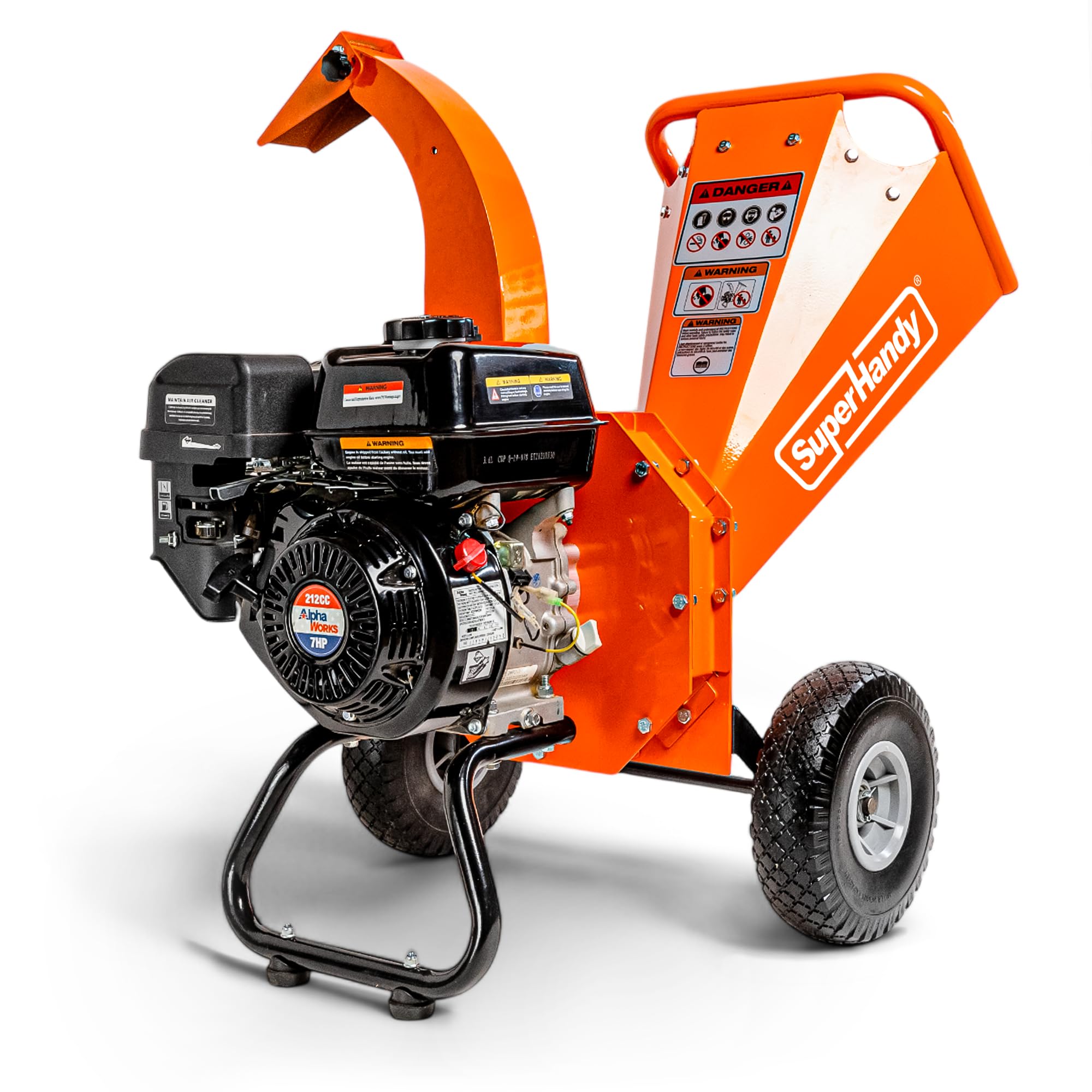
Assembly out of the box is typically straightforward — a handful of bolts, attach the hopper and chute, check your fluids, and you are ready to run. Most people have the machine operational inside of ten minutes, which is refreshing compared to other outdoor power equipment that arrives in a hundred pieces.
After months of regular use — easily 50 to 75 hours of runtime — a well-built gas chipper holds up remarkably well. The engine stays responsive, the blades maintain their edge through normal use, and the overall frame shows no signs of giving up. For the price point, that kind of durability is impressive.
Our Top Pick
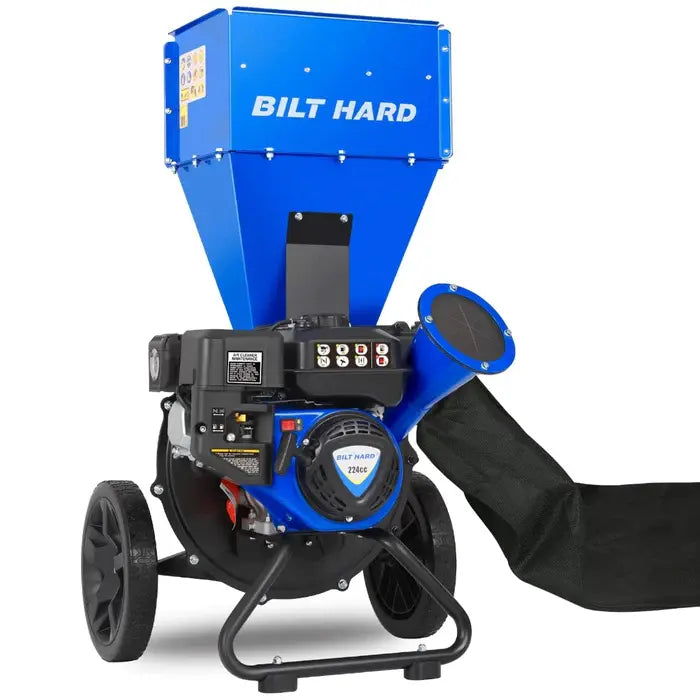
BILT HARD 7.5 HP Wood Chipper
224cc gas engine · 3" max branch capacity · Dual cutting blades · No-flat tires
Tips and Tricks to Get the Most Out of Your Chipper
Tip 1 — Skip the Bag
Most chippers come with a collection bag, and on paper it sounds convenient. In practice, it fills up absurdly fast and becomes more of a nuisance than a help. A better approach is to let the chips fly freely, then rake or shovel the debris into a wheelbarrow and haul it wherever it needs to go. If you prefer a tidier setup, aim the discharge into a five-gallon bucket and empty it every few minutes. You will save yourself a lot of frustration.
Tip 2 — Stock Up on Fuel
Even though a 7 HP engine is relatively modest, you will burn through more gasoline than you expect if you are working hard for several hours straight. Keep a full gas can on hand so you do not have to interrupt your workflow with a trip to the filling station. It is not a gas hog by any means, but steady use adds up faster than most people anticipate.
Tip 3 — Keep Spare Blades Ready
Chipper blades are surprisingly durable as long as you are feeding clean wood — no gravel, nails, or metal debris. But if you run your machine frequently, routine sharpening and the occasional blade swap are part of the deal. You do not want to be halfway through a big cleanup job only to realize your blades have gone dull. Keep a spare set on hand so downtime is never an issue.
Gear That Makes the Job Easier
A wood chipper does the heavy lifting, but a few simple accessories make the entire workflow smoother and less physically demanding. Consider keeping these on hand whenever you fire up the machine:
The Bottom Line
A gas-powered wood chipper in the 7 to 7.5 HP range is one of those tools that earns its keep the first time you use it. The mountain of branches that used to take an entire weekend to bundle, haul, and dispose of gets reduced to a manageable pile of wood chips in under an hour. And those chips? They go straight back into your garden as mulch. There is something deeply satisfying about turning yard waste into something useful.
If you own property with more than a couple of trees, or if you find yourself dealing with storm debris even once a year, a chipper-shredder pays for itself in saved time and eliminated disposal costs. It is affordable, durable, and powerful enough for the vast majority of residential cleanup jobs. Once you have one, you will wonder how you ever managed without it.