

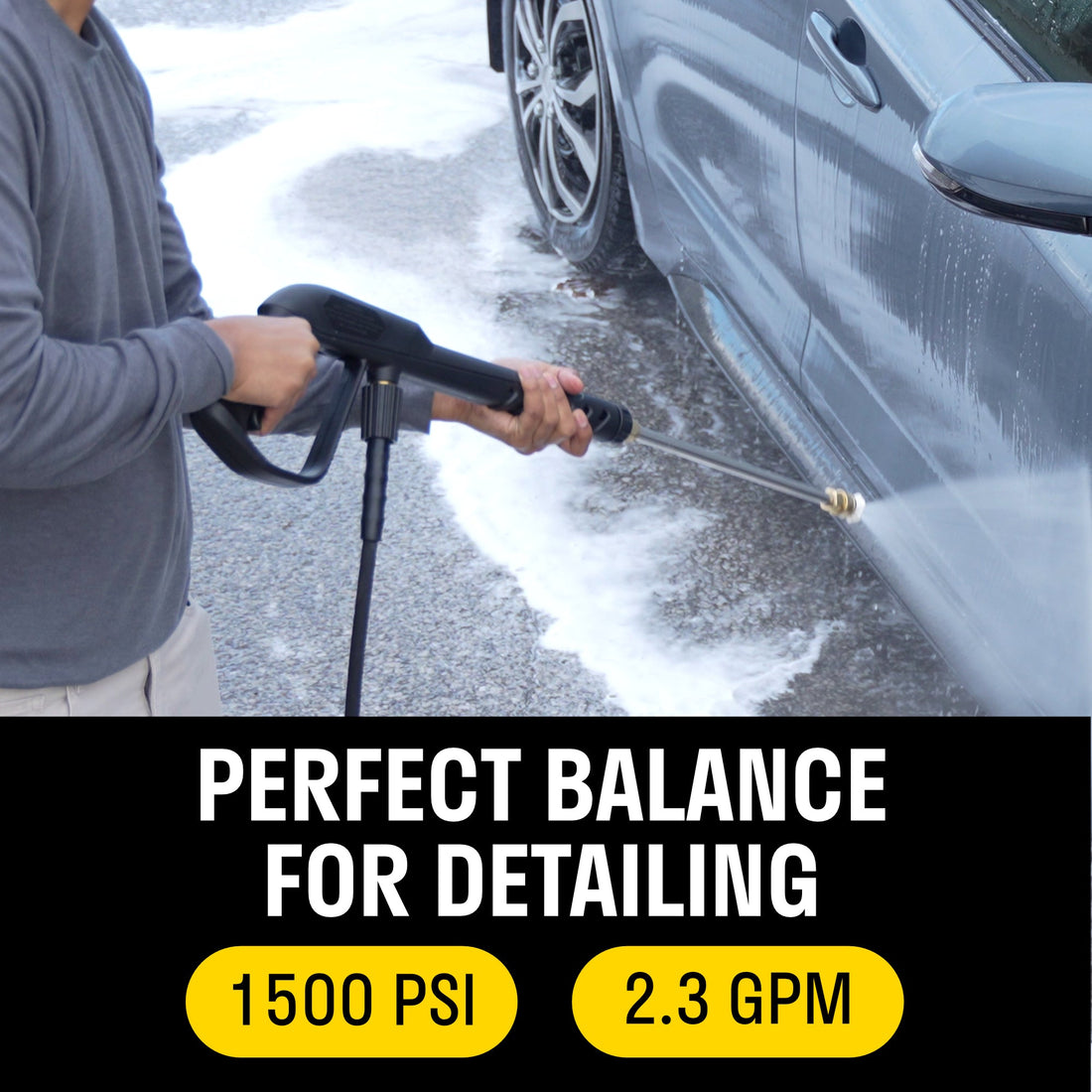
 If you're shopping for a pressure washer or already own one, you've almost certainly run into the term GPM, short for Gallons Per Minute. But what does GPM actually mean, and why does it matter so much? GPM measures the volume of water flowing through your pressure washer each minute — and it plays a major role in how efficiently your machine tackles cleaning tasks. In this guide, we'll break down what GPM is, how it differs from PSI (Pounds per Square Inch), and how to pick the right GPM for the jobs you have in mind.
What Does GPM Mean?
GPM (Gallons Per Minute) refers to the volume of water moving through the pressure washer in a single minute. Think of it as a measurement of water flow rate. A higher GPM means more water is being pushed out each minute, which helps you cover and rinse surfaces faster and more thoroughly.
How GPM Works:
- Higher GPM: More water flows through the unit, which makes it faster to wash away dirt, grime, and debris.
- Lower GPM: Less water flows through, meaning bigger surfaces may take longer to fully clean.
At its core, GPM dictates the rinsing strength of the pressure washer. It works in tandem with PSI, which governs the overall cleaning pressure of the machine.
GPM vs. PSI: What's the Difference?
While PSI (Pounds per Square Inch) measures the force or intensity of the water stream, GPM measures the volume or flow rate. Both numbers — PSI and GPM — work together to determine the cleaning power of any pressure washer. Here's a quick comparison:
- PSI: Refers to the force of water leaving the nozzle. High PSI is excellent for breaking up stubborn dirt, grease, or stains.
- GPM: Refers to the volume of water flowing through the washer. A stronger GPM is critical for rinsing away dirt once the PSI has loosened it.
The Formula for Cleaning Power:
The overall cleaning power of a pressure washer can be calculated by multiplying PSI and GPM. This figure is known as Cleaning Units (CU):
A machine with sky-high PSI but weak GPM may struggle to rinse debris away, while a unit with low PSI but strong GPM won't be able to break tough grime loose. The best pressure washers strike a balance between both numbers for all-around performance.
Why is GPM Important in a Pressure Washer?
GPM matters because it directly shapes how efficiently your pressure washer can clean. A higher GPM means you'll finish jobs faster, because more water is working to rinse away debris. If you're washing large areas such as driveways, patios, or deck boards, a stronger GPM is especially valuable.
Key Reasons GPM Matters:
- Faster Cleaning: More water flowing per minute lets you sweep through larger surfaces quickly, saving you serious time.
- Better Rinsing Power: Once dirt and grime have been broken loose, higher GPM flushes it away thoroughly, leaving a cleaner finish.
- More Efficient: High-GPM machines are well suited to heavy-duty tasks like washing vehicles, siding, or outdoor furniture.
GPM Recommendations for Different Cleaning Tasks
The ideal GPM for your pressure washer really comes down to what you plan to clean. Here's a straightforward breakdown of GPM ranges mapped to common cleaning tasks:
1.2 – 2.0 GPM
2.0 – 2.5 GPM
2.5 – 4.0+ GPM
If you're only tackling everyday light cleaning — washing a car or rinsing down patio furniture — a lower-GPM unit (around 1.2–2.0) will cover those needs just fine. For moderately tougher jobs like cleaning a deck, driveway, or larger vehicles, you'll want something in the 2.0–2.5 GPM range. And for heavy-duty or commercial cleaning tasks — big driveways, commercial fleets, industrial floors — a GPM of 2.5 or higher is what you need to finish the job fast and well.
How to Choose the Right GPM for Your Pressure Washer
Selecting the right GPM depends on the nature of your cleaning work. Here's a simple guide to help you land on the right pressure washer based on GPM:
- For Small, Everyday Jobs: A light-duty pressure washer with a GPM between 1.5 and 2.0 is usually plenty. This range works well for washing cars, bicycles, outdoor furniture, or small patios.
- For Larger Surfaces: If you're cleaning wider areas such as decks, fences, or driveways, a pressure washer delivering 2.0 to 2.5 GPM will offer noticeably more efficient results.
- For Heavy-Duty Cleaning: If you need to clean large, heavily soiled areas or handle commercial tasks, opt for a machine with a GPM of 2.5 or higher.
Pro Tip: If you own a high-output electric pressure washer, models that deliver around 3000 PSI and 4.5 GPM are outstanding choices for car cleaning and residential work — striking the right balance between PSI and GPM across a wide range of cleaning jobs.
Looking for a versatile electric pressure washer built for serious cleaning power at home?
Shop the BE 3000 PSI Pressure WasherGPM and Water Usage: Is It Efficient?
One frequent concern when using a pressure washer is water consumption. A higher GPM does mean more water flows per minute, but pressure washers are generally far more efficient than standard garden hoses.
Here's how GPM in a pressure washer stacks up against a typical garden hose:
- A standard garden hose flows at roughly 8–24 GPM.
- A pressure washer uses around 1.2–4 GPM, depending on the model.
Although pressure washers use more water per minute than some low-flow appliances, they clean much faster, which saves water overall.
Example of Water Usage:
- Running a garden hose (at 10 GPM) for 10 minutes uses 100 gallons of water.
- Using a pressure washer with a 2.0 GPM rating for 10 minutes uses only 20 gallons of water — cleaning more efficiently while conserving water.
Conclusion
In a pressure washer, GPM (Gallons Per Minute) is a key specification that determines how much water moves through the machine and how efficiently it handles cleaning tasks. A higher GPM enables faster and more effective cleaning, making it ideal for larger surfaces or heavier soil.
When choosing the right pressure washer, consider both the GPM and PSI to match your cleaning workload. Whether you're tackling car washing, driveway cleanup, or demanding heavy-duty commercial jobs, understanding GPM helps you make the best choice for your setup.
For peak performance, go with a pressure washer offering a GPM rating tailored to your specific needs. Models like the BE Power Equipment 3000 PSI, 4.5 GPM electric pressure washer deliver excellent cleaning power for car care and residential cleaning — with an ideal mix of water flow and pressure.