

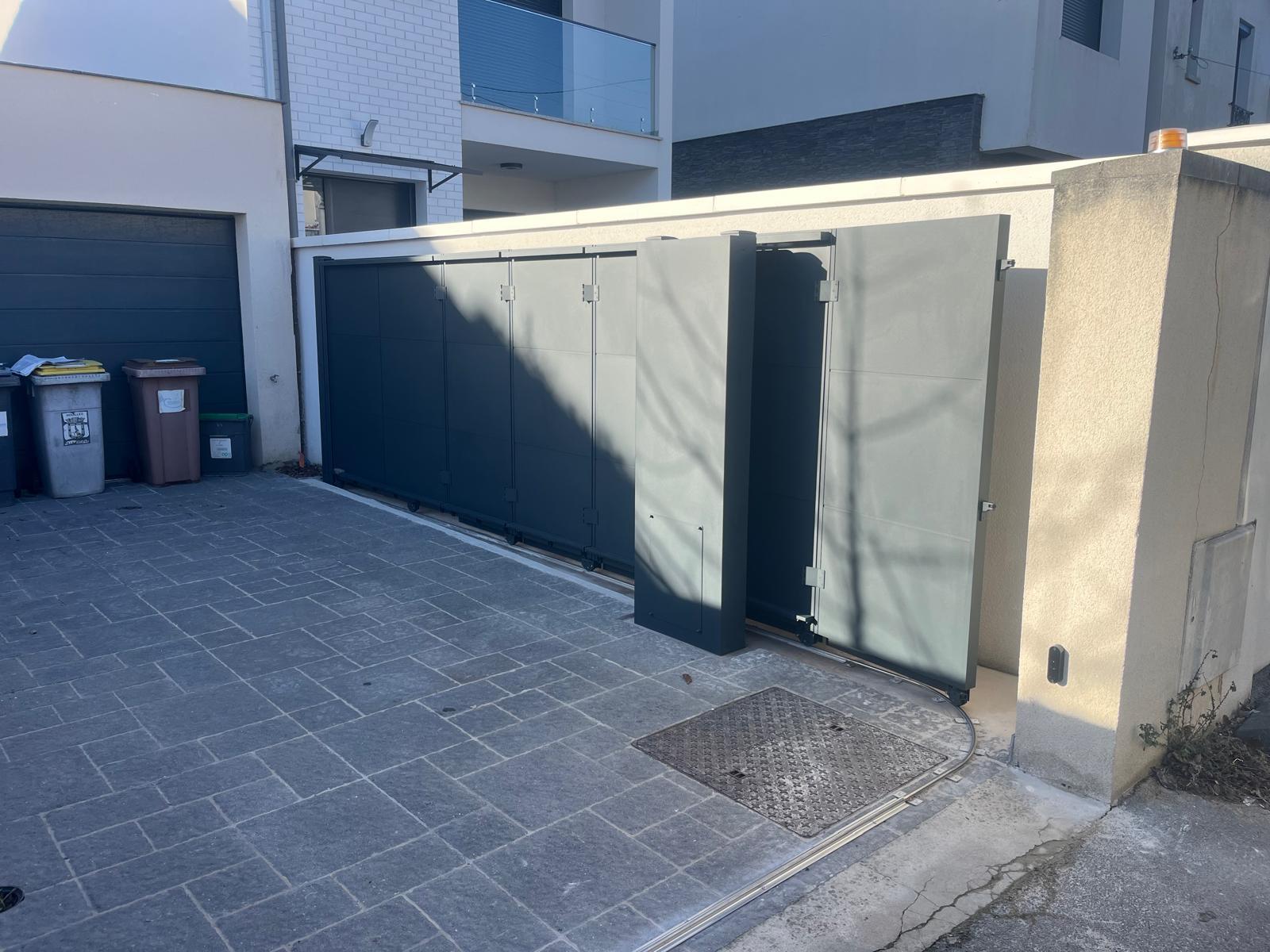
Selecting the perfect driveway gate often feels like juggling aesthetics, functionality, and available space. Maybe your driveway has an incline, or perhaps there just is not enough room for a traditional swing gate to open without hitting your car or blocking the sidewalk. These are everyday frustrations — and they are precisely the problems that sliding driveway gates are engineered to address.
A sliding driveway gate delivers an elegant, space-efficient solution that pairs refined design with dependable performance. When properly engineered and installed, it provides effortless operation, superior security, and years of reliable service. In this guide, the team at Backyard Provider breaks down how these gates operate, the components that make them tick, the advantages of different systems, and why professional installation matters more than you might expect.
Whether you are considering a sliding gate for a compact suburban driveway or seeking a striking entrance for a larger estate, knowing the fundamentals behind the system empowers you to make a confident, well-informed decision.
What Is a Sliding Driveway Gate?
A sliding driveway gate functions by traveling horizontally along a fixed rail or guide system, rather than swinging open on hinges. This design keeps your entrance free from obstructions, making it especially practical when space in front of or behind the gate is limited. The gate panel glides smoothly to one side as it opens, needing only sufficient lateral clearance along your fence line or boundary wall to accommodate the open panel.

Single vs. Bi-Parting Sliding Gates
Sliding gates for driveways generally come in two main configurations. A single sliding gate features one unbroken panel that moves in a single direction to open and close. It is a favorite among residential property owners because it delivers a clean, streamlined look with an uncomplicated design.
A bi-parting sliding gate, by contrast, consists of two panels that separate from the center — one traveling left and the other traveling right. This arrangement works well when lateral space on either side of the entrance is restricted, or when visual symmetry is a key design priority. Both styles can be fully automated and customized to complement your property's architecture, whether you lean toward modern aluminum, traditional wrought iron, or classic timber finishes.
"Both single and bi-parting configurations can be automated and tailored to suit any architectural style — from sleek modern aluminum to timeless wrought iron."
Rail-Guided vs. Cantilever (Trackless) Sliding Gates
The mechanism that drives your sliding gate is one of the most critical decisions you will face. The two primary types are track-guided systems and cantilever systems.
Track-guided gates rely on small wheels that roll along a steel or galvanized track embedded in or mounted on the driveway surface. This rail keeps the gate aligned and stable throughout its travel. Because of its simplicity and cost-effectiveness, the track-guided design is a practical choice, particularly for level, even driveways.
Cantilever gates — sometimes called trackless sliding gates — operate differently. Rather than riding on a ground rail, they are supported by a counterbalanced framework mounted to sturdy posts. The gate panel essentially floats just above the driveway, gliding without ever touching the ground. This makes cantilever systems ideal for properties with uneven surfaces, frost-prone areas, or driveways where debris buildup might interfere with a traditional ground track.
At Backyard Provider, we evaluate each property individually to determine which system delivers the best long-term reliability. Factors like surface conditions, available space, and design preferences all play a role in the recommendation.
Key Components of a Sliding Gate System
To truly understand how sliding driveway gates function, it helps to know the essential parts that make up the system. Here is a breakdown of the core components.
Gate Leaf
The gate leaf is the main panel — the visible "door" of your gate. It can be constructed from wood, steel, aluminum, or composite materials. For a sliding gate, structural rigidity is essential; the leaf must be well-braced to resist sagging or warping over time.
Track, Wheels & Guide System
Rail (track-guided gates): A steel or galvanized track recessed into or laid atop the driveway surface.
Wheels/Rollers: Mounted beneath the gate, these roll along the track or guide. In cantilever setups, rollers and support arms carry the full weight of the gate off the ground.
Guide rollers/side guides: These maintain lateral stability, preventing the gate from swaying as it moves.
Safety Devices & Accessories
Photocells (infrared beams) halt the gate when an obstruction is detected. Safety edges — pressure-sensitive strips — detect contact and immediately stop or reverse the gate. Additional safety features include limit switches to prevent over-travel, manual override mechanisms for power outages, loop detectors or radar sensors that recognize approaching vehicles, and intercom or keypad access control modules.
Motor & Drive Unit
The drive motor is securely mounted on a solid base beside the gate opening. It houses the pinion gear, internal gearing, limit switches, and often the control electronics. The motor must be robust, weather-resistant, and powerful enough to handle both the mass and wind load of the gate panel.
Control Board, Remotes & Sensors
Every motor is backed by a control board that manages open/close commands from remotes, keypads, or smartphone apps. It also handles safety interlocks from photocells, timed auto-close features, obstacle detection, soft start/stop profiles, and manual override in case of power failure.
Remote fobs or smartphone-based systems transmit a signal to the control board, which then activates the motor. The board also monitors motor current, enabling it to sense when something is obstructing the gate's path.
How Do Sliding Gate Motors Work?
The motor is the heartbeat of any automated sliding driveway gate. It supplies the controlled, consistent movement that allows the gate to open and close with ease. The most widely used mechanism is a rack and pinion drive system.
A toothed metal rack runs along the base of the gate panel. Inside the motor unit sits a small gear — the pinion — that meshes with this rack. When the motor engages, the pinion spins and drives the gate leaf forward or backward in a fluid, controlled motion. Limit switches built into the motor define the fully open and fully closed positions, so the gate halts precisely where it should.
This rack-and-pinion approach delivers quiet, dependable operation and has become the industry standard for modern sliding gates. Paired with quality engineering and precise alignment, it ensures smooth performance that lasts for years.

Where Are Sliding Gates Best Used?
Understanding the ideal scenarios for sliding gates explains why so many homeowners and property managers choose them.
Sloped Driveways
When your driveway has a slope or uneven terrain, traditional swing gates can be unreliable. A sliding gate — particularly a cantilever model — does not need to pivot over uneven ground, making it a far more dependable choice.
Compact Spaces
In tighter entrances where a swing gate cannot open fully — perhaps due to a neighboring wall, hedge, or parked vehicle — sliding gates for small driveways shine. They require zero arc clearance in front of or behind the gate.
Commercial & High-Traffic Properties
Sliding systems are frequently the go-to choice for commercial properties and large private estates. They manage wider openings with ease, operate quickly, and present a solid, secure barrier when closed.
Pros & Cons of Sliding Driveway Gates
Advantages
Space-efficient: No swing arc means these gates thrive in tight areas.
Strong security & sleek appearance: A solid panel slides flush, often with hidden mechanisms.
Wind-resistant operation: Greater stability than wide swing gates in gusty weather.
Handles wide entrances: Manages large openings without requiring dual swing leaves.
Considerations
Lateral clearance required: You still need room alongside the entrance to park the open gate panel.
Complex installation: Precision groundwork, alignment, and engineering are essential for reliable performance.
Track upkeep (rail systems): Debris, frost, or ground shifting can affect performance over time.
Higher investment: Engineering and components typically cost more than basic swing gate setups.
FAQs About Sliding Gates for Driveways
Are sliding gates safe for children and pets?
Absolutely — provided that safety devices such as photocells, safety edges, and vehicle detection loops are properly installed and maintained. A well-equipped sliding gate will immediately stop and reverse if any obstruction is detected during movement.
Can I open my sliding gate during a power outage?
Yes. The vast majority of quality sliding gate systems include a manual release or override feature that lets you disengage the motor and move the gate by hand during emergencies or power failures.
How long does a typical installation take?
For a standard residential sliding gate installation — from groundwork through to final commissioning — you can generally expect the process to take between 5 and 10 working days. The exact timeline depends on site-specific factors like foundation requirements, trenching, electrical connections, ground conditions, and any custom fabrication needs.
Featured Product
Explore Our Driveway Swing Gate

Upgrade your property entrance with a beautifully crafted, durable driveway gate designed for lasting elegance and security.
Elevate Your Driveway with Backyard Provider
A sliding gate goes beyond simple functionality — it offers a smooth, space-conscious, and secure way to enhance your home's entrance while adding a touch of sophistication. Sliding driveway gates perform beautifully on both flat and gently sloped terrain, making them a versatile solution for modern living. From compact gates designed for smaller driveways to grand installations that command attention at larger entrances, they deliver dependable automation with timeless style.
Working with experienced professionals ensures that every detail is handled with precision, from careful groundwork to thorough safety testing. At Backyard Provider, we are committed to helping you find the right gate solution — one that is engineered for reliability and crafted to enhance your property's character and value.
If you are thinking about investing in a sliding driveway gate, we invite you to explore our collection and take the first step toward a secure, elegant, and effortless entrance.
Ready to Upgrade Your Driveway Entrance?
Concord Driveway Swing Gate