

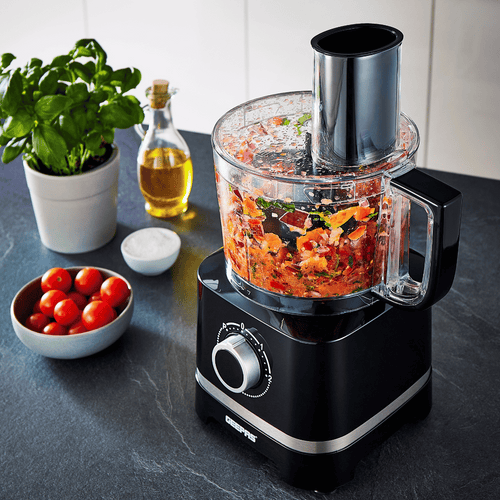
If you have ever stood in front of a commercial kitchen and watched a chef move through prep work at extraordinary speed, chances are a food processor played a central role. These powerful countertop workhorses are built to handle the volume, variety, and velocity that professional environments demand — and getting one right for your kitchen can make all the difference.
A food processor is fundamentally a multi-function electric appliance designed to chop, slice, dice, shred, grind, purée, and mix food ingredients with precision and efficiency. Powered by a robust motor beneath the bowl, it drives interchangeable blades and discs that can tackle virtually any prep task with minimal effort. For a pro kitchen, this means dramatically reduced prep time, consistent output, and lower labor costs across the board.
When you are choosing equipment for a commercial setup, understanding what a food processor actually does — and what makes one model better suited to your operation than another — can save you significant time, money, and frustration down the line.
At the heart of every food processor is a high-torque motor housed in the base unit. The motor spins a central drive shaft at variable speeds, powering whatever blade or disc is attached inside the work bowl. Most commercial-grade units offer two or more speed settings alongside a pulse function, giving the operator precise control over texture and cut consistency.
The interchangeable accessories are where the real versatility lives. A standard S-blade handles most chopping, mixing, and puréeing tasks. Slicing and shredding discs swap in when you need uniform cuts at high volume. Dough blades provide the gentler action needed for bread and pastry prep. Each attachment is engineered to perform a specific function, and professional models typically include a broad range of options right out of the box.

Safety mechanisms are built into every unit — bowls must be properly locked before the motor engages, and most commercial processors include a feed tube with a pusher so hands stay well away from the spinning blade during operation.
Not all food processors are built for the same environment. In a commercial or pro setting, several features separate a reliable workhorse from a unit that will underperform or fail prematurely:
-
Motor Power & Durability — Commercial processors typically run from 1 to 3+ horsepower. Higher wattage means cleaner cuts under load and a longer service life under continuous use.
-
Bowl Capacity — Measured in quarts, bowl size dictates how much you can process in a single batch. For high-volume operations, larger bowls of 10 quarts or more reduce turnaround time significantly.
-
Blade & Disc Selection — A wider range of attachments means greater versatility. Look for stainless steel blades that hold their edge and resist corrosion over repeated wash cycles.
-
Ease of Cleaning — Dishwasher-safe bowls and removable components are essential for maintaining hygiene standards in a professional environment without slowing down the kitchen.
-
Speed Options & Control — Variable speeds and a dedicated pulse function allow nuanced control. Some tasks demand a slow fold; others need full-power bursts to break down dense ingredients.
-
Safety & Warranty — Industrial-grade safety interlocks, overload protection, and a solid manufacturer warranty matter when the machine runs multiple hours a day.
Batch Bowl Food Processors are the most widely used format in professional kitchens. Ingredients load into a sealed bowl, process in full batches, and are emptied before the next cycle begins. These are ideal for tasks like making sauces, hummus, pastry dough, or any application where you need to process a set quantity and check consistency before continuing.
Continuous Feed Food Processors are built for volume. Ingredients feed in through a chute on the top while processed food exits through a side outlet into a collection bin — all without stopping the machine. If your kitchen needs to slice three crates of onions or shred a hundred pounds of cheese, a continuous feed model is the right tool for the job.
Combination Units offer the best of both worlds, with a batch bowl and continuous feed capabilities integrated into one machine. These units are a strong investment for operations with varied prep demands and limited counter space.
Buffalo Choppers are heavy-duty units built around a large, open rotating bowl with a fixed cutting blade overhead. Originally designed for meat processing, they handle dense, hard-to-chop ingredients with ease and are a staple in high-output commercial food production.
Vertical Cutter Mixers (VCMs) feature a tall, enclosed bowl with a high-speed blade positioned vertically at the bottom. These machines process large volumes in seconds and are commonly used in institutional kitchens, catering operations, and food manufacturing environments where speed and batch size are the priority.
Mashed Potato Food Processors are purpose-built units engineered to handle cooked root vegetables and similar soft foods without overworking the starch — which is what causes gluey, gummy mashed potatoes. If your kitchen runs a high volume of comfort food or institutional meal service, these specialized processors produce superior, consistent results batch after batch.
Selecting a commercial food processor starts with a clear-eyed assessment of your kitchen's actual needs. The right unit should match your menu, your volume, your staff, and your available workspace — not simply be the most powerful or most expensive option on the shelf.
| Consideration | What to Evaluate |
|---|---|
| Kitchen Size & Volume | Match bowl capacity and motor power to your daily prep output. |
| Power & Motor | Higher horsepower handles dense ingredients and extended run cycles without overheating. |
| Attachments & Blades | Ensure the unit includes all blades your menu requires. Specialty discs add versatility. |
| Speed Options | Variable speed and pulse control allow you to dial in texture for different recipes. |
| Ease of Cleaning | Removable, dishwasher-safe components reduce downtime between uses. |
| Safety & Warranty | NSF-certified units with strong warranties are worth the added investment. |
Purpose-built designs consistently outperform general-use appliances when it comes to specific tasks like emulsifying dressings, kneading bread, or producing high-volume sliced vegetables with uniform thickness.
It is one of the most common questions in commercial kitchen planning — and the answer matters when you are budgeting equipment. Both machines use spinning blades to process food, but they are optimized for fundamentally different jobs.
A blender is engineered for liquid-heavy applications. Its tall, narrow container and high-speed blade vortex pull wet ingredients downward and process them into smooth, uniform liquids. Soups, smoothies, sauces, and drink bases are where a blender excels. Trying to chop dry or dense ingredients in a blender typically results in uneven processing and undue stress on the motor.
A food processor, by contrast, is built for dry and semi-dry work. Its wide, shallow bowl gives solid ingredients room to move past the blade with each rotation, producing consistently chopped, sliced, or mixed results without requiring added liquid. For the majority of prep-intensive tasks in a professional kitchen, a food processor delivers results that a blender simply cannot replicate.
That said, many modern commercial kitchens benefit from having both. The overlap between them is limited — understanding where each machine performs best helps you make the right investment and avoids the frustration of using the wrong tool for the job.
There are specific scenarios where a commercial blender remains the better choice, even if you already own a high-performance food processor. Understanding these distinctions helps you assign the right tool to every task:
- Hot liquid processing — Blenders handle soups, puréed sauces, and cooked vegetable blends that need to reach a completely smooth consistency.
- Smoothies and beverage production — High-torque commercial blenders break down ice and frozen fruit faster and more consistently than a food processor bowl can accommodate.
- Emulsified dressings and marinades — The sustained high-speed action of a blender produces tighter, more stable emulsions than pulse-based food processor operation.
- Nut butters and creamy dips — When a completely lump-free texture is required, a commercial blender's narrow bowl keeps ingredients cycling through the blade more consistently.
For everything else — slicing, dicing, shredding, chopping, dough mixing, and high-volume prep — a commercial food processor is the right call.
Robot Coupe BLIXER45 Vertical Food Processor
A 47-quart stainless steel bowl, vertical cutter design, and commercial-grade build — engineered for the demands of high-volume professional kitchens.
Robot Coupe BLIXER45 VCMThe Right Equipment Transforms Your Kitchen
A commercial food processor is not just another appliance — it is one of the most impactful investments you can make in your kitchen's efficiency, consistency, and output capacity. Understanding what each type does, how to select the right model, and how it fits alongside your other equipment puts you in a position to build a prep operation that truly performs.