

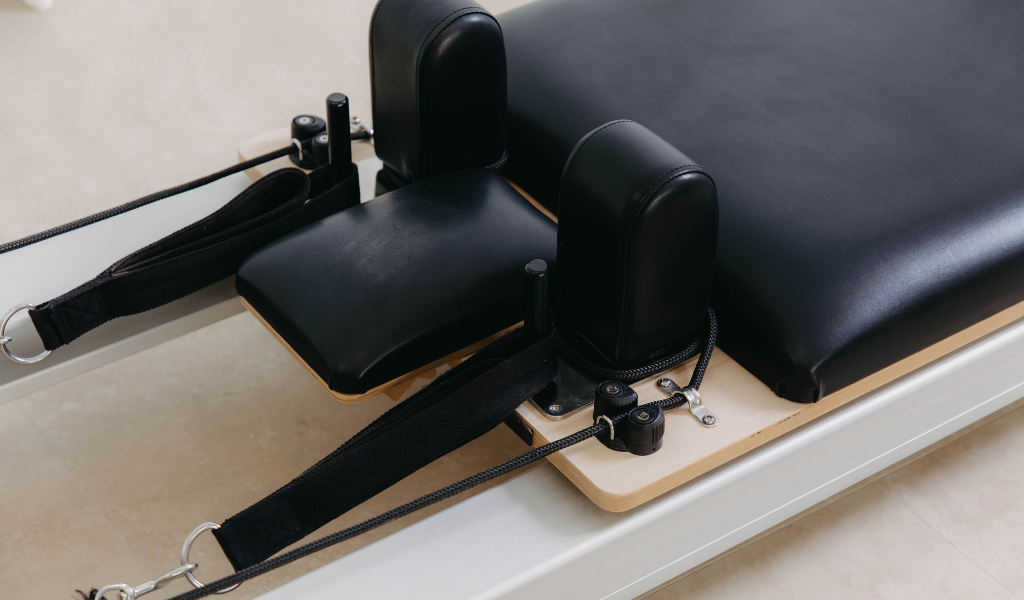
The Pilates Reformer is one of the most iconic pieces of fitness equipment ever designed — a machine that challenges beginners and elite athletes alike. But beyond its springs, straps, and sliding carriage lies a deeply scientific framework. Understanding why it works so well is the key to unlocking everything it has to offer.
01 — Resistance
Resistance & Progressive Overload
At the heart of the Reformer's design are its resistance springs — adjustable, calibrated, and utterly purposeful. These springs allow instructors and users to dial in the precise level of challenge required at any stage of training. This is the scientific principle of progressive overload in action: by incrementally increasing resistance over time, muscles are kept in a continuous state of adaptation, driving strength gains, endurance, and lean muscle development without plateau.
02 — Movement
Leverage & Full Range of Motion
The Reformer's sliding carriage and adjustable foot bar introduce an element rarely found in conventional gym equipment: true mechanical leverage. By shifting body position and bar height, specific muscle groups are isolated and targeted with precision. More importantly, each movement is performed through a complete range of motion — a critical factor for joint health, flexibility, and balanced muscle development that static machines simply cannot replicate.
The straps, pulleys, and moving platform of the Reformer demand constant spatial awareness. This challenges your body's proprioceptive system — its ability to sense position and movement in real time. Regular practice trains the nervous system, leading to measurably better posture, balance, and coordination in everyday life.
Every exercise on the Reformer requires active stabilization. The shifting carriage means your core — particularly deep muscles like the Transverse Abdominis — must engage continuously to maintain control. This is not passive exercise. The Reformer demands that your core work constantly, producing functional strength that carries far beyond the studio.
One of the Reformer's greatest scientific strengths is its adaptability. Through its many configurations and attachments, it can be tailored to accommodate different body types, fitness levels, and rehabilitation requirements. This aligns directly with the exercise science principle of individualisation — the understanding that no two bodies respond identically to the same stimulus. The Reformer bends to fit the person, not the other way around.
The Pilates Reformer is not simply a fitness machine — it is a scientifically engineered apparatus grounded in biomechanics and exercise physiology. Each session is a structured encounter with resistance, leverage, proprioception, and core activation working in concert. Whether your goal is rehabilitation, athletic performance, or long-term mobility, the Reformer delivers a level of intelligent, adaptive training that very few pieces of equipment can match. It does not just work your body — it teaches it.
Ready to bring the science of Pilates into your home? The AeroPilates Premier Foldable Reformer is built for serious training without sacrificing convenience — foldable, spring-loaded, and equipped with a cardio rebounder for a full-body challenge.
AeroPilates Premier Reformer